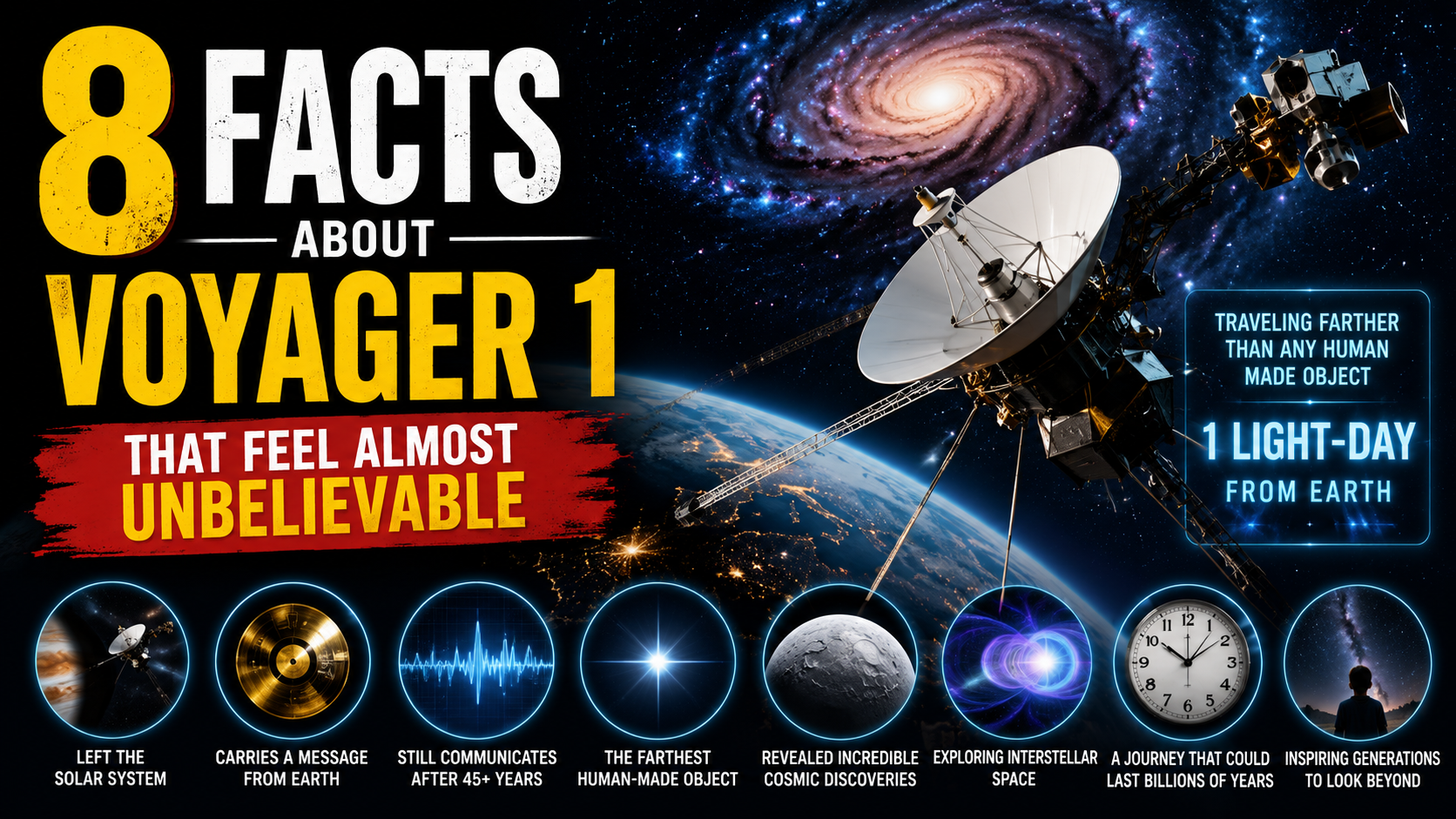
More than four decades ago, a spacecraft no larger than a small car lifted off from Earth on a mission that was originally expected to last only a few years. Today, that same spacecraft is still traveling through the darkness of space, farther away than any human-made object has ever gone.
That spacecraft is Voyager 1.
Launched by NASA in 1977, Voyager 1 has become one of humanity’s greatest engineering achievements. It has traveled billions of miles, survived the harsh conditions of deep space, and continues sending information back to Earth despite being farther away than anyone imagined when it first launched.
Its journey has transformed our understanding of the solar system and inspired generations of scientists, engineers, and dreamers.
What makes Voyager 1 so remarkable is not just its distance from Earth but the extraordinary facts surrounding its mission. Here are eight astonishing truths about Voyager 1 that almost sound too incredible to be real.
1. Voyager 1 Is the Most Distant Human-Made Object Ever Created
Of all the machines humanity has built, none has traveled farther than Voyager 1.
The spacecraft has journeyed so far from Earth that its distance is difficult to comprehend. Even traveling at the speed of light, a signal takes many hours to travel between Earth and Voyager 1.
To put this into perspective, light can circle Earth more than seven times in a single second. Yet communication with Voyager 1 requires patience because of the immense distances involved.
Every day, the spacecraft moves farther into the unknown, extending humanity’s reach deeper into space than ever before.
2. It Was Never Designed to Last This Long
When Voyager 1 launched, engineers expected the spacecraft to operate for only a few years.
Its primary mission was to explore Jupiter and Saturn, gathering valuable scientific data before eventually becoming inactive.
Yet decades later, Voyager 1 continues functioning.
Many of its systems remain operational despite being exposed to extreme temperatures, radiation, and the unforgiving conditions of space for nearly half a century.
Its longevity is often considered one of the greatest success stories in the history of space exploration.
Few machines on Earth last several decades. Voyager 1 has done so while traveling through interstellar space.
3. It Has Left the Solar System’s Protective Bubble
One of Voyager 1’s most historic achievements occurred when it crossed into interstellar space.
The solar system is surrounded by a vast region dominated by particles and magnetic fields flowing outward from the Sun. This protective area is often called the heliosphere.
In 2012, Voyager 1 passed beyond this boundary.
For the first time in human history, a spacecraft entered the space between the stars.
Although it remains influenced by the Sun’s gravity, Voyager 1 now travels through an environment filled with particles and conditions unlike anything found within the heliosphere.
This milestone marked a new chapter in human exploration.
4. The Spacecraft Carries a Message From Earth
One of the most famous features of Voyager 1 is its Golden Record.
Attached to the spacecraft is a gold-plated phonograph record designed as a time capsule representing humanity.
The record contains:
- Music from different cultures
- Natural sounds from Earth
- Greetings in multiple languages
- Images depicting life on our planet
- Scientific information about humanity
The idea was simple yet profound.
If intelligent life ever encounters Voyager 1 in the distant future, the Golden Record could offer a glimpse into who we were and where we came from.
It remains one of humanity’s most ambitious messages to the cosmos.
5. Its Photographs Changed Astronomy Forever
Before Voyager 1 arrived, scientists knew relatively little about the outer planets compared with today.
The spacecraft transformed that understanding.
During its encounters with Jupiter and Saturn, Voyager 1 captured breathtaking images and gathered data that revolutionized planetary science.
Among its discoveries were:
- Active volcanoes on Jupiter’s moon Io
- Complex atmospheric patterns
- Detailed ring structures around Saturn
- Previously unknown features of planetary moons
These observations challenged existing theories and opened entirely new areas of research.
Many of Voyager’s discoveries continue influencing planetary science decades later.
6. Communicating With Voyager 1 Requires Extraordinary Precision
Sending messages to Voyager 1 is not as simple as transmitting a radio signal.
Because the spacecraft is so far away, communication requires some of the most advanced tracking systems ever developed.
Massive radio antennas located around the world work together to maintain contact.
The signals exchanged between Earth and Voyager 1 are incredibly weak by the time they arrive.
In fact, the power reaching Earth from Voyager can be far weaker than many common electronic devices produce.
Yet engineers continue extracting meaningful scientific information from these faint transmissions.
The ability to communicate across such distances remains one of modern engineering’s most impressive accomplishments.
7. Voyager 1 Is Exploring a Region No Human Has Ever Studied Directly
Many spacecraft have visited planets, moons, and asteroids.
Voyager 1 is doing something different.
It is exploring a region of space that humanity has never directly investigated before.
The spacecraft is helping scientists understand:
- Interstellar particles
- Cosmic radiation
- Magnetic fields beyond the heliosphere
- Conditions between star systems
Every piece of information Voyager sends back expands our understanding of a region previously known only through theory.
It is effectively serving as humanity’s first interstellar scout.
8. It May Continue Traveling Long After Humanity Is Gone
Perhaps the most astonishing fact about Voyager 1 is its future.
Eventually, its power sources will become too weak to operate scientific instruments and communications systems.
At that point, the spacecraft will fall silent.
But it won’t stop moving.
With no atmosphere, weather, or significant obstacles in deep space, Voyager 1 could continue drifting through the galaxy for millions—or even billions—of years.
Long after its electronics stop functioning, it will remain a silent ambassador of Earth.
Its Golden Record will continue traveling among the stars, carrying traces of human civilization into the distant future.
Why Voyager 1 Continues to Inspire People
Space missions often capture public attention during launches and dramatic discoveries.
Voyager 1 is different.
Its story has become a symbol of perseverance, curiosity, and exploration.
The spacecraft reminds us that some achievements extend far beyond their original goals.
What began as a mission to study a few planets evolved into one of the most ambitious journeys ever undertaken.
Its continued success reflects humanity’s desire to explore the unknown and push beyond perceived limits.
The Technology Behind an Enduring Mission
One reason Voyager 1’s story feels almost unbelievable is the era in which it was built.
The spacecraft was designed in the 1970s.
At the time:
- Personal computers were rare
- Smartphones did not exist
- The internet had not entered everyday life
- Modern digital technology was still developing
Yet engineers created a machine capable of operating for decades in one of the harshest environments imaginable.
Its success highlights the remarkable ingenuity of the scientists and engineers who designed it.
Lessons From Voyager 1
Beyond its scientific contributions, Voyager 1 offers valuable lessons about human ambition.
Great Journeys Begin With Curiosity
The mission started because scientists wanted answers about the outer planets.
That curiosity led to discoveries nobody anticipated.
Long-Term Thinking Matters
Voyager 1 demonstrates the value of projects that extend beyond immediate results.
Some achievements require decades to reveal their full significance.
Exploration Never Truly Ends
Even after completing its primary mission, Voyager continued making discoveries.
Its journey reminds us that exploration often leads to unexpected opportunities.
What Scientists Hope to Learn Next
Although Voyager 1 has already exceeded expectations, researchers continue analyzing the data it sends.
Scientists are particularly interested in:
- The structure of interstellar space
- Cosmic radiation levels
- Magnetic field behavior
- Particle interactions beyond the heliosphere
Every new measurement helps refine our understanding of the environment between stars.
The spacecraft remains an active contributor to scientific knowledge.
The Human Side of Voyager 1
Perhaps the most emotional aspect of Voyager 1 is what it represents.
The spacecraft carries evidence of our existence into the universe.
Its Golden Record includes music, greetings, and sounds that reflect the diversity of life on Earth.
In many ways, Voyager 1 is more than a scientific instrument.
It is a symbol of humanity’s hope, creativity, and desire to connect with something larger than ourselves.
Few objects ever built carry such profound meaning.
Final Thoughts
Voyager 1 stands as one of the most extraordinary achievements in human history. From becoming the most distant human-made object ever created to entering interstellar space and carrying a message from Earth, its accomplishments continue to inspire wonder.
What makes Voyager 1 truly remarkable is not simply how far it has traveled, but what it represents. It embodies humanity’s endless curiosity and willingness to venture beyond familiar horizons in search of knowledge.
As it continues its lonely journey through the darkness between stars, Voyager 1 serves as a reminder that exploration is one of our species’ defining traits. Long after its final transmission reaches Earth, its story will remain one of the greatest adventures ever undertaken.







