When most people hear the phrase “speed of light,” they imagine something moving almost instantly. After all, light travels at roughly 186,000 miles per second (300,000 kilometers per second), making it the fastest thing known in the universe. It is so fast that sunlight reaches Earth in just over eight minutes.
Yet despite this incredible speed, light still needs hours to travel to some planets in our solar system.
That fact alone reveals something extraordinary about the scale of space. Distances within our own cosmic neighborhood are so enormous that even the universe’s speed limit cannot bridge them instantly. Understanding why light takes so long to reach certain planets offers a fascinating glimpse into the true size of the solar system and the challenges of exploring it.
Here are ten surprising reasons why even light requires hours to travel across parts of our solar system.
1. Space Is Far Bigger Than Most People Imagine
Human brains are excellent at understanding everyday distances. We can easily picture a mile, a city, or even a country. But space operates on a scale that is difficult for our minds to grasp.
For example, Earth is about 93 million miles (150 million kilometers) from the Sun. That distance sounds enormous, yet Earth is relatively close compared to the outer planets.
When people see diagrams of the solar system in books, the planets often appear close together. In reality, those images are heavily compressed to fit on a page.
The true distances between planets are staggering, which is why even light requires significant time to cross them.
2. Light Has a Finite Speed
One common misconception is that light travels instantly.
It does not.
Although light is incredibly fast, it still takes time to move from one place to another. Scientists refer to this as the finite speed of light.
Everything we see is actually a glimpse into the past. When you look at the Moon, you’re seeing it as it appeared about 1.3 seconds ago. When you look at the Sun, you’re seeing sunlight that began its journey more than eight minutes earlier.
The farther away an object is, the older the information carried by its light becomes.
This principle applies throughout the universe.
3. The Outer Planets Are Extremely Distant
The planets closest to the Sun are relatively nearby in cosmic terms.
Mercury can be reached by light in only a few minutes.
Venus and Mars are similarly close compared with the outer planets.
However, once you move beyond the asteroid belt, distances increase dramatically.
Jupiter sits hundreds of millions of miles from the Sun. Saturn is even farther. Uranus and Neptune occupy the distant reaches of the solar system, where light must travel for hours before arriving.
The farther a planet lies from the Sun, the longer sunlight takes to reach it.
4. Neptune Is More Than Four Light-Hours Away
Neptune provides one of the most striking examples of cosmic distance.
Located nearly 2.8 billion miles (4.5 billion kilometers) from the Sun on average, Neptune receives sunlight that has already traveled for more than four hours.
Imagine looking out your window and seeing sunlight that left its source before your workday began.
That’s effectively the reality on Neptune.
The sunlight reaching the planet is old news by Earth standards, emphasizing just how vast our solar system truly is.
5. Communication With Spacecraft Faces the Same Delay
The speed of light doesn’t just affect sunlight.
It also affects communication.
Radio signals travel at light speed, meaning messages sent between Earth and distant spacecraft experience delays.
When NASA communicates with probes exploring the outer solar system, responses are not immediate.
Commands sent to spacecraft near Jupiter can take tens of minutes to arrive. Messages to more distant probes may require hours.
This delay means mission controllers must carefully plan operations well in advance.
Space exploration often demands patience.
6. Voyager 1 Demonstrates Just How Vast Space Is
Voyager 1, launched in 1977, is the most distant human-made object ever created.
Today, it is so far from Earth that radio signals traveling at light speed require many hours to reach it.
If engineers send a command, they cannot immediately know whether it worked. They must wait for the signal to travel across billions of miles and then wait again for a response.
This communication delay offers a powerful reminder of the immense distances separating objects in space.
Even our fastest messages move slowly on cosmic scales.
7. The Solar System Is Mostly Empty Space
When people imagine the solar system, they often picture a crowded collection of planets orbiting close together.
In reality, most of the solar system consists of empty space.
The planets occupy only tiny portions of an enormous region surrounding the Sun.
If the Sun were reduced to the size of a basketball, Neptune might be located several miles away. Most of the area in between would contain almost nothing.
That emptiness contributes significantly to the time required for light to travel between locations.
Space is not packed with objects; it is dominated by distance.
8. Light Helps Scientists Measure the Universe
Because light takes time to travel, astronomers use it as a measurement tool.
Distances in space are often expressed using units such as:
- Light-seconds
- Light-minutes
- Light-hours
- Light-years
These measurements describe how far light travels during a specific period.
For example:
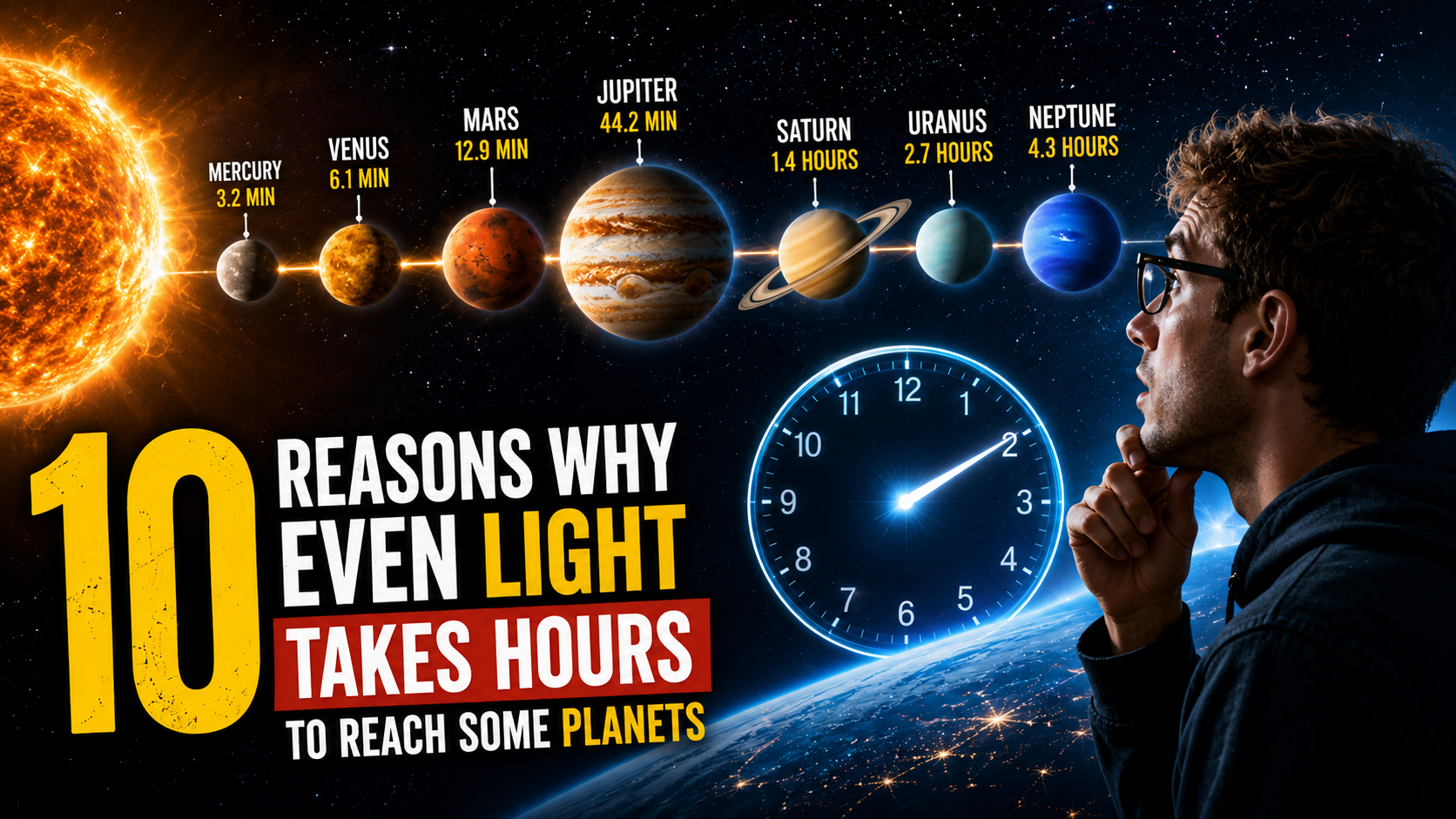
- Earth is about 8 light-minutes from the Sun.
- Jupiter is roughly 44 light-minutes away.
- Neptune is over 4 light-hours away.
Using light as a measuring stick helps scientists communicate the enormous scale of cosmic distances.
9. Looking Into Space Means Looking Into the Past
One of the most fascinating consequences of light travel time is that every astronomical observation shows us history.
When we observe a distant planet, star, or galaxy, we see it as it was when its light began traveling toward us.
The farther away the object, the farther back in time we are looking.
Observing Neptune means seeing it several hours in the past.
Observing distant stars may reveal conditions from years ago.
Observing remote galaxies can show events that occurred millions or even billions of years earlier.
Astronomy is essentially a form of time travel through observation.
10. Cosmic Distances Redefine Our Perspective
Perhaps the most important reason light takes hours to reach some planets is that it reminds us how extraordinary the universe really is.
In everyday life, speed solves most problems.
Cars, airplanes, and digital communication allow us to move and share information quickly.
Space changes the rules.
Even traveling at the fastest speed nature allows, crossing the solar system still requires significant time.
This realization encourages humility and wonder.
The universe is far larger than our everyday experiences suggest, and our solar system is only a tiny part of it.
Why These Distances Matter
Understanding light travel times is not merely an interesting scientific fact.
It has practical implications for astronomy, space exploration, and future missions.
Scientists must account for communication delays when operating robotic spacecraft.
Engineers designing missions to distant planets must consider how long signals require to travel.
Researchers studying planetary systems rely on light travel times to understand where objects are and how they behave.
Without these calculations, modern space science would be impossible.
What Would Travel at Light Speed Feel Like?
Many people wonder what would happen if humans could travel at the speed of light.
According to modern physics, objects with mass cannot actually reach light speed because doing so would require an infinite amount of energy.
However, imagining the journey helps illustrate cosmic distances.
At light speed:
- The Moon would be reached in about 1.3 seconds.
- The Sun would be reached in about 8 minutes.
- Jupiter would be reached in roughly 44 minutes.
- Saturn would take around 1.4 hours.
- Uranus would require nearly 3 hours.
- Neptune would take more than 4 hours.
Even at the fastest possible speed, the solar system remains impressively large.
The Universe Beyond the Solar System
As vast as our solar system seems, it becomes tiny when compared to the broader universe.
The nearest star beyond the Sun, Proxima Centauri, is over four light-years away.
That means light takes more than four years to travel between Earth and that star.
Many galaxies visible through telescopes are millions of light-years away.
Some of the most distant objects ever observed emitted their light billions of years ago.
Compared with those distances, the few light-hours separating us from Neptune seem relatively small.
Final Thoughts
The fact that light takes hours to reach some planets reveals one of the most remarkable truths about the cosmos: space is unimaginably vast. Although light moves faster than anything else in the universe, even it cannot instantly cross the enormous distances that separate worlds within our solar system.
From Neptune’s four-hour sunlight delay to the communication challenges faced by spacecraft like Voyager 1, these travel times remind us that the universe operates on scales far beyond ordinary human experience.
Every beam of sunlight, every radio signal from a distant probe, and every image captured by a telescope carries a story about distance and time. Understanding how long light takes to travel helps us appreciate not only the size of our solar system but also humanity’s ongoing effort to explore and understand the universe beyond our world.







