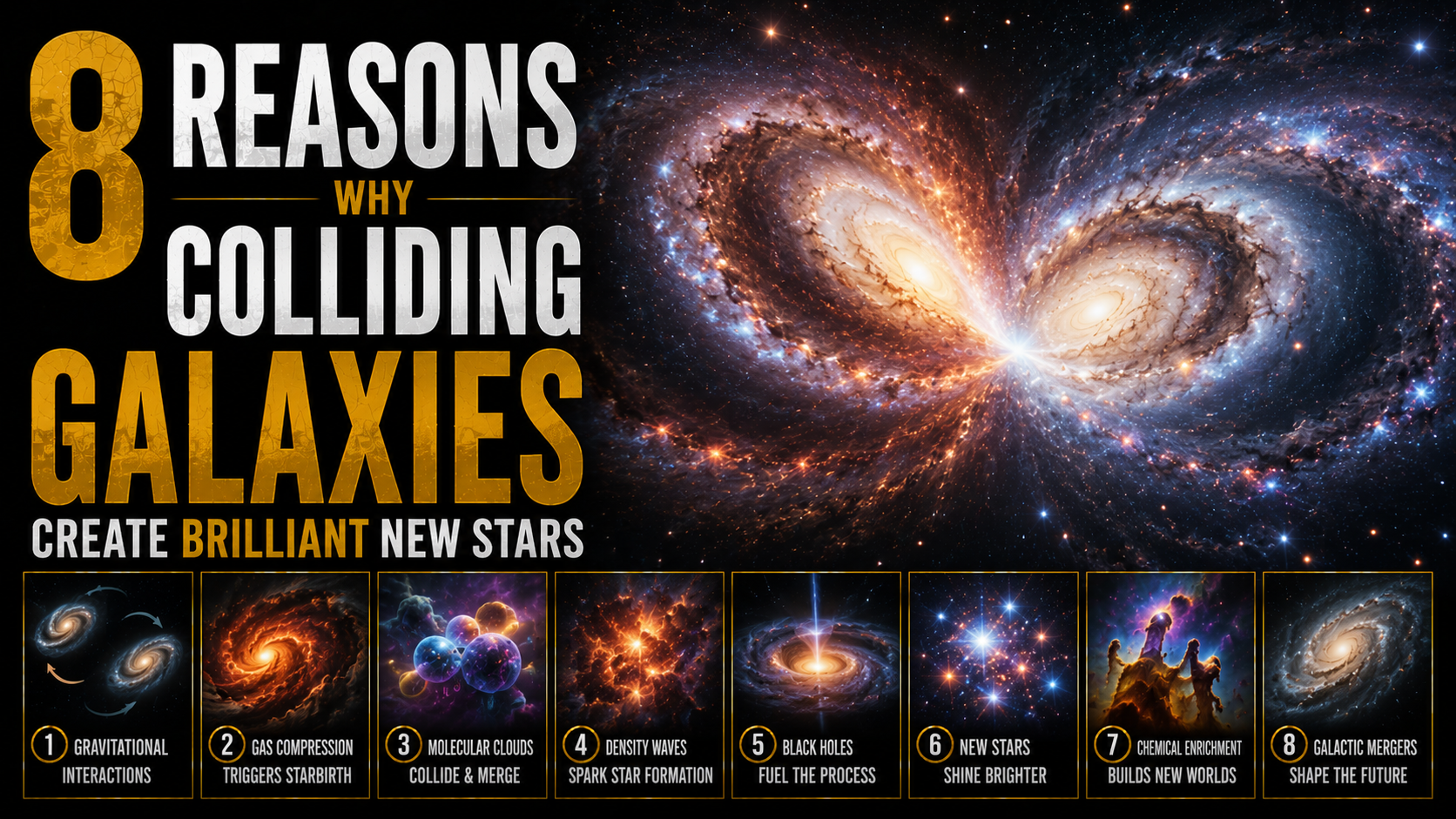
Galaxies are not static islands in space. They move, interact, and sometimes even collide in slow-motion cosmic encounters that last hundreds of millions of years. While the idea of galaxies crashing into each other may sound catastrophic, the reality is far more fascinating—and surprisingly creative.
When galaxies interact, they don’t simply destroy each other. Instead, their gas clouds, dust, and gravitational forces begin to reshape entire regions of space. One of the most remarkable results of these interactions is the birth of new stars.
Far from being chaotic destruction, galaxy collisions often become cosmic nurseries.
Here are 8 reasons why colliding galaxies create brilliant new stars.
1. Gravity Compresses Massive Clouds of Gas
The most important force behind star formation is gravity.
When galaxies pass through or near each other, their gravitational fields intensify dramatically.
This pulls vast clouds of gas and dust together, compressing them into dense regions.
Once these clouds become dense enough, they collapse and begin forming new stars.
2. Shockwaves Trigger Star-Birth Regions
Galaxy collisions generate enormous shockwaves across interstellar space.
These waves travel through gas clouds, compressing and heating them.
As the gas cools again, it becomes unstable and begins to collapse.
This process sparks bursts of star formation in multiple regions at once.
3. Gas Clouds Become More Turbulent
Inside stable galaxies, gas clouds can remain relatively calm for long periods.
But during a collision, turbulence increases dramatically.
This chaotic movement causes gas pockets to collide and merge.
The result is a rapid increase in star-forming activity.
4. Spiral Arms Get Distorted and Activated
Many galaxies, including our Milky Way, have spiral structures filled with gas and dust.
During a collision, these spiral arms can be stretched, twisted, or compressed.
This distortion concentrates material into tighter regions.
Those dense areas become prime locations for new star formation.
5. Intergalactic Gas Gets Pulled Inward
Galaxy collisions don’t only affect existing material—they also draw in gas from surrounding space.
This extra material increases the fuel available for star creation.
As more gas flows inward, the galaxy becomes even more active.
This influx helps sustain long periods of star formation.
6. Star Formation Bursts Occur Across Entire Galaxies
Instead of forming stars slowly and steadily, colliding galaxies often experience starburst events.
These are periods of extremely rapid star formation.
Entire regions light up with new stars forming at once.
Such bursts can dramatically change a galaxy’s appearance.
7. Supermassive Black Holes Can Influence Star Formation
At the center of most galaxies lies a supermassive black hole.
During a collision, these black holes can become more active.
Their energy output can compress surrounding gas in certain regions.
This compression can indirectly trigger star formation in nearby clouds.
8. New Galactic Structures Help Sustain Star Birth
As galaxies merge, they often form entirely new shapes and structures.
These new configurations redistribute gas and dust in different ways.
Some regions become denser, while others clear out.
The dense areas continue forming stars long after the collision begins.
What Happens After the Collision?
Galaxy collisions do not happen quickly in human terms.
They unfold over hundreds of millions to billions of years.
Eventually, the galaxies merge into a single, larger galaxy.
But by that time, countless new stars have already been born.
Why Galaxy Collisions Matter
Although space is vast, galaxy collisions are relatively common on cosmic timescales.
They play a key role in shaping the universe.
Many large galaxies, including the Milky Way, have grown through past mergers.
Without these interactions, the universe would look very different today.
The Future of the Milky Way
Our own galaxy is on a collision course with the Andromeda Galaxy.
In about 4 to 5 billion years, the two will begin merging.
This event will likely trigger a wave of new star formation.
Far from destruction, it will mark the beginning of a new galactic era.
Final Thoughts
Galaxy collisions may sound violent, but they are also deeply creative events in the universe.
They compress gas, trigger starbursts, and reshape entire cosmic structures.
Through these interactions, galaxies evolve and new stars are born.
In the end, what looks like destruction is often the beginning of something spectacular.







