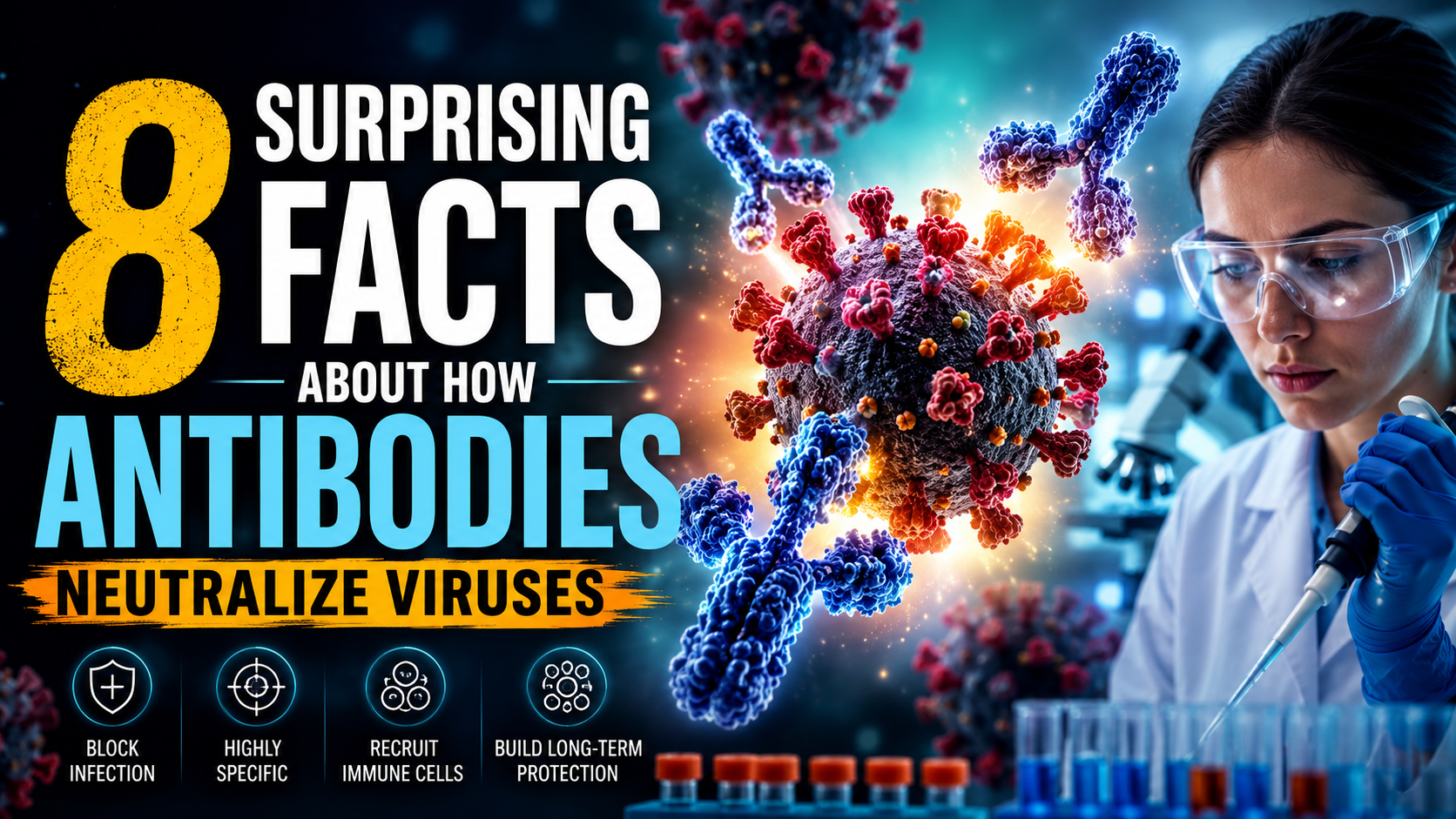
The human body is equipped with one of the most sophisticated defense systems found in nature. Every day, it encounters countless microorganisms, including viruses that have the potential to cause illness. Yet most of the time, our immune system successfully detects and eliminates these threats before they can do serious harm.
At the heart of this defense system are antibodies—specialized proteins designed to recognize and help neutralize invading pathogens. Although antibodies are often mentioned in discussions about vaccines, infections, and immunity, many people don’t fully understand how they actually work.
Recent advances in medical research, including studies involving HIV, COVID-19, influenza, and other viral diseases, have highlighted just how remarkable these microscopic defenders truly are.
Here are eight surprising facts about how antibodies neutralize viruses and why scientists continue studying them as one of medicine’s most powerful tools.
1. Antibodies Work Like Highly Specialized Security Guards
One of the easiest ways to understand antibodies is to imagine a highly trained security team protecting a building.
Viruses are constantly trying to enter the body’s cells and use them to reproduce. Antibodies patrol the bloodstream and tissues, searching for specific molecular signatures found on invading viruses.
Each antibody is designed to recognize a particular target, known as an antigen. When an antibody encounters a virus carrying its matching antigen, it attaches itself with remarkable precision.
This lock-and-key relationship allows the immune system to identify threats with extraordinary accuracy.
Rather than attacking everything indiscriminately, antibodies focus on specific invaders, helping the body respond efficiently while minimizing damage to healthy cells.
2. They Can Stop Viruses Before Cells Become Infected
Many people assume antibodies destroy viruses directly. While that sometimes happens indirectly, one of their most important jobs is actually prevention.
Viruses must attach to healthy cells before they can reproduce. To accomplish this, they use specialized proteins on their outer surfaces.
Antibodies can bind to these viral proteins and block them from connecting with cells.
Imagine placing a cap over a key before it reaches a lock. The key can no longer fit, preventing entry.
By interfering with this process, antibodies may stop infection before the virus gains access to the cells it needs to survive and multiply.
This ability to block entry is known as neutralization and represents one of the immune system’s most effective defense strategies.
3. Some Antibodies Can Recognize Multiple Virus Variants
Viruses are constantly changing.
As they replicate, small genetic mutations can occur, creating new variants that may look slightly different from earlier versions.
This presents a challenge for the immune system because antibodies are typically designed to recognize specific structures.
However, researchers have discovered a special category known as broadly neutralizing antibodies.
These antibodies target parts of a virus that remain relatively unchanged even as mutations occur.
Because of this, they may recognize and neutralize multiple strains or variants of the same virus.
The recent discovery of antibodies capable of neutralizing a large percentage of HIV strains has generated excitement because HIV mutates rapidly and has historically been difficult to target.
4. Antibodies Can Recruit Reinforcements
Neutralization is only one part of the story.
Once antibodies attach to a virus, they often act as biological markers that alert other components of the immune system.
In effect, they place a molecular “tag” on the invader.
This tag signals immune cells such as macrophages and natural killer cells to locate and remove the threat.
Scientists refer to this process as opsonization—a mechanism that helps immune cells identify dangerous particles more efficiently.
Rather than working alone, antibodies coordinate a larger immune response involving multiple layers of defense.
This teamwork significantly increases the body’s ability to eliminate infections.
5. The Body Can Remember Viruses for Years
Perhaps one of the most fascinating abilities of the immune system is memory.
After an infection or vaccination, specialized immune cells store information about the invading pathogen.
If the same virus appears again in the future, the body can rapidly produce antibodies specifically designed to recognize it.
This is why many people develop long-lasting protection after recovering from certain diseases or receiving vaccines.
Immune memory allows the body to respond faster and more effectively during future encounters.
In some cases, this protection may last for years or even decades.
The concept of immune memory forms the foundation of modern vaccination programs around the world.
6. Not All Antibodies Are Created Equal
Although antibodies are often discussed as a single category, there are actually several different types, each with unique responsibilities.
Some of the major classes include:
- IgG
- IgA
- IgM
- IgE
- IgD
Each plays a distinct role in immune defense.
For example:
- IgA helps protect surfaces such as the respiratory and digestive tracts.
- IgM often serves as the body’s first antibody response to infection.
- IgG provides long-term protection and is commonly measured when evaluating immunity.
Researchers continue studying how these various antibody types work together to defend against viral infections.
Their coordinated actions create a highly adaptable and layered immune response.
7. Scientists Can Now Engineer Antibodies in the Laboratory
One of the most exciting developments in modern medicine is the ability to create therapeutic antibodies.
Instead of relying solely on the body’s natural production process, researchers can design and manufacture antibodies in controlled laboratory environments.
These engineered antibodies can be used to target specific diseases with remarkable precision.
Today, antibody-based treatments are being explored or used in areas such as:
- Infectious diseases
- Cancer therapy
- Autoimmune disorders
- Inflammatory conditions
Monoclonal antibody treatments have become particularly important because they provide highly targeted approaches to disease management.
Advances in biotechnology continue to improve their effectiveness and expand their potential applications.
8. Antibody Research Could Shape the Future of Medicine
Perhaps the most surprising fact of all is how much potential antibody science still holds.
Researchers are investigating ways to develop:
- Universal flu antibodies
- Next-generation HIV therapies
- Improved vaccine strategies
- More effective antiviral treatments
- Personalized immune-based medicines
Artificial intelligence, genetic engineering, and advanced molecular imaging are helping scientists discover new antibody candidates faster than ever before.
Some experts believe future therapies may be able to prevent infections before symptoms ever appear or provide highly customized protection based on an individual’s unique biology.
Although many challenges remain, antibody research continues to be one of the most promising fields in modern healthcare.
Why Antibodies Matter More Than Ever
The global focus on infectious diseases over the past several years has highlighted the critical role antibodies play in public health.
Whether protecting individuals from seasonal viruses, supporting vaccine effectiveness, or contributing to breakthrough treatments, antibodies remain central to many of medicine’s most important advances.
Their ability to recognize specific threats, block infections, recruit immune defenses, and create long-term protection makes them uniquely valuable tools in the fight against disease.
As scientists learn more about how antibodies function, they continue uncovering opportunities to improve treatments and strengthen prevention strategies.
The Connection Between Antibodies and HIV Research
Few viruses have challenged scientists as much as HIV.
The virus mutates rapidly, making it difficult for the immune system to maintain long-term control. For decades, researchers have searched for antibodies capable of targeting a broad range of HIV variants.
Recent laboratory discoveries involving broadly neutralizing antibodies have renewed optimism within the scientific community.
These antibodies appear capable of recognizing parts of the virus that remain relatively stable despite frequent mutations.
While significant research is still needed before such findings translate into widespread clinical use, they represent an important step toward developing new prevention and treatment strategies.
Looking Ahead
The study of antibodies is advancing at an extraordinary pace.
New technologies allow scientists to analyze immune responses with unprecedented detail, uncovering mechanisms that were impossible to observe only a few decades ago.
Researchers are increasingly focused on creating therapies that work alongside the body’s natural defenses rather than simply attacking disease directly.
This shift reflects a broader trend in medicine toward precision treatments that are more targeted, personalized, and effective.
As our understanding of antibodies grows, so too does the possibility of developing innovative solutions for some of the world’s most challenging diseases.
Final Thoughts
Antibodies may be microscopic, but their impact on human health is enormous. These remarkable proteins serve as the immune system’s recognition experts, helping identify threats, prevent infections, and coordinate powerful defensive responses.
From blocking viruses before they enter cells to providing long-lasting immune memory, antibodies perform a wide range of essential functions that keep us healthy every day.
The ongoing study of antibody science is not only improving our understanding of infectious diseases but also opening doors to entirely new forms of treatment and prevention. As research continues, antibodies are likely to remain at the center of some of medicine’s most exciting breakthroughs, offering hope for better protection against viral threats in the years ahead.







