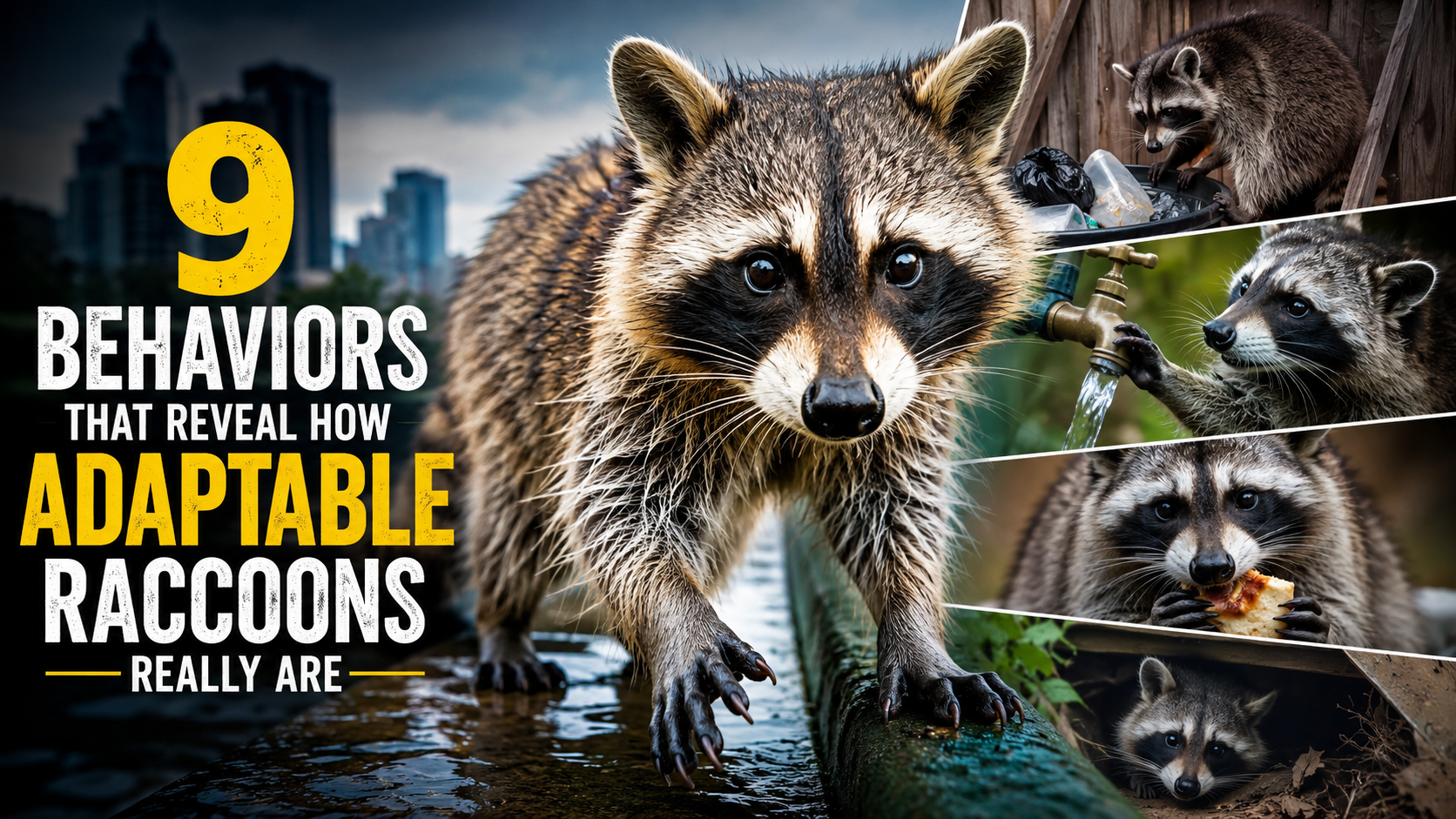
Raccoons are among the most resourceful animals in the world. Found in forests, suburbs, and bustling cities, these clever mammals have earned a reputation for thriving in environments where many other species struggle. Their ability to adjust to changing conditions, find food in unexpected places, and solve problems has fascinated wildlife experts for decades.
While many people recognize raccoons by their distinctive black facial mask and ringed tails, fewer understand just how adaptable these animals truly are. Their survival success is not accidental. It stems from a combination of intelligence, curiosity, and behavioral flexibility that allows them to overcome challenges in both natural and human-made environments.
Here are nine remarkable behaviors that demonstrate why raccoons are considered some of nature’s most adaptable survivors.
1. They Can Thrive in Almost Any Environment
One of the strongest signs of a raccoon’s adaptability is its ability to live in a wide variety of habitats.
Originally associated with wooded areas near rivers and streams, raccoons have successfully expanded into farmland, suburban neighborhoods, and major cities. Today, they can be found everywhere from rural forests to densely populated urban centers.
Unlike animals that depend on highly specific conditions, raccoons adjust their behavior based on available resources. If food, shelter, and water are present, they can often establish themselves and thrive.
This environmental flexibility has played a major role in their widespread success across North America and beyond.
2. They Are Skilled Problem Solvers
Raccoons possess impressive problem-solving abilities that rival those of many highly intelligent animals.
Researchers have observed raccoons opening latches, manipulating objects, and remembering solutions to challenges for extended periods. Their dexterous front paws allow them to investigate and interact with their surroundings in ways that many mammals cannot.
Whether it’s figuring out how to access a food container or navigating an unfamiliar obstacle, raccoons often rely on trial and error combined with memory to achieve their goals.
Their willingness to experiment gives them a significant advantage when adapting to new situations.
3. They Are Not Picky Eaters
A flexible diet is one of the greatest tools for survival, and raccoons have mastered it.
These animals are omnivores, meaning they consume both plant and animal matter. Depending on what’s available, they may eat fruits, nuts, insects, fish, frogs, eggs, small mammals, or human food waste.
This broad menu allows raccoons to take advantage of seasonal changes and shifting food supplies. If one source becomes scarce, they can quickly switch to another.
Their dietary flexibility helps explain why they can flourish in so many different environments.
4. They Learn From Experience
Adaptability often depends on learning, and raccoons excel in this area.
Studies suggest that raccoons can remember successful strategies and apply them in future situations. If they discover a reliable food source or an effective route through a neighborhood, they often return repeatedly.
Young raccoons also learn important survival skills by observing their mothers. Through observation and experience, they develop behaviors that increase their chances of survival.
This ability to retain information and modify behavior based on past experiences contributes significantly to their success.
5. They Use Human Structures as Shelter
In natural habitats, raccoons commonly den in hollow trees, rock crevices, or abandoned burrows. However, their adaptability becomes especially apparent in urban areas.
When natural shelters are limited, raccoons often make use of attics, chimneys, sheds, garages, crawl spaces, and abandoned buildings.
Rather than depending on a single type of shelter, they assess available options and adjust accordingly. This flexibility enables them to survive even in heavily developed environments where natural den sites may be scarce.
While this behavior can sometimes create conflicts with homeowners, it demonstrates the raccoon’s remarkable ability to adapt to changing landscapes.
6. They Are Mostly Nocturnal
Raccoons are primarily active at night, a behavior that offers several advantages.
Operating under the cover of darkness helps them avoid predators, reduce competition, and navigate human environments with less risk of disturbance.
In urban settings, nighttime activity allows raccoons to explore neighborhoods, search for food, and move between locations while encountering fewer people and vehicles.
Their ability to adjust activity patterns based on environmental conditions showcases another layer of behavioral flexibility.
7. They Are Naturally Curious
Curiosity is often associated with intelligence, and raccoons display an extraordinary level of both.
These animals frequently investigate unfamiliar objects, sounds, and smells. While curiosity can sometimes expose them to risks, it also helps them discover new opportunities.
A curious raccoon may find a previously unknown food source, a safer shelter, or a shortcut through its territory. This constant exploration allows them to gather information about their surroundings and adapt more effectively.
In many ways, curiosity serves as one of their most valuable survival tools.
8. They Adjust Their Behavior to Human Activity
Few wild animals have adapted to human presence as successfully as raccoons.
In areas with frequent human activity, raccoons often alter their routines to avoid direct encounters. They may change feeding times, use alternative travel routes, or become more cautious when approaching developed areas.
Some populations have even learned to exploit resources created by people, such as garbage bins, pet food, gardens, and compost piles.
Their ability to modify behavior in response to human activity demonstrates a high degree of environmental awareness and flexibility.
9. They Persist Through Challenges
Perhaps the most impressive trait of raccoons is their persistence.
When faced with obstacles, raccoons rarely give up after a single failed attempt. They continue exploring, testing solutions, and adapting their approach until they succeed.
Whether they’re trying to access food, find shelter, or navigate unfamiliar territory, persistence often works in their favor.
This determination, combined with intelligence and flexibility, allows raccoons to overcome challenges that might defeat less adaptable animals.
Why Adaptability Matters
Adaptability is one of the most important traits for survival in a rapidly changing world. Habitat loss, urban expansion, climate shifts, and competition for resources create challenges for wildlife across the globe.
Raccoons have succeeded because they possess characteristics that help them respond effectively to these pressures. Their intelligence, flexible diet, learning ability, and willingness to explore new opportunities allow them to adjust where many species cannot.
While not every animal benefits from such versatility, raccoons provide a fascinating example of how behavioral flexibility can contribute to long-term survival.
The Secret Behind Their Success
What makes raccoons so adaptable isn’t any single behavior. Rather, it’s the combination of several traits working together.
Their curiosity helps them discover opportunities. Their intelligence allows them to solve problems. Their flexible diet ensures they can take advantage of available resources. Their persistence enables them to overcome obstacles. And their ability to learn from experience helps them continuously improve their survival strategies.
Together, these qualities create an animal uniquely equipped to handle change.
Final Thoughts
Raccoons are far more than clever scavengers. They are highly adaptable creatures whose behaviors reveal an impressive capacity to survive and thrive in diverse environments.
From solving complex problems to adjusting their routines around human activity, raccoons consistently demonstrate the flexibility needed to succeed in an ever-changing world. Their remarkable adaptability offers valuable insight into how intelligence, curiosity, and persistence can help animals navigate challenges and seize opportunities.
Whether encountered in a forest, a suburban backyard, or the heart of a city, raccoons remain one of nature’s most fascinating examples of resilience and adaptation.







