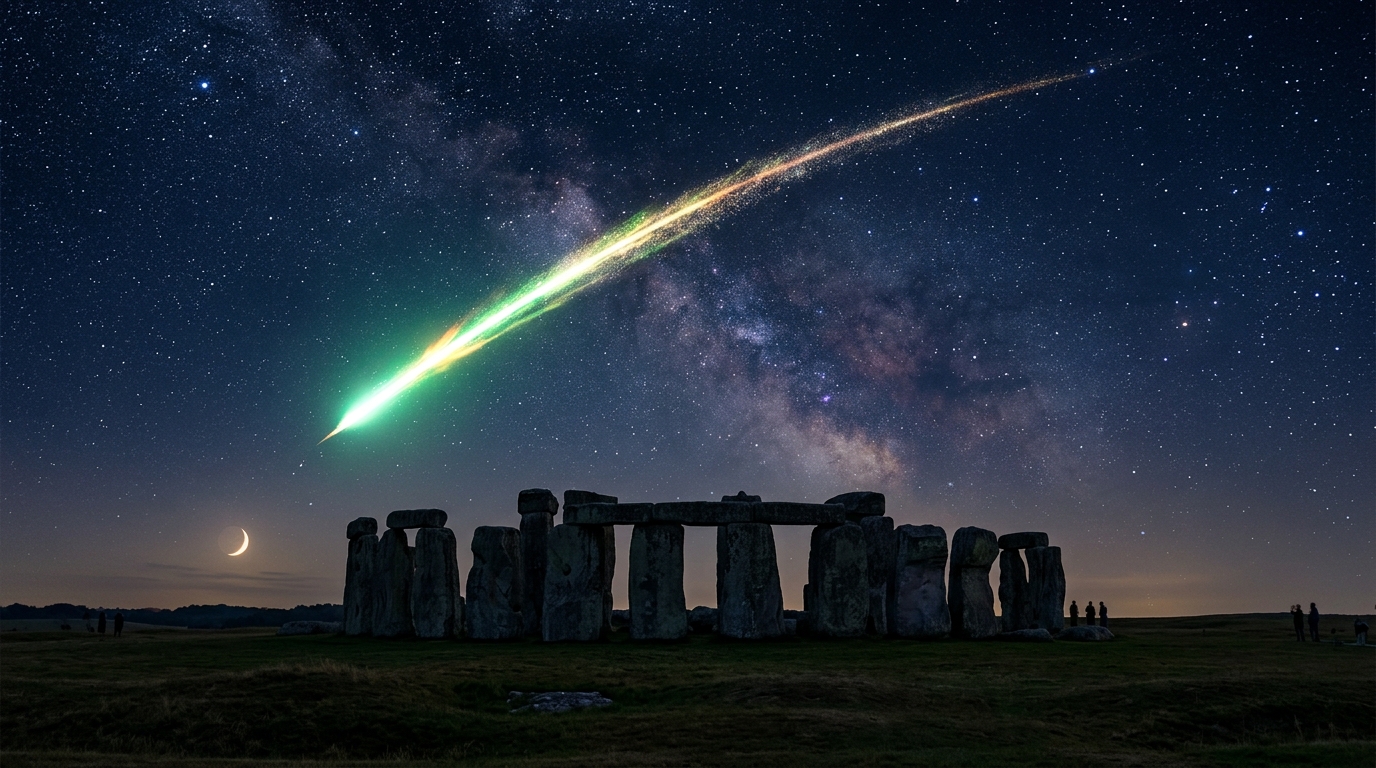
Few sights combine history and astronomy as beautifully as a meteor streaking across the sky above an ancient monument. Whether it’s a shooting star passing over a centuries-old temple, a meteor shower illuminating a prehistoric stone circle, or a bright fireball appearing above a historic ruin, these moments create images that connect humanity’s past with the wonders of the cosmos.
For photographers, capturing meteors above ancient landmarks is both an artistic challenge and a rewarding experience. The resulting images often tell a story that spans thousands of years, linking structures built by ancient civilizations with celestial events that have fascinated people throughout history.
Here are nine fascinating facts about photographing meteors above ancient monuments.
1. These Images Combine Two Different Kinds of History
Ancient monuments preserve the story of human civilization, while meteors provide a glimpse into the history of the solar system.
Most meteors are caused by tiny particles left behind by comets or asteroids. Some of this material has traveled through space for millions or even billions of years. When a meteor appears above a monument that has stood for centuries or millennia, the photograph captures two very different timelines in a single frame.
This unique combination is one reason such images are so captivating.
2. Timing Is Often the Biggest Challenge
Unlike the Moon or planets, meteors are unpredictable.
Even during major meteor showers, photographers may wait long periods before a bright meteor appears in the right part of the sky. Success often requires patience, planning, and a willingness to spend hours outdoors under the stars.
Many of the most dramatic meteor photographs result from numerous attempts rather than a single lucky shot.
3. Ancient Monuments Add Scale to the Scene
Without a foreground object, it can be difficult to appreciate the size and beauty of the night sky.
Ancient monuments provide a powerful sense of scale by anchoring the image to something familiar and tangible. A meteor streaking above a towering temple or historic stone structure helps viewers better understand the vastness of the sky overhead.
The contrast between Earth and space often creates a striking visual effect.
4. Dark Skies Are Essential
Many ancient monuments are located far from major cities, making them excellent places for astrophotography.
Low levels of light pollution allow photographers to capture fainter meteors and reveal more stars in the background. Dark skies can also enhance visibility of the Milky Way, adding even greater depth to the composition.
For meteor photography, darkness is often just as important as camera equipment.
5. Meteor Showers Increase the Odds of Success
Although meteors can appear on any night, photographers often plan trips around major annual meteor showers.
Events such as the Perseid Meteor Shower, Geminid Meteor Shower, and Southern Delta Aquariid Meteor Shower produce higher numbers of visible meteors than usual.
These showers greatly improve the chances of capturing a dramatic image above a historic site.
6. Ancient Structures Often Have Astronomical Connections
Many monuments were built with careful attention to celestial events.
Structures such as Stonehenge, Chichén Itzá, and other ancient sites contain alignments related to the Sun, Moon, or stars.
Photographing meteors above these locations creates a meaningful connection between the astronomical knowledge of ancient peoples and modern observations of the night sky.
7. Long Exposures Reveal More Than the Human Eye
Many meteor photographs are created using long-exposure techniques.
While the human eye sees only a brief flash, cameras can collect light over extended periods, revealing countless stars, faint sections of the Milky Way, and subtle atmospheric details. Long exposures often make the sky appear far richer than it does in real time.
This capability allows photographers to capture scenes that feel almost magical.
8. Weather Can Make or Break a Shoot
The perfect meteor shower means little if clouds cover the sky.
Astrophotographers often spend considerable time monitoring weather forecasts and atmospheric conditions before traveling to a location. Clear skies, low humidity, and minimal haze can significantly improve image quality.
Because opportunities may occur only once per year, weather becomes a crucial factor in planning successful shoots.
9. The Best Images Tell a Story
The most memorable meteor photographs are often about more than technical perfection.
A meteor streaking above an ancient monument can symbolize humanity’s long relationship with the heavens. For thousands of years, people have looked up at the same sky, observed shooting stars, and wondered about their meaning.
By capturing both a historic structure and a fleeting celestial event, photographers create images that connect past and present in a powerful and emotional way.
Why These Photographs Inspire People
Images of meteors above ancient monuments resonate with people because they combine two sources of wonder: human achievement and the natural universe. Ancient structures remind us of the ingenuity and persistence of past civilizations, while meteors highlight the beauty and unpredictability of the cosmos.
Together, they create scenes that feel timeless. A meteor may last only a fraction of a second, yet when photographed above a monument that has endured for centuries, it becomes part of a much larger story.
These images encourage viewers to reflect on humanity’s place in the universe and our enduring fascination with the night sky.
Conclusion
Photographing meteors above ancient monuments is one of the most rewarding forms of astrophotography. It requires patience, planning, favorable conditions, and often a bit of luck. Yet the results can be extraordinary.
From showcasing the beauty of meteor showers to highlighting the historical significance of ancient landmarks, these photographs bridge the gap between Earth and sky, past and present. They remind us that while civilizations rise and fall, people have always shared a common experience: looking upward in wonder at the stars.
Every meteor captured above an ancient monument tells a story that spans both human history and cosmic time, creating images that continue to inspire generations of skywatchers and photographers alike.







