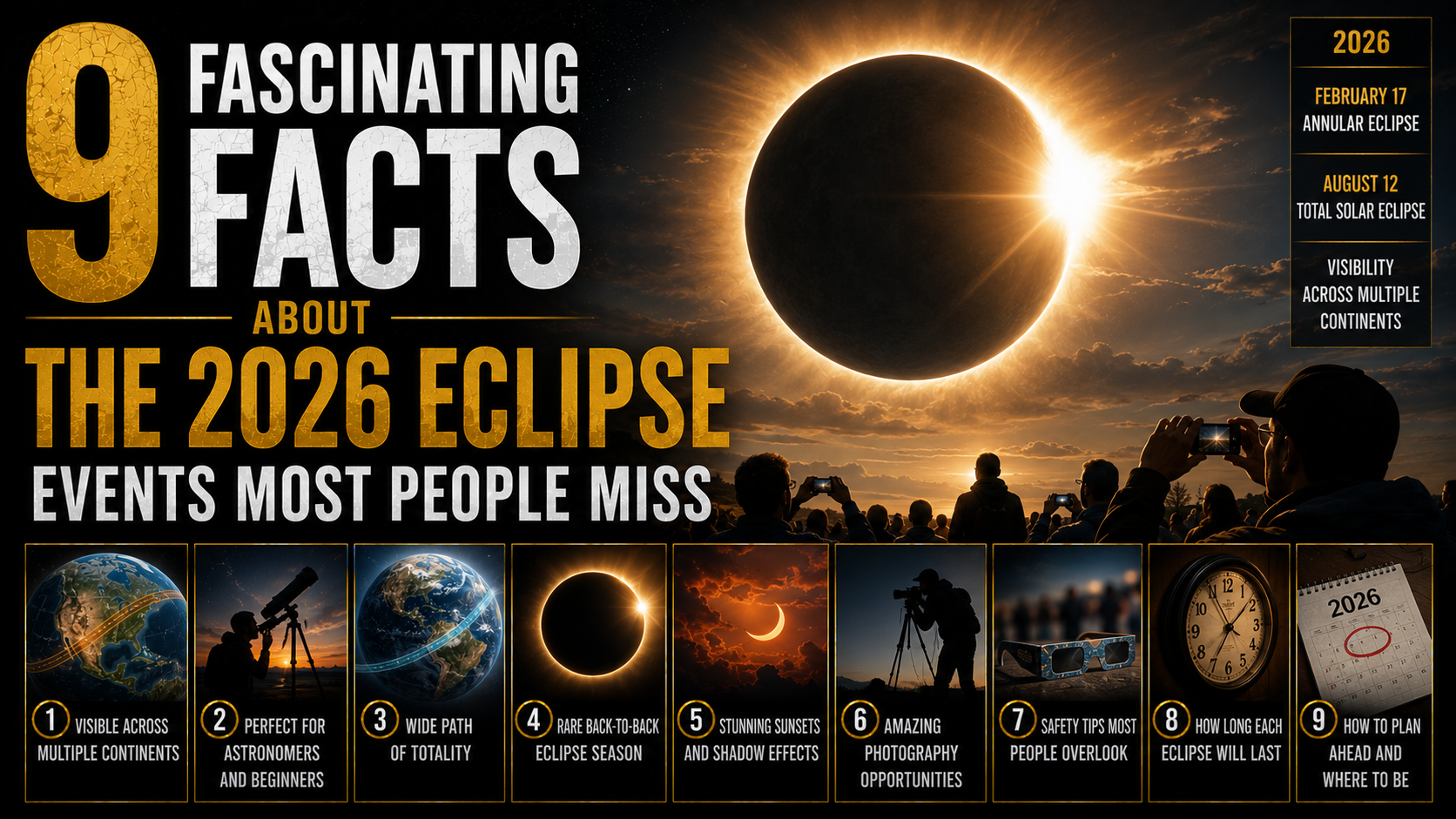
Eclipses have always fascinated humanity. For thousands of years, people have looked to the sky with a mix of awe and curiosity when the Sun or Moon suddenly shifts into shadow. The eclipse events expected in 2026 are no exception, drawing attention from astronomers, travelers, and casual skywatchers alike.
While most headlines focus on the basic facts—when and where to watch—there are many lesser-known details that make these celestial events even more interesting. From subtle atmospheric effects to rare viewing opportunities, the 2026 eclipses offer more than just a moment of darkness.
Here are nine fascinating facts about the 2026 eclipse events that most people tend to miss.
1. The 2026 Eclipse Will Be Visible Across Multiple Regions
One of the most exciting aspects of the 2026 eclipse is its wide visibility path.
Depending on the type of eclipse, different regions across Europe, North America, and parts of the Atlantic will experience varying levels of coverage.
Some areas will see a full eclipse, while others will witness only a partial event.
This wide geographic reach makes it a global spectacle rather than a localized phenomenon.
2. Timing Will Affect How Dramatic the Eclipse Appears
Not all eclipse experiences look the same, even within the same region.
The time of day plays a major role in visibility and contrast.
Eclipses occurring near sunrise or sunset often appear more dramatic due to the Sun’s lower position in the sky.
This creates deeper shadows and more vivid atmospheric colors.
3. Atmospheric Conditions Can Change the Experience Completely
Weather plays a crucial role in eclipse visibility.
Cloud cover, humidity, and air pollution can all influence how clearly the event is seen.
Even thin clouds can soften or distort the eclipse view.
In contrast, clear skies can produce a sharp and unforgettable visual experience.
4. Animal Behavior Often Changes During Eclipses
One of the more surprising effects of eclipses is their impact on wildlife.
Birds may stop singing, nocturnal animals may become active, and diurnal animals may become confused.
These behavioral shifts occur because the sudden drop in light mimics nighttime conditions.
Scientists continue to study how different species respond to these brief environmental changes.
5. Temperature Drops Can Be Noticeable
During a solar eclipse, the sudden reduction in sunlight can lead to a temporary drop in temperature.
This cooling effect varies depending on location and weather conditions.
In some cases, people can feel the change within minutes.
It is a subtle but noticeable reminder of how much energy the Sun provides to Earth.
6. The Eclipse Shadow Moves at Incredible Speed
The Moon’s shadow travels across Earth at thousands of kilometers per hour.
This means the total phase of a solar eclipse only lasts a few minutes in any given location.
Despite its short duration, the event feels much longer to observers due to its dramatic visual impact.
The speed of the shadow also creates a moving path of darkness across the planet.
7. Eclipses Help Scientists Study the Sun’s Corona
One of the most scientifically valuable aspects of a total solar eclipse is the ability to observe the Sun’s corona.
This outer atmosphere is usually hidden by the Sun’s brightness.
During an eclipse, it becomes visible as a glowing halo of plasma.
Studying the corona helps scientists understand solar winds and space weather.
8. Historical Cultures Recorded Similar Eclipse Events
Eclipses have been documented for thousands of years across different civilizations.
Ancient astronomers in China, Babylon, and the Americas recorded eclipse events in detail.
These records help modern scientists track long-term celestial patterns.
The 2026 eclipse continues a natural cycle that has been observed throughout human history.
9. Photography Conditions Will Be Exceptionally Unique
For photographers, eclipses present rare and challenging opportunities.
The shifting light conditions require careful timing and specialized equipment.
During totality, the contrast between darkness and the glowing corona creates dramatic images.
This makes eclipse photography one of the most rewarding forms of astrophotography.
Why the 2026 Eclipse Matters
Beyond its visual beauty, the 2026 eclipse is part of a larger astronomical cycle that helps scientists refine predictions and models of celestial motion.
Each eclipse provides new data about the Earth-Moon-Sun system.
It also encourages public interest in astronomy and space science, inspiring people to look up and reconnect with the night sky.
The Human Connection to Eclipses
Eclipses have always carried emotional and cultural significance.
They remind us of the vast forces at work in the universe and our small place within it.
Even in modern times, they continue to evoke awe, curiosity, and shared global excitement.
Few natural events can bring so many people together in collective observation.
Final Thoughts
The 2026 eclipse events are more than just predictable astronomical occurrences—they are moments of wonder that blend science, history, and human experience.
From shifting animal behavior to the revealing glow of the Sun’s corona, these eclipses offer layers of detail that go far beyond what most people expect.
For those who take the time to observe carefully, the experience becomes not just a visual spectacle, but a reminder of the intricate and ever-moving clockwork of our solar system.







