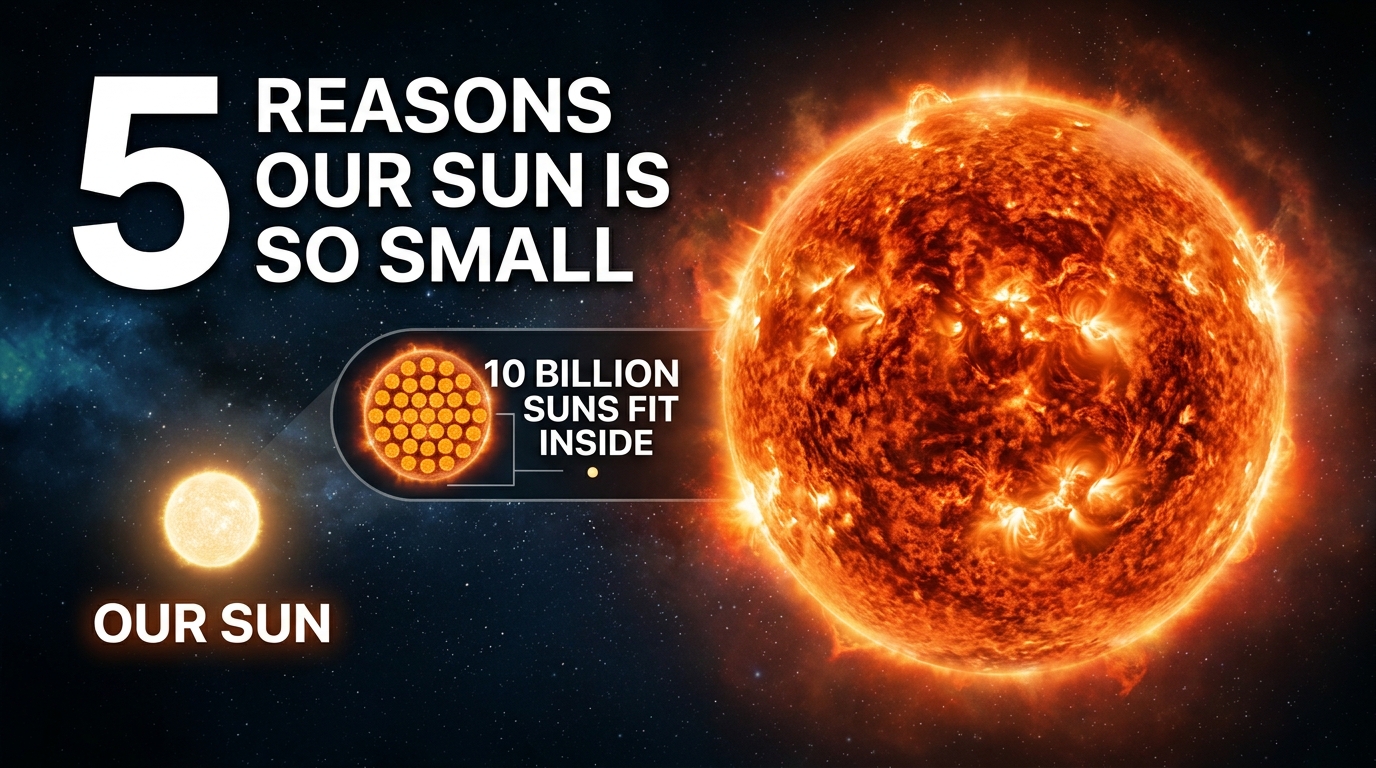
When most people think about the Sun, they imagine an enormous ball of blazing gas dominating our solar system. And compared to Earth, it certainly is. More than one million Earths could fit inside the Sun, making it difficult to comprehend just how massive our star really is.
Yet in the grand scale of the universe, the Sun is far from exceptional.
Astronomers have discovered stars so enormous that they make our solar system seem tiny by comparison. Among these cosmic giants is Stephenson 2-18, a red supergiant star that has captured the attention of scientists and space enthusiasts alike. Located thousands of light-years away, this stellar behemoth ranks among the largest stars ever identified.
What makes Stephenson 2-18 so fascinating isn’t just its size—it’s the perspective it gives us. By comparing this giant star to our own Sun, we gain a deeper appreciation for how vast and astonishing the universe truly is.
Here are five incredible reasons why Stephenson 2-18 makes our Sun look surprisingly small.
1. Its Diameter Is Almost Impossible to Imagine
The first thing that sets Stephenson 2-18 apart is its extraordinary size.
The Sun has a diameter of about 864,000 miles (1.39 million kilometers), which sounds enormous—and it is. However, Stephenson 2-18 takes that scale to an entirely different level.
Astronomers estimate that Stephenson 2-18’s radius is roughly 2,100 times larger than the Sun’s. If accurate, that would make it one of the largest stars ever measured.
Numbers alone don’t always convey the reality of such a comparison. Imagine placing the Sun beside Stephenson 2-18. Our star would appear like a tiny speck next to a colossal glowing sphere.
Even experienced astronomers often describe these dimensions as difficult to visualize because human brains are simply not built to process distances and sizes on such an enormous scale.
The comparison reminds us that what seems gigantic within our solar system can become surprisingly modest when viewed against the backdrop of the wider cosmos.
2. It Could Swallow the Inner Solar System
One of the most popular ways astronomers explain giant stars is by comparing them to the size of our solar system.
If Stephenson 2-18 were somehow placed where the Sun currently sits, its outer layers would extend far beyond the orbit of several planets.
Mercury would disappear inside the star almost instantly. Venus would be consumed as well. Earth would have no chance of survival.
In fact, Stephenson 2-18’s immense size could stretch beyond the orbit of Mars and potentially reach near Jupiter’s path, depending on the exact measurements used.
This comparison dramatically changes our perspective.
We often think of the solar system as vast because the distances between planets are so great. Yet a single star can be so large that it engulfs much of that space.
The idea that one star could occupy a significant portion of our planetary neighborhood highlights just how extreme stellar evolution can become.
3. It’s Living in a Completely Different Stage of Life
Another reason Stephenson 2-18 seems so extraordinary is that it represents a very different chapter in stellar evolution than our Sun.
The Sun is considered a middle-aged star. At approximately 4.6 billion years old, it remains relatively stable and is expected to continue shining for billions of years.
Stephenson 2-18 tells a different story.
It belongs to a category known as red supergiants, stars that have exhausted much of their hydrogen fuel and expanded dramatically as they approach the final stages of their lives.
As stars age, complex processes occur within their cores. Changes in pressure, temperature, and nuclear fusion can cause them to balloon outward to astonishing dimensions.
Stephenson 2-18 is essentially a star nearing the end of its cosmic journey. Its enormous size is a result of these late-stage evolutionary processes.
In contrast, the Sun remains relatively compact and stable. The difference between the two stars reflects how diverse stellar life cycles can be throughout the universe.
4. Its Volume Makes the Sun Seem Tiny
Diameter is impressive, but volume reveals an even more astonishing story.
When a star’s radius increases dramatically, its volume grows exponentially. This means that even a seemingly modest increase in size can result in a massive increase in overall volume.
Stephenson 2-18 isn’t just a little bigger than the Sun—it’s incomprehensibly larger.
Scientists estimate that billions of Suns could theoretically fit inside the volume occupied by Stephenson 2-18.
Think about that for a moment.
The Sun already contains 99.8 percent of the mass in our solar system. It dominates everything around it and serves as the gravitational anchor for all the planets.
Yet billions of Suns could fit inside a star like Stephenson 2-18.
This comparison demonstrates why astronomers often describe the universe as humbling. Every time we believe we’ve grasped the scale of something, nature presents an even larger example.
Stephenson 2-18 is one of those examples that forces us to rethink what “big” really means.
5. It Reveals How Little of the Universe We Truly Know
Perhaps the most fascinating aspect of Stephenson 2-18 isn’t its size but what it teaches us about scientific discovery.
For centuries, humanity knew only the stars visible to the naked eye. Today, advanced telescopes allow astronomers to study objects located thousands and even millions of light-years away.
Stephenson 2-18 itself wasn’t widely recognized until relatively recent astronomical observations revealed its extraordinary characteristics.
Even now, scientists continue refining their measurements and studying stars like it to better understand stellar evolution, mass loss, and the physical limits of star formation.
What’s particularly exciting is that new discoveries occur regularly. Astronomers are constantly identifying unusual stars, exotic planets, black holes, and distant galaxies that challenge existing theories.
Stephenson 2-18 serves as a reminder that the universe remains full of mysteries waiting to be explored.
Every giant star discovered expands our understanding of what is possible in nature.
Why Giant Stars Fascinate Us
Humans have always been captivated by extremes.
We are fascinated by the tallest mountains, deepest oceans, fastest animals, and largest structures. Giant stars naturally inspire the same curiosity.
Part of the appeal comes from the challenge of understanding scale. Everyday life operates within dimensions we can easily comprehend. A building might be hundreds of feet tall. A city might stretch for miles.
Astronomy operates on an entirely different level.
Distances are measured in light-years. Temperatures reach millions of degrees. Objects can be larger than entire planetary systems.
Stars like Stephenson 2-18 force us to step outside ordinary experience and consider the staggering diversity of the cosmos.
They remind us that the universe is far more imaginative than anything humans could invent.
The Sun Is Still Remarkable
While comparisons often make the Sun appear small, it’s important not to underestimate our home star.
The Sun remains an extraordinary object.
Its gravitational influence holds the solar system together. Its energy powers Earth’s climate and supports all known life. Without it, our planet would be a frozen, lifeless world.
In fact, many astronomers consider the Sun nearly perfect for sustaining life. It’s stable, long-lived, and produces energy at a consistent rate.
Giant stars such as Stephenson 2-18 may be larger, but they are often less stable and have significantly shorter lifespans.
So while the Sun may look modest next to a red supergiant, it possesses qualities that make it uniquely valuable.
Size isn’t everything in the universe.
Could Stephenson 2-18 Become a Supernova?
One of the most exciting possibilities surrounding giant stars involves their eventual fate.
Because red supergiants are nearing the end of their life cycles, many are expected to end in spectacular explosions known as supernovae.
These events rank among the most energetic phenomena in the universe.
During a supernova, a dying star can briefly outshine an entire galaxy, releasing enormous amounts of energy and scattering heavy elements into space.
Those elements eventually become part of future stars, planets, and even living organisms.
In a very real sense, the atoms that make up our bodies were forged in ancient stars that lived and died billions of years ago.
Stephenson 2-18 may one day contribute to this ongoing cosmic cycle, helping create the building blocks for future worlds.
Final Thoughts
Stephenson 2-18 is one of the most astonishing stars ever discovered. Its immense size, incredible volume, and advanced stage of evolution make it a true giant among giants.
By comparison, our Sun suddenly seems much smaller than we typically imagine. A star capable of engulfing much of the solar system and containing billions of solar volumes challenges our understanding of scale in profound ways.
Yet perhaps the greatest lesson Stephenson 2-18 offers is one of perspective.
Every time astronomers uncover a cosmic giant, they remind us that the universe is far larger, stranger, and more spectacular than we often realize. Our Sun may be modest compared to some stars, but it remains part of an endlessly fascinating cosmic landscape filled with wonders beyond imagination.
And somewhere, thousands of light-years away, Stephenson 2-18 continues to shine as one of the universe’s most breathtaking examples of just how extraordinary a star can become.







