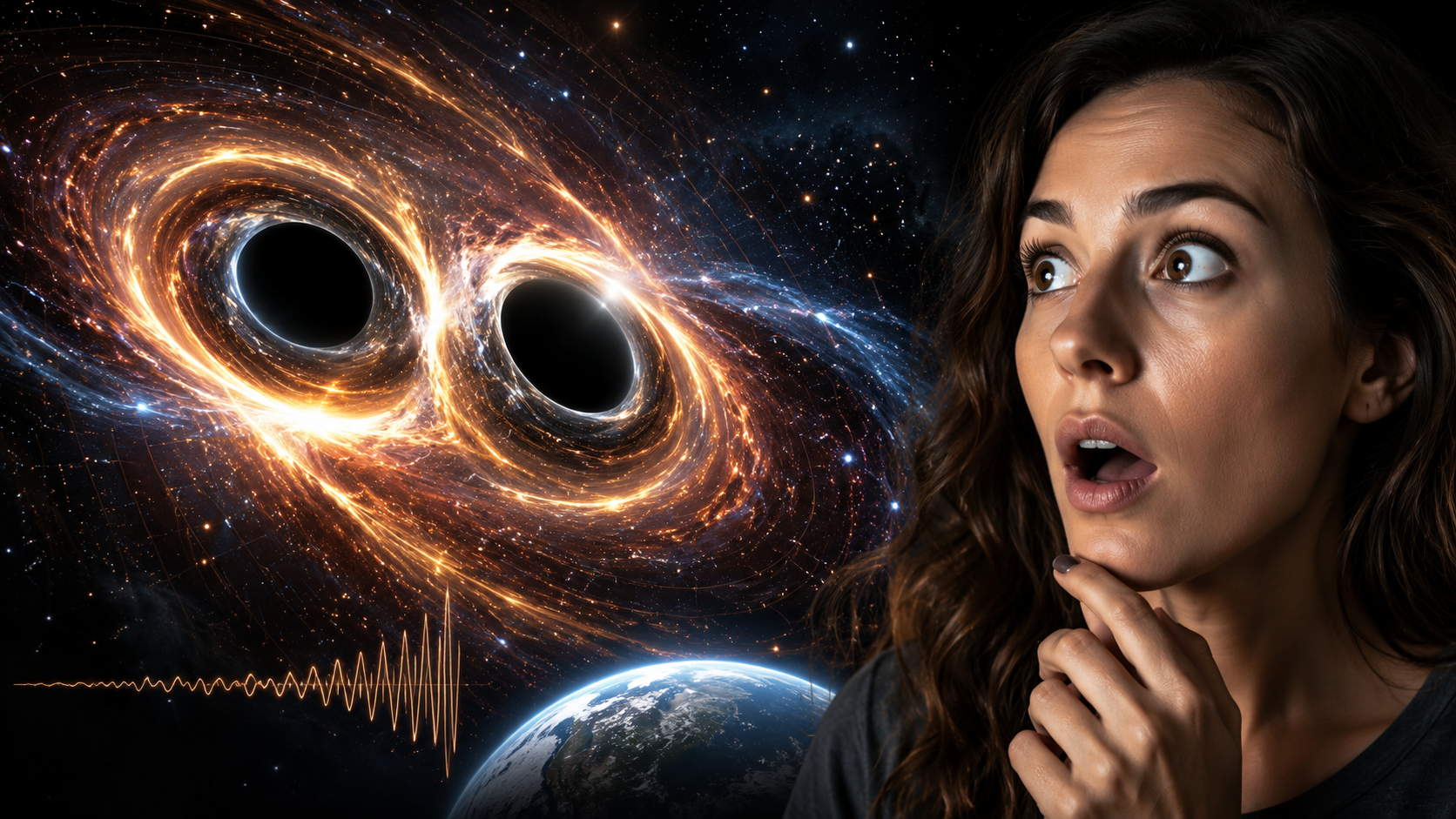
Black holes are among the most mysterious objects in the universe. Invisible by nature and capable of trapping even light within their immense gravitational pull, these cosmic giants continue to challenge our understanding of space and time.
Over the last decade, scientists have made extraordinary progress in studying black holes, thanks largely to groundbreaking gravitational-wave observatories. These instruments have allowed researchers to detect cosmic events that were once thought impossible to observe directly.
One of the most astonishing discoveries involved the largest black hole merger ever detected. The event, known as GW190521, shocked astronomers because of its enormous scale and the questions it raised about how black holes form and evolve.
This collision wasn’t simply another astronomical observation—it represented one of the most powerful events humanity has ever measured.
Here are 12 fascinating facts about the largest black hole collision ever detected and why it continues to reshape our understanding of the cosmos.
1. The Collision Involved Truly Massive Black Holes
Before GW190521, most black hole mergers detected by scientists involved relatively modest-sized stellar black holes.
This event was different.
The two black holes that collided were estimated to have masses approximately 85 and 66 times greater than our Sun. Those numbers may not sound extraordinary at first, but in black hole terms, they are remarkably large.
Their sheer size immediately caught the attention of astronomers because they exceeded what many existing models predicted for typical stellar black holes.
The discovery suggested that nature may create black holes through processes scientists are only beginning to understand.
2. The Merger Created an Even Bigger Monster
When the two black holes finally collided, they merged into a single object with an estimated mass of about 142 Suns.
That result was significant because it placed the newly formed black hole into a category known as an intermediate-mass black hole.
Astronomers had long suspected such objects existed, but evidence remained limited.
This merger provided one of the strongest indications yet that intermediate-mass black holes can form through repeated black hole collisions.
In many ways, the event offered scientists a glimpse into how some of the universe’s largest black holes may grow over time.
3. It Released an Unimaginable Amount of Energy
Black hole mergers are among the most energetic events in existence.
During GW190521, several solar masses worth of material were converted directly into energy in a fraction of a second.
According to Einstein’s famous equation, E = mc², even a small amount of mass can generate extraordinary energy. In this case, the amount involved was far from small.
The collision briefly produced more power than all the stars in the observable universe combined.
Although the event occurred billions of light-years away, its energy was so immense that scientists were able to detect its effects here on Earth.
4. Scientists Didn’t See It—They Heard It
One of the most surprising aspects of modern black hole research is that astronomers often “listen” to collisions rather than observe them through traditional telescopes.
Black holes themselves emit no light. Instead, researchers detect the gravitational waves produced when these objects collide.
These waves are ripples in spacetime that travel outward at the speed of light.
When GW190521 occurred, the resulting gravitational waves eventually reached Earth, where highly sensitive instruments detected tiny distortions in spacetime.
Scientists often convert these signals into audio frequencies, creating sounds that resemble brief chirps or pops.
In a sense, humanity heard this cosmic collision long before it could be visualized.
5. The Event Lasted Less Than a Second
Considering its enormous scale, many people assume the merger unfolded over a long period.
In reality, the detectable signal lasted only about one-tenth of a second.
That brief burst contained enough information for scientists to estimate the masses, distance, and properties of the colliding black holes.
The fact that researchers could extract so much knowledge from such a short signal highlights the incredible precision of modern gravitational-wave astronomy.
A tiny moment in time revealed an event that occurred billions of years ago.
6. It Challenged Existing Theories
One reason GW190521 generated so much excitement is that one of the black holes appeared to fall into a category previously thought unlikely to exist.
According to established stellar evolution models, black holes within a certain mass range should be extremely rare or impossible to form directly from collapsing stars.
Yet one of the colliding black holes seemed to occupy exactly that range.
This discrepancy forced scientists to reconsider some long-held assumptions about how stars die and how black holes are created.
The discovery demonstrated that the universe often has surprises in store for researchers.
7. The Collision Happened Billions of Years Ago
Although scientists detected the signal in 2019, the event itself occurred long before humanity existed.
The merger took place roughly 7 billion light-years from Earth.
That means the gravitational waves traveled for approximately 7 billion years before reaching our planet.
When the collision happened, Earth looked very different than it does today. Entire species had yet to evolve, continents occupied different positions, and human civilization was unimaginably far in the future.
Studying distant cosmic events allows us to look backward in time and explore the universe’s history.
8. It Helped Confirm Einstein’s Predictions Again
More than a century ago, Albert Einstein proposed the theory of general relativity.
Among its many predictions was the existence of gravitational waves.
For decades, scientists lacked the technology necessary to detect these subtle distortions directly.
The successful observation of events like GW190521 provides powerful confirmation that Einstein’s theory remains extraordinarily accurate, even under the most extreme conditions.
Few scientific ideas have survived so many rigorous tests over such a long period.
Each gravitational-wave detection strengthens confidence in our understanding of gravity and spacetime.
9. It May Reveal How Supermassive Black Holes Grow
One of astronomy’s greatest mysteries involves the origins of supermassive black holes.
These gigantic objects can contain millions or even billions of solar masses and reside at the centers of many galaxies.
Scientists still debate exactly how they become so large.
Events like GW190521 provide valuable clues.
If black holes repeatedly merge over billions of years, they could gradually build increasingly massive structures.
The largest black holes in the universe may have begun as much smaller objects that experienced countless mergers throughout cosmic history.
10. The Discovery Required Extraordinary Technology
Detecting gravitational waves is one of the most challenging tasks in science.
Observatories such as the LIGO and the Virgo Collaboration measure distortions thousands of times smaller than the width of a proton.
To achieve this, scientists use powerful lasers, vacuum systems, and highly sophisticated measurement equipment.
Even tiny environmental disturbances can interfere with observations.
The successful detection of GW190521 highlights decades of engineering innovation and international scientific cooperation.
Without these technological breakthroughs, the event would have passed unnoticed.
11. It Opened a New Era of Astronomy
Traditional astronomy relies heavily on electromagnetic radiation, including visible light, radio waves, and X-rays.
Gravitational-wave astronomy offers an entirely different way of exploring the universe.
Instead of observing light, researchers study the movement of spacetime itself.
This new approach allows scientists to investigate objects that may be invisible to conventional telescopes.
GW190521 demonstrated just how much information can be gained through this method.
Many astronomers believe we are only beginning to uncover the potential of this revolutionary field.
Future observatories may reveal countless hidden events occurring throughout the cosmos.
12. It Reminds Us How Dynamic the Universe Really Is
When we look up at the night sky, the stars appear calm and unchanging.
In reality, the universe is incredibly active.
Stars explode. Galaxies collide. Neutron stars merge. Black holes consume matter and occasionally crash into one another with unimaginable force.
GW190521 serves as a dramatic reminder that cosmic evolution is an ongoing process.
Even seemingly empty regions of space can host events powerful enough to reshape entire environments.
The universe is not a static place—it’s a constantly evolving landscape filled with extraordinary phenomena.
Why This Discovery Matters
The largest black hole collision ever detected is important for more than its record-breaking size.
It represents a major step forward in humanity’s ability to study the universe.
For centuries, black holes existed only as theoretical concepts. Today, scientists can measure their masses, track their movements, and observe their collisions across billions of light-years.
Each new detection helps answer old questions while creating new ones.
How many intermediate-mass black holes exist? How do supermassive black holes form? Are there even larger mergers waiting to be discovered?
The answers may fundamentally change our understanding of cosmic evolution.
Final Thoughts
The discovery of GW190521 revealed one of the most dramatic events ever recorded by human instruments. Two enormous black holes collided billions of years ago, releasing staggering amounts of energy and creating an even larger cosmic giant.
Beyond its impressive statistics, the event challenged scientific theories, confirmed key predictions of general relativity, and offered important clues about the growth of black holes throughout the universe.
Most importantly, it showcased the incredible power of modern astronomy. By detecting tiny ripples in spacetime, scientists were able to reconstruct a cataclysmic event that occurred billions of years in the past.
As gravitational-wave observatories continue improving, discoveries like GW190521 may become only the beginning. Somewhere in the vastness of space, even larger collisions could be unfolding right now—waiting for humanity to hear their echoes across the universe.







