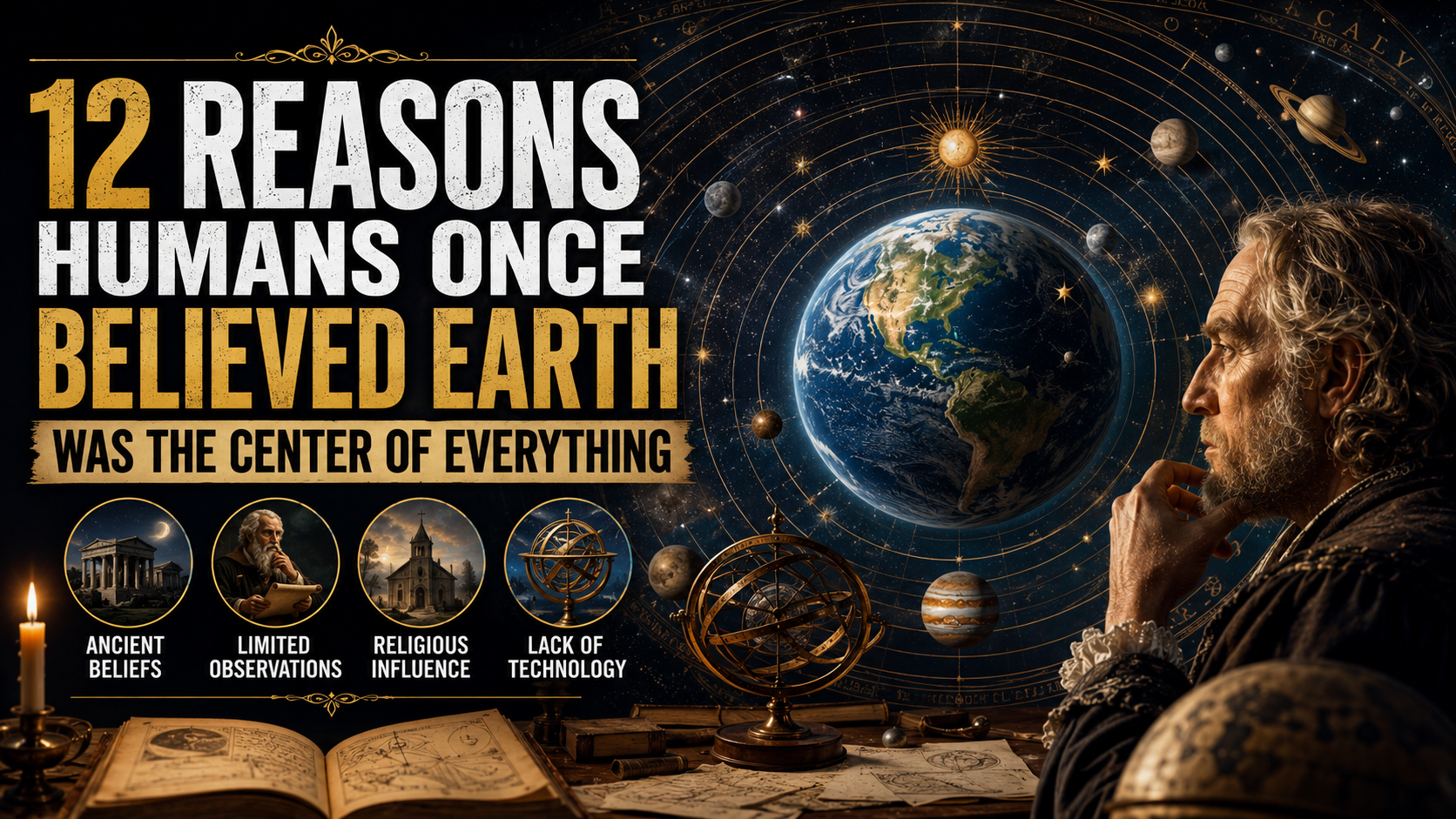
For most of human history, people were convinced that Earth sat at the very center of the universe. This idea, known as the geocentric model, shaped science, religion, and philosophy for thousands of years. It wasn’t just a casual belief—it was a deeply rooted worldview supported by everyday observation and influential thinkers of the time.
Today, we know that Earth is just one planet orbiting the Sun in a vast universe. But understanding why ancient civilizations believed otherwise helps us appreciate how human knowledge evolves. It also highlights how limited perspective, combined with the tools available at the time, can shape our understanding of reality.
Here are 12 key reasons humans once believed Earth was the center of everything.
1. The Sky Appears to Move Around Earth
One of the strongest reasons for the geocentric belief was simple observation.
When people looked at the night sky, it clearly appeared that the Sun, Moon, stars, and planets moved around Earth. From sunrise to sunset, everything seemed to revolve around the observer’s position on the ground.
Without scientific instruments, it was natural to assume that Earth was stationary and everything else was in motion.
2. Lack of Perception of Earth’s Motion
Humans do not feel Earth moving. Even though our planet rotates and orbits the Sun at incredible speeds, there is no obvious sensation of motion in daily life.
Because of this, ancient observers assumed Earth must be still.
Without understanding inertia or gravity, the idea of a moving Earth seemed impossible and even illogical.
3. Ancient Philosophers Supported the Idea
Influential thinkers like Aristotle and later Ptolemy developed detailed models of a universe centered around Earth.
These models were based on careful observation and mathematical reasoning available at the time.
Ptolemy’s geocentric system, which included complex circular motions called epicycles, was widely accepted for centuries because it could predict planetary movements with reasonable accuracy.
Authority played a major role in reinforcing the belief.
4. The Model Matched Everyday Experience
The geocentric model aligned with what people experienced in their daily lives.
Objects fall straight down, not sideways. The ground feels stable and unmoving. The sky appears to rotate overhead.
These everyday observations reinforced the idea that Earth was fixed at the center, while everything else revolved around it.
5. No Telescopes or Scientific Instruments
Before the invention of telescopes in the early 17th century, humans had no way to observe distant celestial bodies in detail.
The naked eye could not detect planetary motion beyond simple patterns in the sky.
Without better tools, there was no evidence strong enough to challenge the geocentric view.
Scientific understanding was limited by technological capability.
6. Religious and Cultural Beliefs Reinforced It
Many ancient cultures and religious traditions placed Earth—and humanity—at the center of creation.
This worldview made philosophical sense at the time, as humans naturally saw themselves as the most important beings in existence.
The idea that the universe revolved around Earth aligned with these cultural and spiritual beliefs, making it even harder to question.
7. The Stars Appear Fixed in a Sphere
To early observers, stars seemed to be attached to a giant rotating dome surrounding Earth.
This “celestial sphere” concept was widely accepted in ancient astronomy.
Because stars maintained fixed patterns relative to each other, it reinforced the idea of a structured system revolving around Earth.
The night sky looked orderly and predictable from this perspective.
8. Planetary Motion Was Difficult to Explain
Even though planets sometimes move in strange patterns—like retrograde motion where they appear to move backward in the sky—the geocentric model attempted to explain these behaviors using complex systems.
These explanations included epicycles, or small circular motions within larger orbits.
While complicated, this system worked well enough for predictions, which helped it remain widely accepted.
9. Lack of Understanding of Gravity
Before Isaac Newton’s work on gravity, there was no scientific explanation for how celestial bodies stayed in motion.
Without understanding gravitational forces, it was difficult to imagine Earth orbiting the Sun or the Moon orbiting Earth in a structured system.
The absence of this knowledge made the geocentric model seem more reasonable.
10. Human Perspective Creates a Natural Bias
Humans naturally interpret the universe from their own point of view.
Standing on Earth, everything appears to move around us. This creates a strong observational bias.
Without abstract reasoning or scientific modeling, it is easy to assume that what we see directly reflects how the universe actually works.
This cognitive limitation played a major role in shaping early astronomy.
11. The Geocentric Model Worked for a Long Time
One of the most important reasons the geocentric model persisted was that it worked reasonably well for practical purposes.
Astronomers could predict eclipses, planetary positions, and seasonal changes using existing models.
Even though the system was not entirely accurate, it was useful enough to remain in use for centuries.
Scientific ideas often persist when they provide functional results, even if they are not entirely correct.
12. Scientific Revolution Eventually Changed Everything
The shift away from the geocentric model began during the Scientific Revolution.
Astronomers like Nicolaus Copernicus proposed a heliocentric model, placing the Sun at the center of the solar system. Later, Galileo Galilei’s telescopic observations and Johannes Kepler’s laws of planetary motion provided strong evidence supporting this new view.
Isaac Newton’s theory of gravity finally explained why planets orbit the Sun.
This combination of evidence transformed humanity’s understanding of the universe and ended the long-held belief that Earth was the center of everything.
Why the Geocentric Model Mattered
Even though we now know it is incorrect, the geocentric model played a crucial role in the development of science.
It provided a framework for early astronomical study and encouraged centuries of observation, calculation, and refinement.
Without it, later breakthroughs might not have been possible.
Understanding why people once believed in it helps us see how scientific knowledge evolves over time.
Final Thoughts
The belief that Earth was the center of the universe was not a simple mistake—it was a logical conclusion based on the information available at the time.
It reflected human observation, cultural beliefs, and limited scientific tools.
As knowledge expanded, so did our understanding of the cosmos.
Today, we know Earth is just one of many planets orbiting a star in a vast and expanding universe. But the story of the geocentric model remains an important reminder that human understanding is always evolving—and that even our most confident beliefs can change with new evidence.







