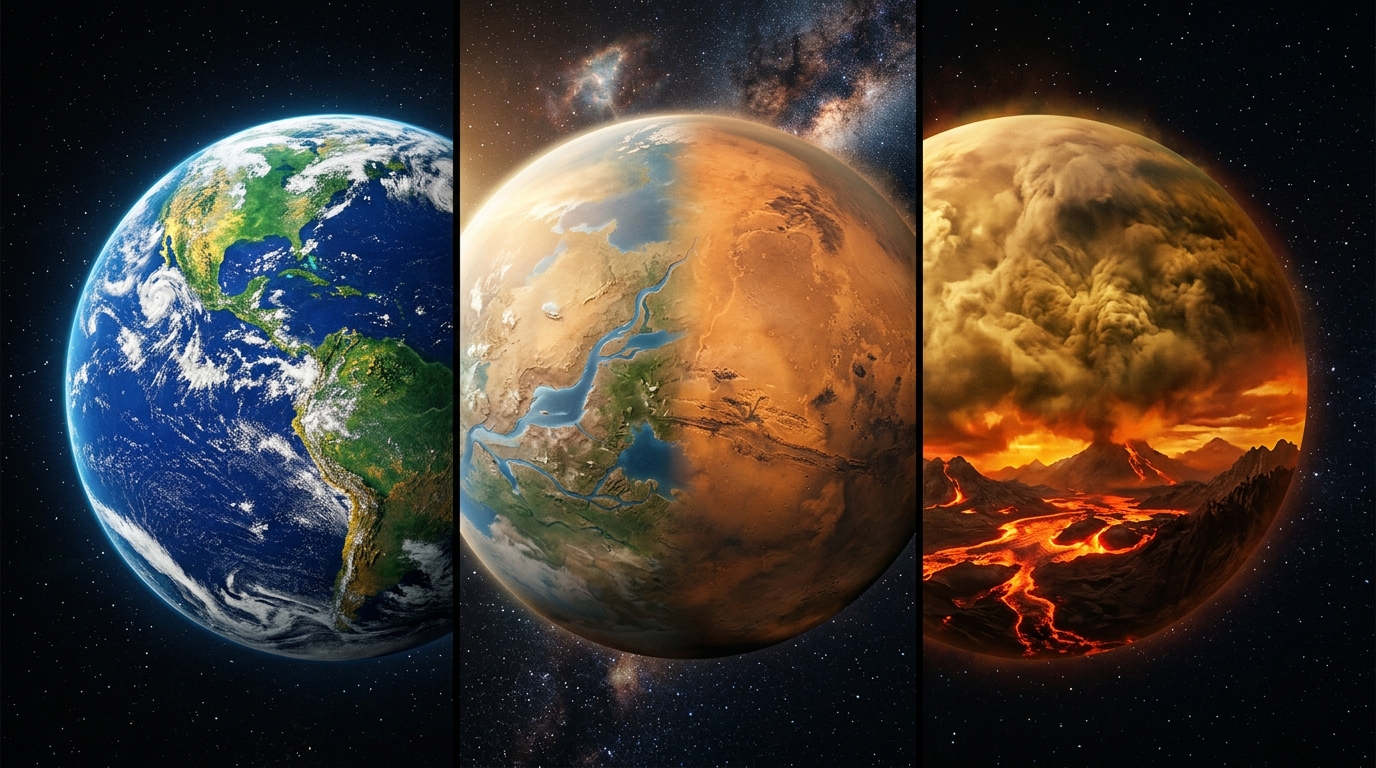
Today, Earth, Mars, and Venus seem like three very different worlds. Earth is teeming with life, Mars is a cold desert with a thin atmosphere, and Venus is a scorching planet shrouded in thick clouds. Yet billions of years ago, these neighboring worlds may have been far more alike than they are today.
Scientists believe that all three planets formed from the same swirling disk of gas and dust surrounding the young Sun about 4.6 billion years ago. Over time, however, each world followed a dramatically different path. By studying these planetary histories, researchers are gaining valuable clues about climate change, planetary evolution, and the conditions that make life possible.
Here are 10 fascinating facts about how Earth, Mars, and Venus changed over billions of years.
1. All Three Planets Began With Similar Building Blocks
Earth, Mars, and Venus formed from the same protoplanetary disk that surrounded the newborn Sun.
This means they were created from many of the same materials, including rock, metal, and volatile compounds. Early in their histories, the three planets likely shared certain similarities, including intense volcanic activity and frequent impacts from asteroids and comets.
Their common origin makes their vastly different outcomes even more remarkable.
2. Venus May Once Have Had Oceans
Although Venus is now the hottest planet in the solar system, some studies suggest it may once have possessed significant amounts of water.
Scientists believe that early Venus could have had temperatures cool enough to support liquid water on its surface. If true, the planet may have resembled a very different world billions of years ago.
Understanding what happened to Venus’s water remains one of planetary science’s most intriguing mysteries.
3. Mars Was Once Much Wetter Than It Is Today
Evidence collected by orbiters, landers, and rovers indicates that ancient Mars had rivers, lakes, and possibly even shallow seas.
Dry river channels, mineral deposits, and sedimentary rock formations suggest that liquid water once flowed across large portions of the Martian surface. Billions of years ago, Mars may have been significantly warmer and wetter than it is today.
These discoveries continue to fuel interest in whether ancient Mars could have supported microbial life.
4. Earth Maintained Conditions Favorable for Life
Among the three planets, Earth followed the most hospitable path.
While its neighboring worlds underwent dramatic environmental changes, Earth retained liquid water, a protective atmosphere, and a climate that allowed life to emerge and evolve. Geological processes, including plate tectonics and the carbon cycle, helped regulate long-term environmental conditions.
These factors played a crucial role in making Earth the only known planet that supports life.
5. Venus Experienced a Runaway Greenhouse Effect
One of the most dramatic transformations in the solar system occurred on Venus.
As temperatures increased, more water evaporated into the atmosphere. Because water vapor is a powerful greenhouse gas, this process trapped additional heat, causing even more warming. Over time, the cycle intensified, leading to a runaway greenhouse effect.
Today, Venus has surface temperatures hot enough to melt lead, making it one of the most extreme environments in the solar system.
6. Mars Lost Much of Its Atmosphere
Ancient Mars likely possessed a much thicker atmosphere than it does today.
Over billions of years, solar wind gradually stripped away large portions of the Martian atmosphere. Unlike Earth, Mars lacks a strong global magnetic field capable of providing substantial protection from these charged particles.
As the atmosphere thinned, the planet became colder and less capable of sustaining liquid water on its surface.
7. Earth’s Magnetic Field Helped Protect Its Environment
Earth’s magnetic field acts as a protective shield against much of the solar wind.
This magnetic protection helps preserve the atmosphere and limits the loss of important gases into space. Scientists believe Earth’s long-lasting magnetic field has been a significant factor in maintaining stable conditions suitable for life.
Without it, Earth’s history might have unfolded very differently.
8. Volcanic Activity Shaped All Three Worlds
Volcanoes played an important role in the evolution of Earth, Mars, and Venus.
Volcanic eruptions helped release gases that contributed to planetary atmospheres and influenced climate conditions. Massive volcanic features can still be seen on both Mars and Venus.
For example, Mars is home to Olympus Mons, a giant volcano that towers far above the surrounding landscape.
9. Planetary Climate Can Change Dramatically Over Time
The histories of Earth, Mars, and Venus demonstrate that planetary climates are not fixed.
Over billions of years, atmospheric composition, solar radiation, geological activity, and other factors can profoundly alter environmental conditions. Small differences early in a planet’s history may eventually lead to dramatically different outcomes.
These lessons are helping scientists better understand climate processes both within and beyond our solar system.
10. Studying These Planets Helps Scientists Search for Life Elsewhere
Earth, Mars, and Venus provide natural laboratories for understanding planetary evolution.
By comparing how these neighboring worlds changed over time, researchers can identify the factors that influence habitability. These insights are especially valuable as astronomers discover thousands of planets orbiting distant stars.
Understanding why Earth remained habitable while Mars and Venus evolved differently may help scientists identify other worlds capable of supporting life.
Why Planetary Histories Matter
The stories of Earth, Mars, and Venus are about more than just three planets. They reveal how complex interactions between geology, atmosphere, water, magnetic fields, and solar energy can shape the fate of entire worlds.
These planetary histories also offer important context for understanding our own planet. By studying how conditions changed elsewhere in the solar system, scientists gain a better appreciation of the factors that have allowed life to flourish on Earth for billions of years.
At the same time, these worlds provide valuable clues in the search for habitable environments beyond our solar system.
Conclusion
Earth, Mars, and Venus began their journeys as neighboring planets formed from the same cosmic materials. Yet over billions of years, they evolved into dramatically different worlds. Earth became a thriving home for life, Mars transformed into a cold and arid landscape, and Venus developed into an intensely hot world dominated by a powerful greenhouse effect.
Their histories demonstrate how planetary environments can change in extraordinary ways over immense spans of time. By continuing to study these neighboring worlds, scientists are uncovering valuable insights into climate evolution, planetary habitability, and the processes that shape planets throughout the universe.
The more we learn about Earth, Mars, and Venus, the better we understand not only our solar system’s past but also the possibilities that may exist among countless worlds beyond it.