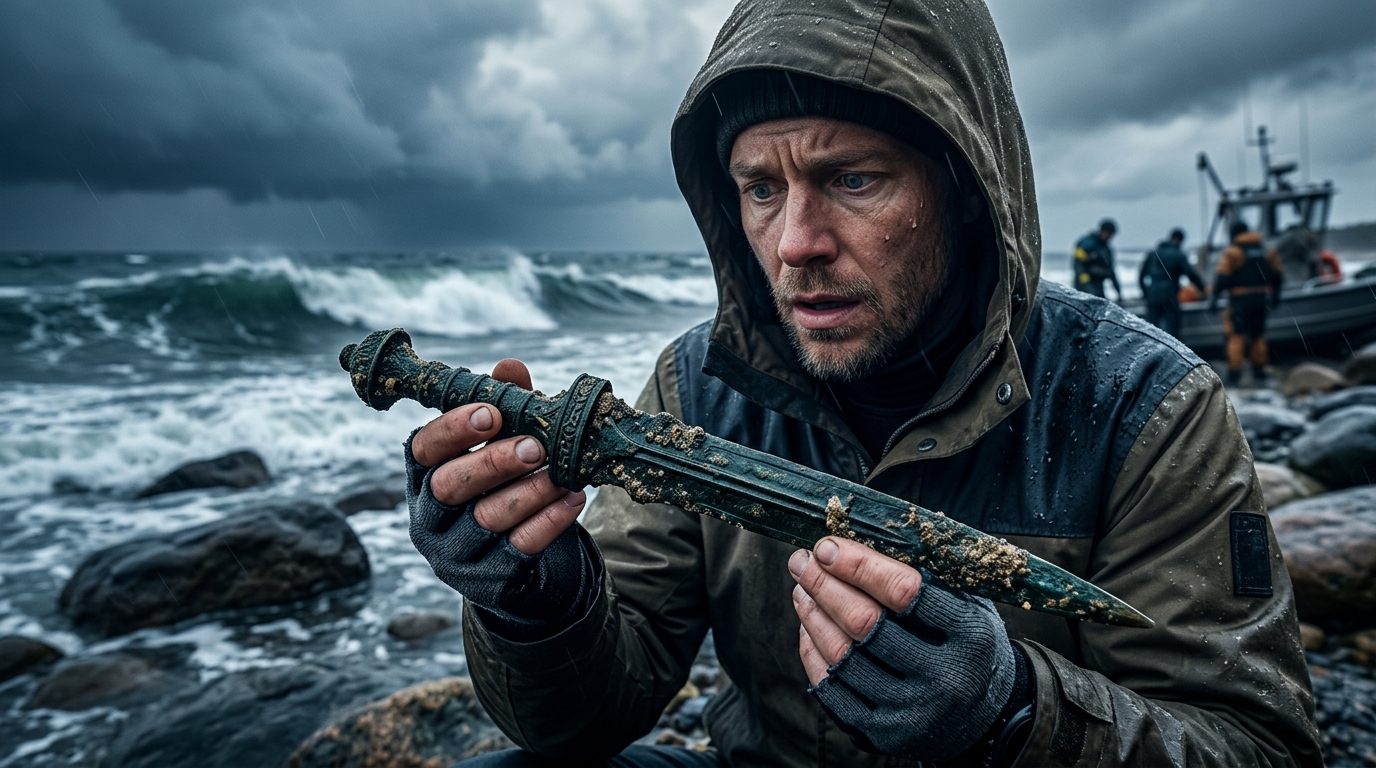
When powerful storms hit the Baltic region, they don’t just reshape coastlines—they sometimes reveal secrets buried for thousands of years. One of the most remarkable discoveries in recent years was a 2,800-year-old bronze dagger uncovered after intense coastal erosion exposed ancient layers of earth.
This artifact immediately captured the attention of archaeologists and history enthusiasts. Not only is it incredibly old, but its condition, craftsmanship, and location offer rare insights into early European societies during the Bronze Age.
Objects like this dagger are more than just ancient tools—they are time capsules. They help researchers understand how people lived, fought, traded, and expressed identity thousands of years ago.
Here are nine surprising facts about the 2,800-year-old bronze dagger found after Baltic storms.
1. The Dagger Dates Back to the Late Bronze Age
Archaeological analysis places the dagger at roughly 2,800 years old, originating from the Late Bronze Age.
This period was marked by significant cultural development across Europe, including advances in metalworking, trade networks, and social organization.
The dagger is a direct link to a time when bronze was one of the most valuable materials available to human societies.
2. Coastal Storms Played a Key Role in Its Discovery
The dagger was uncovered not through excavation but by natural forces.
Strong storms along the Baltic coast eroded layers of soil and sand, revealing the artifact beneath.
This type of discovery is not uncommon in coastal archaeology, where shifting landscapes frequently expose buried historical objects.
Nature, in this case, acted as an unintentional archaeologist.
3. Bronze Was a Highly Valuable Material in Ancient Times
In the era when this dagger was created, bronze was considered a premium material.
It was made by combining copper and tin, both of which were not always easily accessible.
Objects made from bronze often indicated status, wealth, or ceremonial importance.
This suggests that the dagger may have held significance beyond simple utility.
4. The Design Reflects Advanced Metalworking Skills
Despite its age, the dagger shows evidence of skilled craftsmanship.
Bronze Age metalworkers used techniques such as casting, hammering, and polishing to create functional yet decorative weapons.
The quality of the blade indicates that ancient artisans had a sophisticated understanding of metallurgy.
This challenges outdated assumptions about early technological limitations.
5. It May Have Been Used for Ceremonial Purposes
Not all Bronze Age daggers were designed for combat.
Some were symbolic objects used in rituals, burials, or as status markers.
The careful design of this dagger suggests it may have had ceremonial or symbolic importance rather than being purely functional.
Such objects often reflected social identity and spiritual beliefs.
6. The Baltic Region Is Rich in Ancient Archaeological Finds
The area surrounding the Baltic Sea has long been a hotspot for archaeological discoveries.
Its combination of wetlands, forests, and coastal environments helps preserve organic and metal artifacts.
Many ancient settlements once existed in this region, leaving behind tools, weapons, and burial sites.
The discovery of the dagger adds another layer to this rich historical landscape.
7. Storm Erosion Is Increasingly Revealing Hidden History
While storms can be destructive, they also expose previously hidden archaeological sites.
Coastal erosion caused by rising sea levels and extreme weather is becoming more common in many parts of the world.
As a result, archaeologists are increasingly racing against time to document and preserve newly exposed artifacts.
The dagger is an example of how climate and archaeology can unexpectedly intersect.
8. Bronze Age Societies Were More Connected Than Once Believed
Finds like this dagger help researchers understand trade and cultural exchange during the Bronze Age.
Materials such as copper and tin often traveled long distances through trade networks.
The style and composition of artifacts can reveal connections between distant regions of Europe and beyond.
This suggests that ancient societies were more interconnected than previously assumed.
9. Every Artifact Adds a Piece to Human History
Perhaps the most important fact is that discoveries like this help complete the puzzle of human history.
Even a single object can provide insights into technology, culture, and daily life from thousands of years ago.
Each artifact adds depth to our understanding of how humans lived and evolved.
The bronze dagger is not just a relic—it is a message from the past.
Why This Discovery Matters Today
The discovery of the 2,800-year-old dagger is significant not only for archaeology but also for public understanding of history.
It highlights how much of the past remains hidden beneath the surface, waiting to be uncovered by natural forces or careful excavation.
It also shows how fragile historical preservation can be, especially in coastal regions affected by climate change.
As landscapes continue to shift, more discoveries like this are likely to emerge.
Final Thoughts
The bronze dagger uncovered after Baltic storms is a powerful reminder of how history can resurface in unexpected ways.
From its age and craftsmanship to the conditions that revealed it, every aspect of the artifact tells a story about ancient life and modern discovery.
It stands as both a relic of the past and a symbol of how nature continues to shape our understanding of human history.
In the end, even a small object buried for nearly three millennia can offer extraordinary insight into the world that came before us.