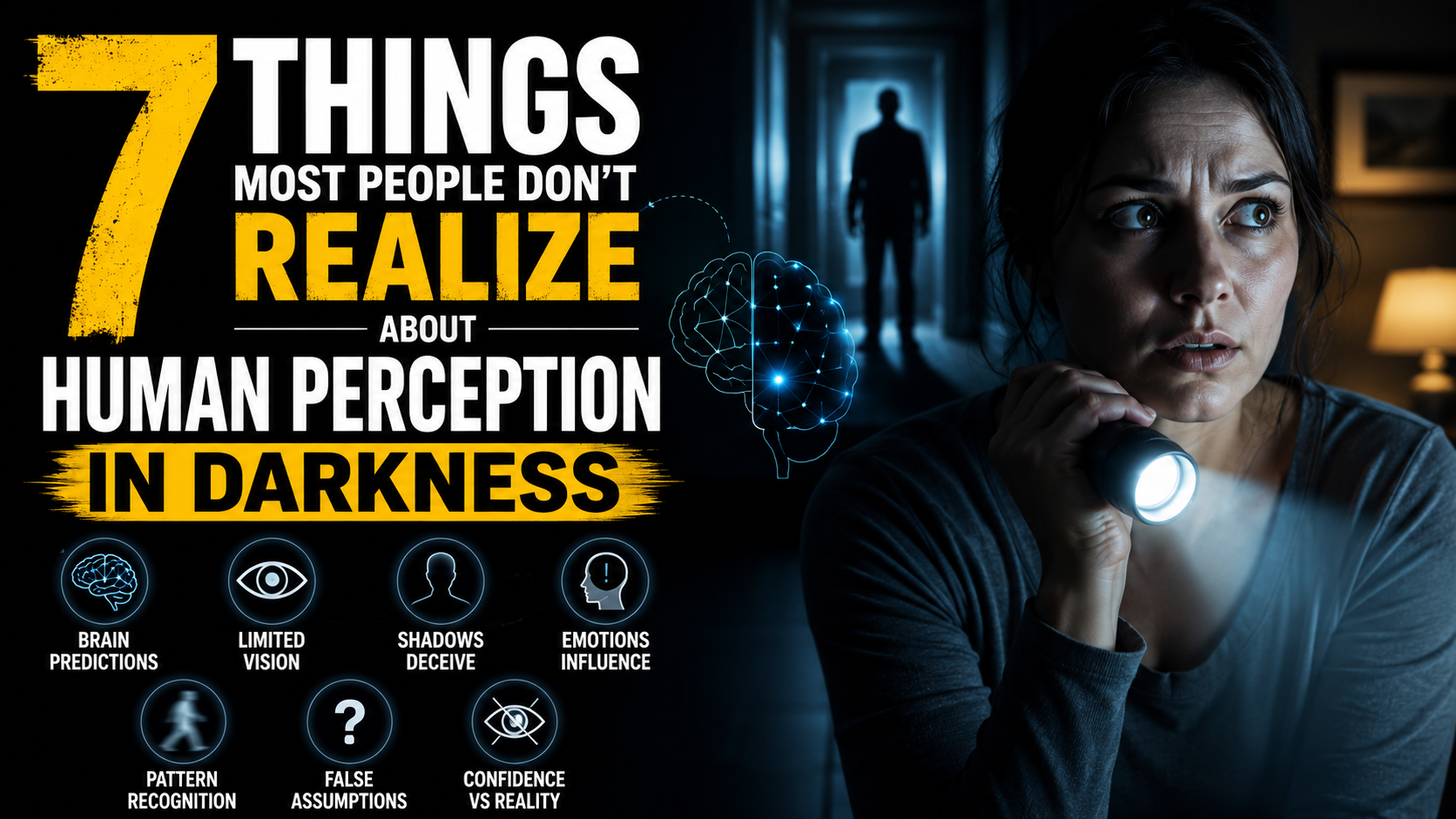
Imagine walking through a familiar room during a power outage. Suddenly, ordinary objects seem strange, shadows appear to move, and your confidence in what you’re seeing begins to fade. Even though the room hasn’t changed, your experience of it certainly has.
This happens because human perception isn’t simply about seeing what’s in front of us. Our brains constantly interpret, predict, and fill in missing information based on past experiences and expectations. In well-lit environments, this process usually works remarkably well. But when darkness reduces the amount of visual information available, the brain must work much harder—and that’s when some surprising things can happen.
Stories of people mistaking one object for another, especially in dim lighting, may sound unbelievable at first. Yet psychology and neuroscience suggest that such mistakes are more common than most people realize. Darkness changes how the brain processes information, increasing the chances of misinterpretation, false assumptions, and perceptual errors.
Here are seven fascinating things most people don’t realize about how human perception works in darkness.
1. Your Brain Sees More Than Your Eyes Do
Many people assume that vision happens entirely through the eyes.
In reality, your eyes only collect information. The brain is responsible for turning that information into a meaningful picture of the world.
Every second, your brain receives enormous amounts of sensory input and must rapidly interpret what it all means. To do this efficiently, it relies heavily on previous experiences, memory, and expectations.
When lighting conditions are good, the brain has plenty of visual data to work with. In darkness, however, much of that information disappears.
Instead of receiving a complete image, the brain often receives fragments. To compensate, it begins filling in the gaps.
Most of the time this process helps us navigate uncertain environments. Occasionally, however, it leads to surprisingly inaccurate conclusions.
2. Darkness Makes the Brain Rely on Assumptions
When visual information becomes limited, the brain doesn’t stop trying to identify what it’s seeing.
Instead, it shifts toward prediction.
Psychologists refer to this as top-down processing. Rather than building perception entirely from incoming sensory information, the brain uses prior knowledge and expectations to make educated guesses.
For example, if you expect to see your pet sitting in a corner, your brain may interpret a vague shape as your pet—even when the object is actually something entirely different.
This tendency explains why people occasionally mistake harmless objects for animals, people, or threats in low-light situations.
The brain prefers having an answer—even an imperfect one—rather than remaining uncertain.
3. Shadows Can Dramatically Alter Perception
Shadows are among the most powerful sources of visual confusion.
Under bright conditions, shadows provide useful information about depth and distance. In darkness, however, they can distort the appearance of familiar objects.
A chair may resemble a crouching figure.
A coat hanging on a door may seem like a person standing silently in the room.
A pile of clothes can suddenly appear animal-like.
This occurs because the brain uses outlines and shapes to identify objects. When shadows obscure important details, the remaining visual clues may resemble something completely different.
The result is a perception that feels real—even when it is inaccurate.
4. Fear and Emotion Can Influence What You See
Perception is not purely visual.
Emotions play a significant role in how the brain interprets sensory information.
When people feel anxious, nervous, or uncertain, the brain becomes more alert to potential threats. Evolutionarily, this response helped humans survive dangerous environments.
Thousands of years ago, mistaking a predator for a harmless object could have had serious consequences. As a result, the brain developed a tendency to err on the side of caution.
In modern life, this means that unfamiliar sounds, shadows, or movements in darkness may appear more threatening than they actually are.
Research suggests that emotional states can directly influence perception, increasing the likelihood of false alarms when information is incomplete.
5. Peripheral Vision Behaves Differently in Low Light
Most people don’t realize that different parts of the eye perform different functions.
The center of your vision is responsible for detailed, color-rich information. This area works best in bright conditions.
In contrast, peripheral vision relies more heavily on cells that are sensitive to low levels of light.
These cells help us detect movement and navigate darker environments, but they provide less detail.
As a result:
- Objects may appear blurry
- Colors become less accurate
- Movement may seem exaggerated
- Shapes become harder to identify
This explains why something seen out of the corner of your eye often appears mysterious until you look directly at it.
In darkness, the limitations of peripheral vision become even more noticeable.
6. The Brain Constantly Searches for Patterns
Humans are natural pattern-recognition machines.
Throughout evolution, recognizing meaningful patterns quickly provided a survival advantage.
This ability helps us identify faces, read emotions, recognize animals, and navigate complex environments.
However, the brain sometimes becomes too eager to find patterns.
Psychologists call this phenomenon pareidolia.
It’s the reason people sometimes see:
- Faces in clouds
- Shapes in rock formations
- Figures in shadows
- Animals in abstract patterns
Darkness creates ideal conditions for pareidolia because visual information is incomplete.
The brain examines vague shapes and attempts to transform them into something familiar.
Often, the resulting perception feels completely convincing despite being incorrect.
7. Confidence Doesn’t Always Mean Accuracy
One of the most surprising aspects of perception is that confidence and accuracy are not always connected.
People often assume that if they are certain about what they saw, their perception must be correct.
Psychological research suggests otherwise.
The brain constructs a coherent narrative based on available information. Once this interpretation forms, it can feel absolutely real.
Even when evidence later proves the perception was mistaken, individuals may remain convinced they accurately observed the event.
This phenomenon explains why eyewitness testimony, visual memories, and personal observations can sometimes be less reliable than people expect.
In darkness, where information is already limited, the gap between confidence and accuracy can become even larger.
Why Human Perception Is So Remarkable
At first glance, these limitations might seem like flaws.
In reality, they highlight how sophisticated the human brain truly is.
Perception is not a passive recording of reality. Instead, it is an active process involving prediction, interpretation, memory, emotion, and sensory input working together simultaneously.
The brain’s ability to construct a useful picture of the world—even when information is incomplete—is one of its greatest achievements.
Most of the time, this system performs extraordinarily well.
Only occasionally do its shortcuts become visible through unusual mistakes or surprising misunderstandings.
The Evolutionary Advantage of “Getting It Wrong”
Interestingly, many perceptual errors may have evolved because they were safer than the alternative.
Imagine two prehistoric humans hearing movement in tall grass.
One assumes it’s the wind.
The other assumes it might be a predator.
If the movement actually comes from a dangerous animal, the cautious individual has a greater chance of survival.
Over thousands of generations, natural selection favored brains that sometimes overestimated potential threats.
This evolutionary bias still influences perception today.
In uncertain situations—especially in darkness—the brain often prioritizes safety over precision.
While this occasionally produces false alarms, it may also explain why humans survived in environments filled with genuine dangers.
Modern Examples of Perception in Darkness
Many everyday experiences demonstrate these principles.
People frequently report:
- Seeing movement that wasn’t there
- Mistaking objects for people
- Misjudging distances
- Interpreting sounds incorrectly
- Feeling watched when alone
These experiences are usually not signs of poor vision or unusual thinking.
Instead, they reflect the brain doing exactly what it evolved to do: making the best possible prediction based on incomplete information.
Understanding this can help explain why strange experiences often feel so convincing in the moment.
What Science Continues to Discover
Researchers continue studying how perception works under conditions of uncertainty.
Advances in neuroscience, brain imaging, and cognitive psychology are revealing increasingly detailed insights into how the brain constructs reality.
Scientists now understand that perception involves a constant conversation between incoming sensory information and the brain’s internal predictions.
This predictive system allows humans to navigate complex environments efficiently, but it also creates opportunities for mistakes when information becomes scarce.
Darkness provides one of the clearest windows into this fascinating process.
Final Thoughts
Human perception is far more complex than simply opening our eyes and observing the world. Every moment, the brain interprets sensory information, fills in gaps, predicts outcomes, and constructs a version of reality that helps us function effectively.
In darkness, this process becomes even more apparent. Reduced visual information forces the brain to rely more heavily on memory, expectations, emotions, and pattern recognition. While these mechanisms often help us navigate uncertain situations, they can also produce surprising misinterpretations.
Understanding how perception works doesn’t make these experiences less fascinating. If anything, it highlights the extraordinary capabilities of the human brain. The next time a shadow looks unusual or a familiar object seems strangely different in the dark, remember that your brain is doing what it has always done—working tirelessly to make sense of an incomplete picture of the world.







