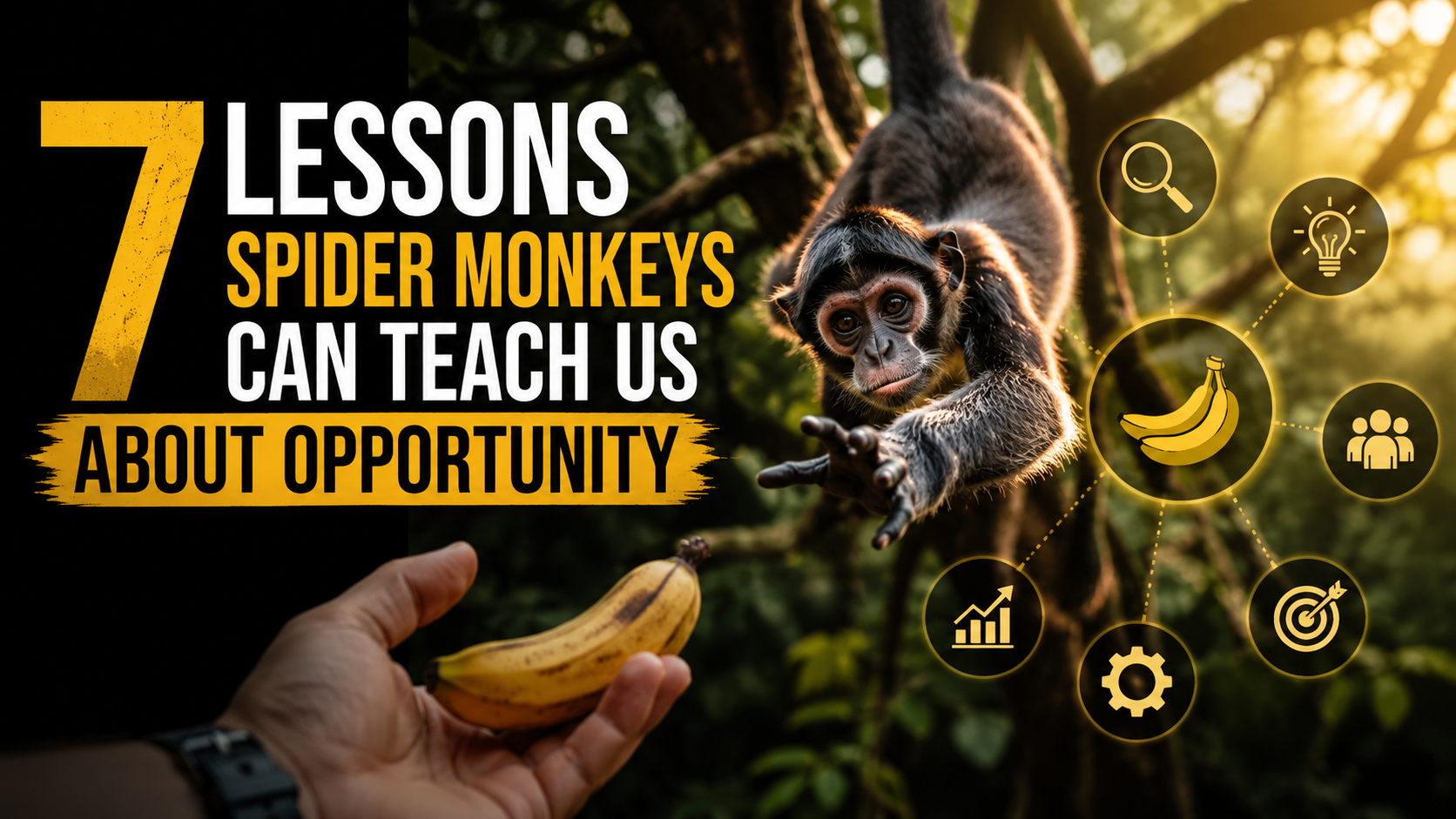
Imagine sitting at a tropical resort, enjoying a relaxing breakfast, when a group of spider monkeys suddenly appears and makes a beeline for the buffet. Within moments, bananas vanish, guests stare in amazement, and the monkeys disappear almost as quickly as they arrived.
While the scene might sound like something from a comedy movie, it highlights an interesting truth about nature: some animals are exceptionally good at recognizing opportunities and acting on them.
Spider monkeys, known for their intelligence, agility, and problem-solving abilities, have survived for thousands of years by paying close attention to their surroundings. They constantly scan their environment for food, safety, and advantages that improve their chances of survival.
As humans, we often think of opportunity as something tied to careers, finances, or personal success. Yet many of the principles that help animals thrive are surprisingly relevant to our own lives.
The next time you hear a story about a clever monkey spotting an easy meal, consider that there may be valuable lessons hidden beneath the entertainment. Here are seven powerful lessons spider monkeys can teach us about recognizing and seizing opportunities.
1. Opportunity Often Appears to Those Who Pay Attention
Spider monkeys don’t wander through the forest randomly hoping food will fall into their laps. They are constantly observing.
They notice fruit ripening in distant trees. They track changes in their environment. They remember where food sources can be found and adjust their movements accordingly.
Humans frequently miss opportunities for one simple reason: we aren’t paying attention.
A new career possibility, a business idea, a valuable connection, or a chance to learn something new may be sitting right in front of us. However, distractions, routines, and assumptions can prevent us from seeing what’s available.
Successful people often share one important trait—they notice things others overlook.
Paying attention doesn’t require special talent. It simply means becoming more aware of your surroundings, listening carefully, and staying curious about possibilities.
Sometimes the biggest opportunities are visible only to those who are looking.
2. Curiosity Can Open Unexpected Doors
Spider monkeys are naturally curious animals. Their willingness to explore helps them discover food sources and navigate changing environments.
Curiosity serves a similar purpose in human life.
Many opportunities begin with a simple question:
“What happens if I try this?”
“What can I learn here?”
“Is there a better way?”
Curious people tend to explore new ideas, develop new skills, and meet new people. As a result, they often encounter opportunities that would never appear to someone who stays within familiar boundaries.
Curiosity encourages growth because it pushes us beyond what we already know.
Instead of fearing uncertainty, curious individuals treat it as an invitation to learn.
In many cases, success starts not with expertise but with a willingness to explore.
3. Acting Quickly Matters When the Moment Is Right
When spider monkeys spot an available food source, they rarely hesitate.
Waiting too long could mean losing the opportunity to another animal.
Humans sometimes face the opposite problem. We spend so much time analyzing possibilities that we never take action.
Of course, thoughtful decisions are important. Not every opportunity deserves an immediate response. But there are moments when waiting becomes a greater risk than moving forward.
A promising job opening may close.
A valuable partnership may disappear.
A creative idea may lose momentum.
People who consistently achieve their goals understand the difference between preparation and procrastination.
When the timing is right, they act.
The lesson isn’t to be reckless. It’s to recognize that opportunities often have an expiration date.
4. Adaptability Creates New Possibilities
One reason spider monkeys have survived in changing environments is their ability to adapt.
When conditions shift, they adjust their behavior. They explore new food sources, modify travel routes, and find alternative solutions to challenges.
Life often rewards the same flexibility in people.
Unexpected setbacks are inevitable. Industries change. Technology evolves. Personal circumstances shift.
Those who resist change often struggle to move forward.
Meanwhile, adaptable individuals view change differently. Instead of asking, “Why is this happening?” they ask, “How can I respond?”
This mindset creates opportunities where others see obstacles.
Adaptability doesn’t eliminate problems, but it increases the likelihood of finding solutions.
The ability to pivot may be one of the most valuable skills anyone can develop.
5. Confidence Grows Through Experience
Spider monkeys don’t become skilled climbers overnight.
Their abilities develop through repeated practice, observation, and exploration.
Humans often wait for confidence before taking action. In reality, confidence usually arrives afterward.
Many people believe successful individuals are naturally fearless. More often, they simply gained confidence by taking small steps repeatedly.
The entrepreneur launches a modest project.
The speaker gives a short presentation.
The athlete practices daily.
The writer publishes a first article.
Each experience builds competence, and competence builds confidence.
If you’re waiting to feel completely ready before pursuing an opportunity, you may be waiting forever.
Progress often begins with action, not certainty.
6. Working Together Can Multiply Success
Spider monkeys are social animals that spend much of their lives interacting with others.
Although they are highly independent, they benefit from living within groups that provide support, communication, and protection.
Humans are no different.
Many of the greatest opportunities emerge through relationships.
A recommendation leads to a new job.
A conversation sparks a business idea.
A mentor provides guidance.
A friend introduces an important connection.
Success is often portrayed as a solitary achievement, but reality tells a different story.
Behind nearly every accomplishment is a network of people who contributed knowledge, encouragement, or assistance along the way.
Building strong relationships expands access to opportunities that might otherwise remain hidden.
The more meaningful connections you cultivate, the more possibilities tend to emerge.
7. Resourcefulness Can Be More Valuable Than Resources
The famous buffet-raiding monkeys offer one final lesson: resourcefulness matters.
Spider monkeys don’t possess advanced technology, financial assets, or carefully planned strategies. Yet they frequently find creative ways to obtain what they need.
Humans sometimes assume that success depends primarily on having more money, more time, or more advantages.
While resources certainly help, resourcefulness often matters even more.
Resourceful people focus on what they can do with what they already have.
They find solutions instead of dwelling on limitations.
They improvise when circumstances change.
They seek alternatives when obstacles appear.
History is filled with examples of individuals who achieved remarkable things despite limited resources.
Their advantage wasn’t abundance—it was creativity.
The ability to think differently often creates opportunities that others never notice.
Why Opportunity Is Often a Matter of Perspective
One of the most fascinating aspects of opportunity is that two people can encounter the exact same situation and see completely different possibilities.
One person notices obstacles.
Another notices potential.
This difference often comes down to mindset.
Spider monkeys don’t spend time wondering whether a fruit tree is too difficult to reach. They focus on finding a path.
Similarly, people who consistently discover opportunities tend to focus on possibilities rather than limitations.
They aren’t blind to challenges. They simply refuse to let challenges dominate their thinking.
Perspective shapes what we notice, how we respond, and ultimately what opportunities become available.
The Hidden Connection Between Curiosity and Success
Researchers have long observed a strong connection between curiosity and achievement.
Curious individuals tend to gather more information, ask better questions, and remain open to new experiences.
These habits naturally increase the likelihood of discovering opportunities.
Spider monkeys demonstrate this principle every day in the wild. Their survival depends on exploration and observation.
For humans, curiosity offers similar benefits.
The more interested you become in learning, growing, and exploring, the more likely you are to encounter valuable opportunities.
Curiosity keeps doors open.
Complacency closes them.
Final Thoughts
A group of spider monkeys raiding a resort buffet may seem like a humorous vacation story, but it also offers a fascinating reminder about how opportunity works.
These intelligent animals succeed because they stay alert, remain curious, adapt quickly, act when necessary, and make the most of available resources.
Those same principles can help people navigate life more effectively.
Opportunities rarely arrive with flashing lights and obvious announcements. More often, they appear quietly—in conversations, ideas, challenges, relationships, and unexpected moments.
The key is learning to recognize them.
Like spider monkeys scanning their environment for possibilities, we can improve our chances of success by staying curious, adaptable, resourceful, and willing to act.
Sometimes the difference between missing an opportunity and making the most of it comes down to one simple choice: paying attention when it appears.







