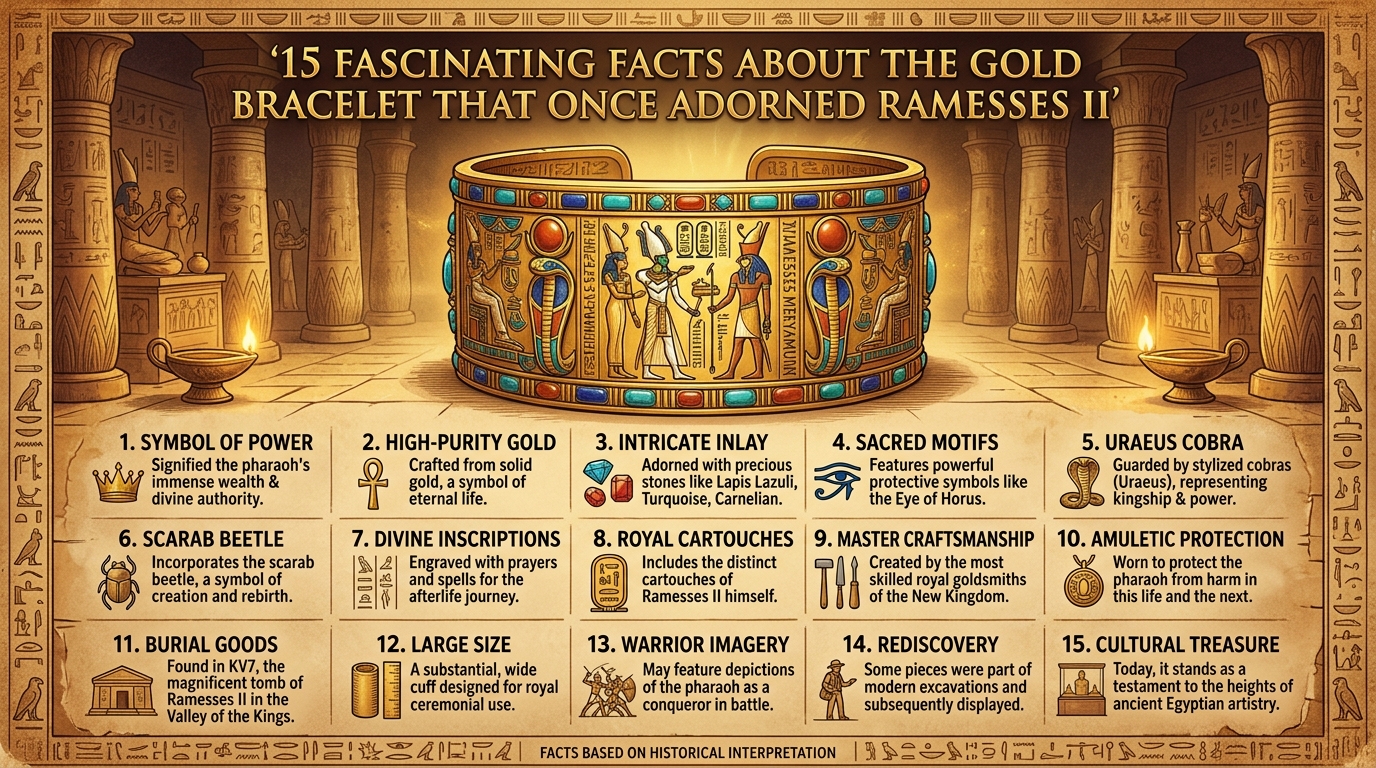
Ancient Egypt has left behind countless treasures, but few artifacts capture the imagination quite like royal jewelry. Among these remarkable objects is a gold bracelet believed to have once adorned Pharaoh Ramesses II, one of Egypt’s most celebrated rulers. More than just an ornament, the bracelet serves as a window into the wealth, artistry, and symbolism of one of history’s greatest civilizations.
Ramesses II, often called “Ramesses the Great,” ruled Egypt for more than six decades and oversaw a period of immense prosperity and monumental construction. Every object associated with him carries enormous historical significance, and this exquisite bracelet is no exception.
Here are fifteen fascinating facts about the gold bracelet that once adorned Ramesses II.
1. It Is More Than 3,000 Years Old
The bracelet dates back to the reign of Ramesses II, who ruled during the 13th century BCE.
That means the piece of jewelry is more than three millennia old. It existed long before the rise of classical Greece, the Roman Empire, and many of the world’s modern nations.
Its survival across thousands of years is a remarkable achievement and offers a tangible connection to one of humanity’s oldest civilizations.
2. It Was Associated With One of Egypt’s Greatest Pharaohs
Ramesses II remains one of ancient Egypt’s most famous rulers.
He reigned for approximately 66 years, led military campaigns, commissioned enormous monuments, and became renowned for his ambitious building projects. His statues and temples can still be found throughout Egypt today.
An artifact connected to such an influential ruler naturally attracts tremendous historical interest.
3. Gold Held Special Meaning in Ancient Egypt
To the ancient Egyptians, gold was much more than a precious metal.
They believed it possessed divine qualities and associated it with eternity, power, and the gods. Because gold does not tarnish or rust, it symbolized permanence and immortality.
Royal jewelry crafted from gold therefore carried profound spiritual and political significance.
4. The Bracelet Demonstrates Extraordinary Craftsmanship
Ancient Egyptian goldsmiths were among the most skilled artisans of the ancient world.
Creating royal jewelry required exceptional technical ability and meticulous attention to detail. Craftsmen carefully shaped, polished, and decorated precious metals using sophisticated methods developed over generations.
The bracelet stands as evidence of the remarkable artistic achievements reached by Egyptian artisans more than 3,000 years ago.
5. Royal Jewelry Was a Symbol of Authority
Jewelry in ancient Egypt served purposes that extended far beyond decoration.
Pharaohs wore elaborate ornaments to communicate their status and divine role within society. Gold bracelets, necklaces, crowns, and rings acted as visible expressions of royal power.
An object like this bracelet would have immediately signaled its wearer’s exceptional position and authority.
6. It May Have Carried Religious Symbolism
Many pieces of Egyptian jewelry incorporated sacred symbols.
Designs often featured protective motifs, representations of deities, or symbols associated with life, kingship, and eternal existence. These decorative elements were believed to possess spiritual significance and provide divine protection.
The bracelet may therefore have functioned as both an ornament and a sacred object.
7. Ramesses II Was One of History’s Longest-Reigning Monarchs
Ramesses II’s lengthy reign helped solidify his legendary reputation.
Ruling for more than six decades allowed him to oversee extensive building programs and witness multiple generations of subjects grow up under his leadership.
The bracelet represents an era of remarkable stability and prosperity that left an enduring mark on Egyptian civilization.
8. Gold Had to Be Obtained Through Extensive Networks
Acquiring enough gold for royal treasures required enormous resources.
Ancient Egypt obtained gold from mines and trade networks that stretched across regions of northeastern Africa. The precious metal’s abundance contributed significantly to Egypt’s wealth and international prestige.
The bracelet reflects not only artistic skill but also the economic strength of the kingdom that produced it.
9. Jewelry Played an Important Role in Royal Identity
Egyptian rulers carefully used clothing and ornaments to project their image.
Every element of royal appearance, including bracelets and other jewelry, reinforced the pharaoh’s role as both king and divine intermediary.
Artifacts like this one help historians understand how ancient rulers deliberately crafted public identities that inspired loyalty and respect.
10. The Bracelet Connects Us to Daily Life in the Royal Court
Although it belonged to a famous pharaoh, the bracelet also provides insight into everyday life at court.
It reminds us that kings wore clothing, selected accessories, attended ceremonies, and surrounded themselves with objects that reflected their status.
Through such personal possessions, historical figures become more than names in textbooks—they become individuals who interacted with the material world in familiar ways.
11. It Highlights the Importance of Personal Adornment in Ancient Egypt
Ancient Egyptians deeply appreciated beauty and craftsmanship.
Jewelry was worn by people from many levels of society, though royal pieces were naturally the most elaborate. Ornaments reflected identity, social standing, and religious beliefs.
The bracelet demonstrates how profoundly aesthetics and symbolism were intertwined in Egyptian culture.
12. It Survived Thousands of Years Because Gold Is Remarkably Durable
Unlike many materials, gold does not corrode easily.
This resistance to deterioration explains why so many Egyptian gold objects have survived in extraordinary condition. While textiles, wood, and other materials often disappeared over time, gold artifacts endured.
The bracelet’s excellent preservation allows modern audiences to appreciate details that would otherwise have been lost forever.
13. It Reveals the Sophistication of Ancient Egyptian Society
The creation of luxury objects required specialized knowledge and organized systems.
Mining operations, trade networks, skilled craftsmen, and royal patronage all contributed to producing treasures like the bracelet.
Such artifacts remind us that ancient Egypt was an exceptionally advanced civilization capable of coordinating complex economic and artistic activities.
14. Artifacts Like This Continue to Inspire Modern Designers
Ancient Egyptian jewelry remains highly influential even today.
Designers around the world frequently draw inspiration from Egyptian motifs, geometric forms, and symbolic elements. The elegance and sophistication of royal ornaments continue to captivate artists and collectors alike.
The bracelet demonstrates the timeless appeal of Egyptian craftsmanship.
15. The Bracelet Makes History Feel Personal
Perhaps the most fascinating aspect of the gold bracelet is its ability to humanize one of history’s most famous rulers.
Massive temples and colossal statues portray Ramesses II as an almost legendary figure. A bracelet, however, is an intimate object. It suggests moments when the pharaoh prepared for ceremonies, participated in state events, or simply wore the jewelry as part of his royal attire.
Such personal items create a sense of closeness that monumental architecture cannot always provide.
Why the Bracelet Continues to Fascinate Historians
The gold bracelet associated with Ramesses II is far more than a beautiful piece of jewelry. It is a surviving witness to an extraordinary civilization that flourished more than 3,000 years ago. Through its craftsmanship, symbolism, and connection to one of Egypt’s greatest pharaohs, the bracelet reveals important details about royal life, religious beliefs, and artistic achievement.
Most importantly, it reminds us that history is not composed solely of wars, monuments, and dates. Sometimes, a single object worn by a ruler thousands of years ago can offer a remarkably intimate glimpse into the human side of the ancient world.
After more than three millennia, the gold bracelet of Ramesses II continues to shine—not only because of its precious metal but because of the stories and mysteries it still carries from the age of the pharaohs.