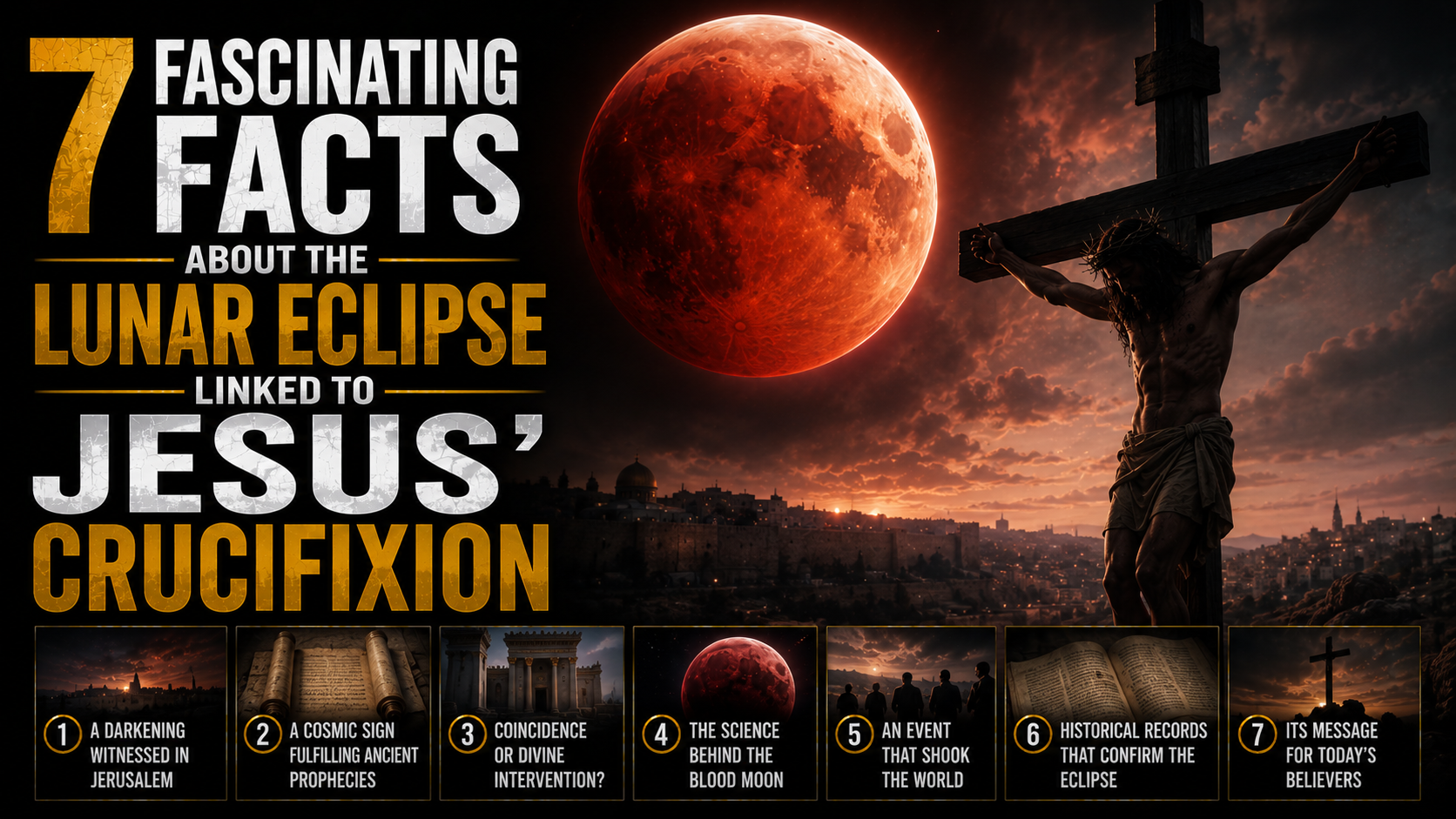
Throughout history, celestial events have often been interpreted as meaningful signs, especially when they appear to align with major historical or religious moments. One of the most discussed examples is the idea of a lunar eclipse occurring around the time of Jesus’ crucifixion.
While scholars continue to debate exact timelines and interpretations, references to unusual darkness and astronomical phenomena in ancient texts have inspired centuries of research, speculation, and cultural storytelling.
Whether viewed through a scientific or historical lens, the topic continues to attract attention because it sits at the intersection of astronomy, archaeology, and theology.
Here are seven fascinating facts about the lunar eclipse often associated with the crucifixion narrative.
1. Ancient Texts Describe Unusual Darkness
One of the most cited references comes from ancient writings that describe darkness covering the land during the crucifixion.
Some interpretations suggest this could correspond to a solar or lunar eclipse.
However, scholars note that Passover occurs during a full moon, making a solar eclipse unlikely at that time.
This has led to ongoing discussion about symbolic versus literal interpretations.
2. A Lunar Eclipse Was Astronomically Possible Around That Era
Astronomical calculations show that lunar eclipses did occur in the region during the early first century.
One frequently discussed date is April 3, 33 AD, when a partial lunar eclipse may have been visible.
This has led some researchers to connect the phenomenon with historical accounts.
However, there is no universal agreement on this identification.
3. Lunar Eclipses Often Appear Red in Color
During a lunar eclipse, Earth’s atmosphere filters sunlight before it reaches the Moon.
This scattering effect can cause the Moon to appear reddish or copper-colored.
This phenomenon is sometimes called a “blood moon.”
Such an appearance may have influenced ancient interpretations of the sky.
4. Ancient Cultures Interpreted Eclipses as Omens
In the ancient world, eclipses were often seen as powerful signs or warnings.
Many civilizations associated them with divine activity or major historical change.
This cultural context is important when interpreting historical references.
What we now understand scientifically was once viewed symbolically or spiritually.
5. Timing and Calendar Differences Complicate Interpretation
One major challenge in linking eclipses to historical events is the difference in calendar systems.
Ancient calendars did not always align with modern astronomical dating.
This makes it difficult to match specific events with precise celestial occurrences.
As a result, interpretations remain debated among historians and astronomers.
6. The “Darkness” May Not Refer to an Eclipse at All
Some scholars argue that the darkness described in ancient texts may not refer to an eclipse.
It could represent a symbolic event, a localized atmospheric phenomenon, or a theological metaphor.
Others suggest it may have been exaggerated or stylized in later writings.
This uncertainty keeps the discussion open to multiple interpretations.
7. The Topic Bridges Science, History, and Faith
One reason this subject remains so fascinating is its interdisciplinary nature.
It brings together astronomy, ancient history, and religious studies.
Each field offers a different perspective on the same question.
This intersection continues to inspire both academic research and public curiosity.
Why This Connection Continues to Capture Interest
The idea of a lunar eclipse linked to a pivotal moment in human history naturally draws attention.
It combines the precision of astronomy with the depth of historical narrative.
Even when conclusions are uncertain, the exploration itself is meaningful.
It encourages dialogue between science and tradition.
The Science of Lunar Eclipses Explained Simply
A lunar eclipse occurs when Earth passes directly between the Sun and the Moon.
This causes Earth’s shadow to fall on the Moon’s surface.
Depending on alignment, the eclipse can be partial or total.
Unlike solar eclipses, lunar eclipses are safe to observe with the naked eye.
Historical Interpretation Versus Scientific Evidence
One of the key challenges in studying this topic is balancing historical accounts with scientific data.
Ancient descriptions were often symbolic and not intended as precise astronomical records.
Modern science relies on exact calculations and orbital modeling.
When these two approaches meet, interpretations can vary widely.
The Role of Astronomy in Understanding Ancient Events
Modern astronomy allows researchers to reconstruct sky patterns from thousands of years ago.
By using orbital simulations, scientists can estimate when eclipses were visible in specific regions.
This helps provide context for historical narratives.
However, it does not always confirm direct connections to specific events.
Final Thoughts
The idea of a lunar eclipse linked to the crucifixion of Jesus remains one of history’s most intriguing and debated topics.
While scientific evidence can identify possible celestial events from that time period, historical interpretation remains complex and uncertain.
What makes the discussion compelling is not just the search for answers, but the way it connects science, history, and human belief.
In the end, this topic continues to remind us how closely people throughout history have looked to the skies for meaning, guidance, and understanding of extraordinary events.







