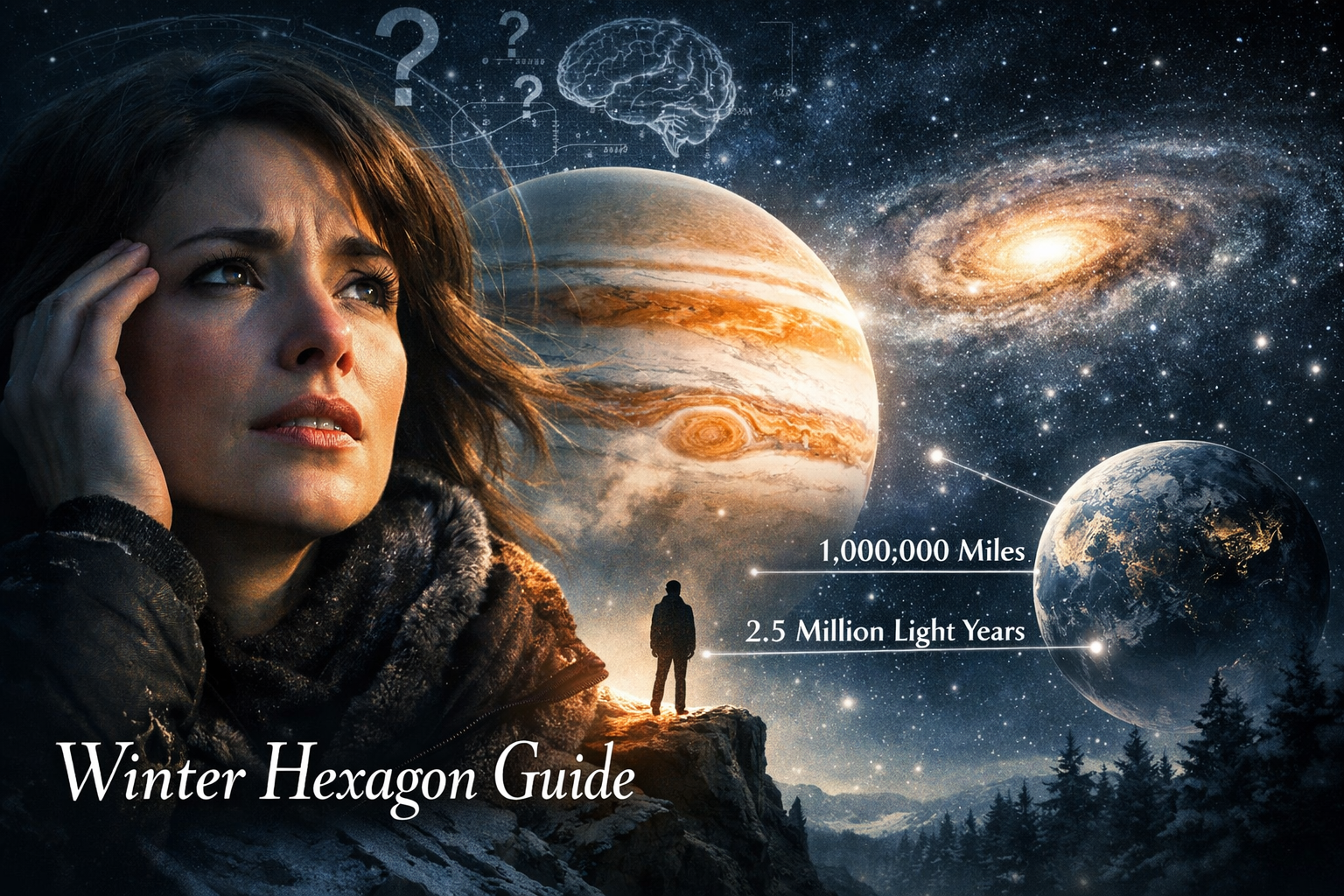
The universe is filled with numbers so enormous that they seem almost impossible to comprehend. We learn that the Moon is about 238,000 miles from Earth, the Sun is roughly 93 million miles away, and the nearest star beyond our solar system is trillions of miles distant. Then we hear about galaxies containing hundreds of billions of stars and a universe spanning unimaginable distances.
Yet despite having access to these facts, most people find it difficult to truly grasp what they mean.
This isn’t a sign of poor intelligence or a lack of scientific understanding. In fact, psychology suggests that our brains simply weren’t designed to process scales as vast as those found in astronomy. Human cognition evolved to handle everyday experiences—distances we can walk, objects we can see, and timeframes that fit within a human lifetime.
When confronted with cosmic dimensions, our mental tools begin to reach their limits.
Here are ten psychology-backed reasons why understanding astronomical scales is so challenging and why even the most educated people often struggle to visualize the true size of the universe.
1. Our Brains Evolved for Everyday Environments
For most of human history, survival depended on understanding nearby surroundings.
Our ancestors needed to estimate the distance to a water source, judge how far an animal could run, or determine how long it would take to reach shelter. These practical challenges shaped the way the human brain processes size, distance, and time.
The problem is that astronomical distances exist far outside the range of experiences our minds evolved to handle.
A few miles? Easy.
A few hundred miles? Still manageable.
A few trillion miles? That’s where intuition begins to fail.
The brain performs best when dealing with scales that are relevant to daily life. Cosmic distances simply don’t fit that category.
2. We Rely Heavily on Visual Experience
Much of our understanding of size comes from what we can see.
When someone tells us a building is taller than another building, we can usually picture the difference. When we compare a basketball to a baseball, our brains instantly create a visual reference.
Astronomical objects rarely offer that advantage.
Stars, planets, and galaxies are so far away that they often appear as tiny points of light regardless of their actual size. A massive star millions of times larger than Earth may look no different from a much smaller star in the night sky.
Without useful visual cues, the brain struggles to create accurate mental images.
This disconnect makes astronomical scales feel abstract rather than tangible.
3. Large Numbers Lose Meaning Quickly
Psychologists have long observed that people struggle to distinguish between extremely large quantities.
The difference between 10 and 100 feels significant because both numbers fall within familiar ranges.
The difference between one billion and one trillion is mathematically enormous, yet many people perceive them as similarly “very large.”
This phenomenon occurs because our intuitive number sense weakens as values increase.
In astronomy, distances, masses, and timescales often involve numbers containing dozens of zeros.
Once numbers reach a certain size, they stop feeling meaningful and become difficult to conceptualize.
4. The Brain Prefers Relative Comparisons
Humans understand information best through comparison.
We know a mountain is tall because we compare it to a building. We know an elephant is large because we compare it to a dog.
Astronomical scales often lack relatable reference points.
How do you meaningfully compare a galaxy spanning 100,000 light-years to anything in everyday life?
Scientists frequently use analogies to bridge this gap. For example, they may compare the solar system to a coin on a football field or describe Earth as a grain of sand relative to larger structures.
These comparisons help because the brain naturally understands relationships better than raw numbers.
5. We Think in Human Timescales
Distance isn’t the only challenge. Time presents similar problems.
Human lives typically span decades. Recorded history covers thousands of years. Yet astronomical events unfold over millions or billions of years.
Psychologists refer to this limitation as temporal constriction—the tendency to think within timeframes relevant to personal experience.
As a result, concepts such as:
- Stellar evolution
- Planet formation
- Galactic collisions
- Cosmic expansion
can feel almost impossible to visualize.
When someone says a star has existed for 10 billion years, the number is so far beyond everyday experience that the brain struggles to assign it practical meaning.
6. We Naturally Simplify Complex Information
The human brain constantly searches for shortcuts.
This process helps us navigate daily life efficiently, but it can create problems when dealing with complex scientific concepts.
Instead of fully processing astronomical scales, people often compress them into simplified categories:
- Near
- Far
- Very far
- Extremely far
While this simplification makes information easier to manage, it obscures the enormous differences between various cosmic distances.
For example, the distance to the Moon, the distance to the Sun, and the distance to the nearest star may all become mentally grouped as “far away,” even though they differ dramatically.
This tendency makes it difficult to appreciate the true structure of the universe.
7. Everyday Language Wasn’t Built for Cosmic Measurements
Language evolved to describe ordinary human experiences.
Words such as “big,” “small,” “long,” and “far” work well in daily conversations. They become less useful when discussing galaxies, black holes, or interstellar space.
Consider the phrase “very large.”
It can describe a house, a stadium, a mountain, or a planet. Yet those objects differ enormously in scale.
Astronomy often requires specialized terms such as:
- Light-year
- Astronomical unit
- Parsec
- Solar mass
While scientifically precise, these terms are unfamiliar to many people and can feel disconnected from everyday understanding.
This language gap creates another obstacle to comprehending astronomical size and distance.
8. We Struggle to Imagine Exponential Growth
Research in cognitive psychology shows that humans are generally poor at understanding exponential relationships.
We tend to think linearly.
If one distance doubles, we can easily understand the change. But when values increase exponentially across multiple orders of magnitude, intuition breaks down.
The universe contains countless examples of exponential scaling.
Moving from Earth to the Moon is a significant distance.
Moving from Earth to the Sun is vastly larger.
Moving to the nearest star increases the scale dramatically again.
The leap from stars to galaxies introduces yet another enormous jump.
Because our brains naturally favor linear thinking, these escalating scales become increasingly difficult to imagine.
9. Familiar Objects Create Misleading Expectations
Many people unconsciously use familiar experiences as mental anchors.
This strategy works well in everyday life but can distort understanding of astronomical concepts.
For example, because the Sun and Moon appear similar in size when viewed from Earth, some people assume they are physically comparable.
In reality, the Sun is vastly larger.
Likewise, stars often appear tiny because of their immense distance, leading some individuals to underestimate their true size.
Visual appearance and physical reality are frequently very different in astronomy.
Our tendency to trust appearances can therefore create inaccurate intuitions about cosmic scales.
10. The Universe Is Simply Beyond Ordinary Human Experience
Perhaps the most important reason astronomical scales are difficult to grasp is that they genuinely exceed normal human experience.
The universe is not merely larger than everyday objects—it is larger than anything evolution prepared us to understand intuitively.
Psychologists often distinguish between knowing and comprehending.
We can know a fact intellectually without fully experiencing its meaning.
For example, a person may know that light takes more than four years to travel from the nearest star to Earth. Yet truly imagining that journey remains extraordinarily difficult.
The universe operates on scales so vast that complete intuitive understanding may never be fully possible.
And that’s perfectly normal.
Why Astronomers Use Analogies
Because astronomical scales are so challenging, scientists frequently rely on analogies and models.
These tools translate unfamiliar concepts into forms the brain can process more easily.
Examples include:
- Shrinking the solar system to fit inside a city.
- Representing planets with fruits.
- Comparing galaxies to islands in a cosmic ocean.
- Using travel times instead of raw distances.
While no analogy is perfect, they provide valuable mental bridges between abstract numbers and familiar experiences.
This is why astronomy educators often prioritize visualization over memorization.
The Psychological Value of Cosmic Perspective
Interestingly, struggling to comprehend the universe can produce positive psychological effects.
Studies suggest that experiences of awe may improve well-being, increase curiosity, and encourage a broader perspective on life.
When people encounter something vastly larger than themselves, their attention shifts away from everyday concerns and toward bigger questions.
Astronomy frequently triggers this response.
Looking at a star-filled sky can create a sense of wonder precisely because the scale feels beyond ordinary understanding.
In this way, the universe’s enormity becomes a source of inspiration rather than frustration.
How to Better Understand Astronomical Scales
Although complete comprehension may be impossible, several strategies can help improve understanding.
Use Scale Models
Physical models make abstract distances more tangible.
Learn Through Comparisons
Analogies help translate large numbers into familiar experiences.
Focus on Relationships
Understanding how objects compare to one another is often more useful than memorizing exact figures.
Visualize Travel Times
Thinking about how long light or spacecraft take to reach destinations can make distances feel more concrete.
Embrace the Limits of Intuition
Recognizing that some concepts exceed natural intuition can reduce frustration and encourage curiosity.
Why This Challenge Is Universal
Even professional astronomers sometimes describe the universe as difficult to fully grasp.
Years of education provide mathematical understanding, but emotional and intuitive comprehension often remains elusive.
This shared challenge highlights an important truth: struggling to imagine cosmic scales isn’t a personal limitation. It’s a reflection of how the human mind evolved.
Our brains were designed to navigate Earth—not the entire universe.
Final Thoughts
The vast distances, immense sizes, and extraordinary timescales found in astronomy push the limits of human cognition. Psychology shows that our brains are optimized for everyday experiences, making it difficult to intuitively understand concepts involving billions of years, trillions of miles, and galaxies containing countless stars. From our reliance on visual cues and relative comparisons to our difficulty processing enormous numbers and exponential growth, many natural cognitive tendencies make astronomical scales challenging to grasp.
Yet this struggle is also part of what makes astronomy so fascinating. The universe constantly reminds us that reality is far larger, older, and more complex than our instincts suggest. While we may never fully comprehend its true scale, the effort to understand it expands our perspective and deepens our appreciation for the remarkable cosmos we inhabit.







