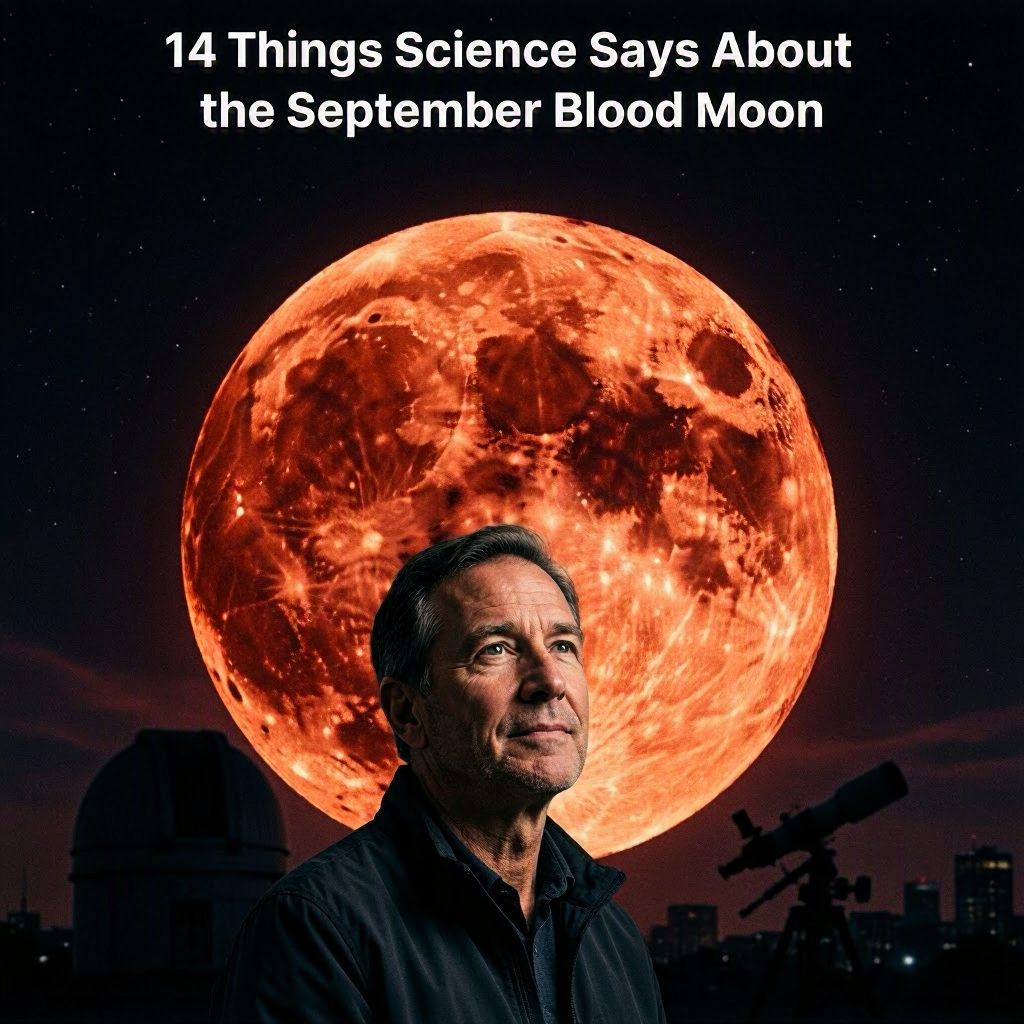
Few celestial events capture public attention quite like a Blood Moon. When the familiar glow of the full Moon transforms into shades of copper, orange, and deep red, millions of people around the world stop to watch. While ancient civilizations often viewed these events with fear or wonder, modern science has revealed the fascinating mechanisms behind this dramatic lunar transformation.
The September Blood Moon is more than just a beautiful sight. It offers scientists valuable opportunities to study Earth’s atmosphere, the Moon, and the complex interactions between sunlight and our planet. Behind the stunning red glow lies a wealth of scientific discoveries that make the event even more remarkable.
Here are 14 fascinating things science says about the September Blood Moon.
1. A Blood Moon Is Actually a Total Lunar Eclipse
Despite its dramatic name, a Blood Moon is not a separate astronomical event.
The term refers to a total lunar eclipse, which occurs when Earth moves directly between the Sun and the Moon. During this alignment, Earth’s shadow completely covers the lunar surface, creating the conditions necessary for the Moon to appear red.
Without this precise alignment, the Blood Moon effect would not occur.
2. The Moon Never Truly Disappears
Many people assume the Moon should become completely invisible during an eclipse.
In reality, sunlight passing through Earth’s atmosphere is bent and redirected toward the Moon. This filtered light continues to illuminate the lunar surface even while it sits within Earth’s shadow.
As a result, the Moon remains visible throughout totality.
3. Earth’s Atmosphere Creates the Red Color
The reddish appearance of a Blood Moon is caused by the same atmospheric process responsible for colorful sunrises and sunsets.
As sunlight travels through Earth’s atmosphere, shorter blue wavelengths scatter in many directions. Longer red and orange wavelengths pass through more effectively and are bent toward the Moon.
This filtered light paints the lunar surface with its distinctive reddish glow.
4. Every Blood Moon Looks Slightly Different
No two Blood Moons are exactly alike.
Some appear bright orange, while others take on a dark crimson or copper color. The Moon’s appearance depends largely on the condition of Earth’s atmosphere at the time of the eclipse.
Dust, pollution, wildfire smoke, and volcanic particles can all influence the Moon’s color and brightness.
5. Volcanic Eruptions Can Change the Eclipse’s Appearance
Large volcanic eruptions can inject enormous amounts of ash and aerosols into the atmosphere.
These particles affect how sunlight passes through Earth’s atmospheric layers. Following major eruptions, Blood Moons may appear darker than usual because less light reaches the lunar surface.
Scientists sometimes use eclipses to study the impact of atmospheric changes caused by volcanic activity.
6. The Event Is Completely Safe to Watch
Unlike solar eclipses, which require eye protection, a lunar eclipse is perfectly safe to observe with the naked eye.
No special glasses, filters, or equipment are necessary. Viewers can watch every stage of the eclipse without risking eye damage.
This accessibility is one reason lunar eclipses attract such large audiences worldwide.
7. The Moon Doesn’t Produce Its Own Light
A Blood Moon offers a useful reminder that the Moon shines only because it reflects sunlight.
During an eclipse, the amount and type of sunlight reaching the Moon changes dramatically, revealing how dependent lunar brightness is on illumination from the Sun.
The event highlights the interconnected relationship between Earth, the Moon, and the Sun.
8. The Eclipse Helps Scientists Study Earth’s Atmosphere
Researchers can analyze the light reflected from the eclipsed Moon to gain information about Earth’s atmosphere.
The filtered sunlight carries clues about atmospheric composition, including the presence of certain gases and particles.
In some ways, lunar eclipses provide a natural laboratory for studying our planet from a unique perspective.
9. The Moon May Reveal Shades Beyond Red
Although “Blood Moon” is the popular nickname, observers often notice a range of colors.
Depending on atmospheric conditions, portions of the Moon may appear orange, bronze, copper, brown, or even slightly yellow during different stages of totality.
The variety of colors adds to the event’s visual appeal.
10. The Entire Eclipse Can Last Several Hours
The red phase may be the most dramatic part, but the full event unfolds gradually.
A total lunar eclipse often lasts several hours from beginning to end. The Moon slowly enters Earth’s shadow, reaches totality, and then gradually emerges back into full sunlight.
This extended duration gives observers plenty of time to enjoy the spectacle.
11. Ancient Civilizations Often Feared Blood Moons
Long before the science of eclipses was understood, Blood Moons inspired myths and legends across the world.
Many cultures interpreted the red Moon as a warning, omen, or supernatural event. Some believed celestial creatures were consuming the Moon, while others saw it as a sign of major change.
Today, science explains the phenomenon, but the sense of wonder remains.
12. Billions of People Can Potentially See It
A lunar eclipse is visible from anywhere on Earth where the Moon is above the horizon.
This broad visibility means a single Blood Moon can be viewed by a large percentage of the global population. Unlike solar eclipses, which are confined to narrow paths, lunar eclipses are shared experiences across vast regions.
Few astronomical events reach such a large audience.
13. Blood Moons Help Test Astronomical Predictions
Astronomers can predict lunar eclipses with extraordinary accuracy.
The timing, duration, and path of Earth’s shadow are calculated years—or even decades—in advance. Every successful prediction demonstrates the precision of our understanding of celestial mechanics.
These events serve as powerful examples of how predictable the motions of the solar system can be.
14. A Blood Moon Is a Reminder of Cosmic Precision
Perhaps the most remarkable scientific fact is the alignment required to create a Blood Moon.
Earth, the Moon, and the Sun must line up with remarkable accuracy. Even small differences in orbital positions can prevent a total lunar eclipse from occurring.
When the alignment happens, it creates one of the most beautiful and scientifically fascinating spectacles visible from Earth.
Why the September Blood Moon Matters
The September Blood Moon is more than an eye-catching event in the night sky. It is a demonstration of physics, orbital mechanics, atmospheric science, and celestial geometry all working together in perfect harmony.
For scientists, it provides valuable opportunities for observation and research. For photographers, it offers stunning visual possibilities. For the public, it serves as a reminder that some of the most extraordinary natural events require nothing more than stepping outside and looking up.
As the Moon takes on its signature red glow, millions of people will witness the same celestial phenomenon—a powerful reminder of the beauty, precision, and interconnectedness of our place in the universe.







