Few military leaders have left a legacy as enduring as Alexander the Great. In little more than a decade, the Macedonian king created one of history’s largest empires, stretching from Greece and Egypt to the borders of India. His extraordinary success has fascinated historians for centuries, prompting one major question: How did he defeat so many powerful enemies?
While Alexander’s leadership and ambition played crucial roles, one of his greatest advantages was his highly effective battle formation. Built upon innovations introduced by his father, Philip II of Macedon, this military system combined discipline, strategy, and adaptability in ways that transformed ancient warfare.
Here are ten surprising facts about Alexander’s battle formation and why it proved so successful.
1. It Was Based on the Macedonian Phalanx
At the heart of Alexander’s army was the Macedonian phalanx, a tightly organized formation of infantry soldiers.
The soldiers stood in closely packed ranks, creating a massive wall of men and weapons. Unlike earlier Greek formations, the Macedonian phalanx was specifically designed for both offensive power and coordinated movement.
Its disciplined structure made it one of the most formidable military formations of the ancient world.
2. Soldiers Carried Enormous Spears
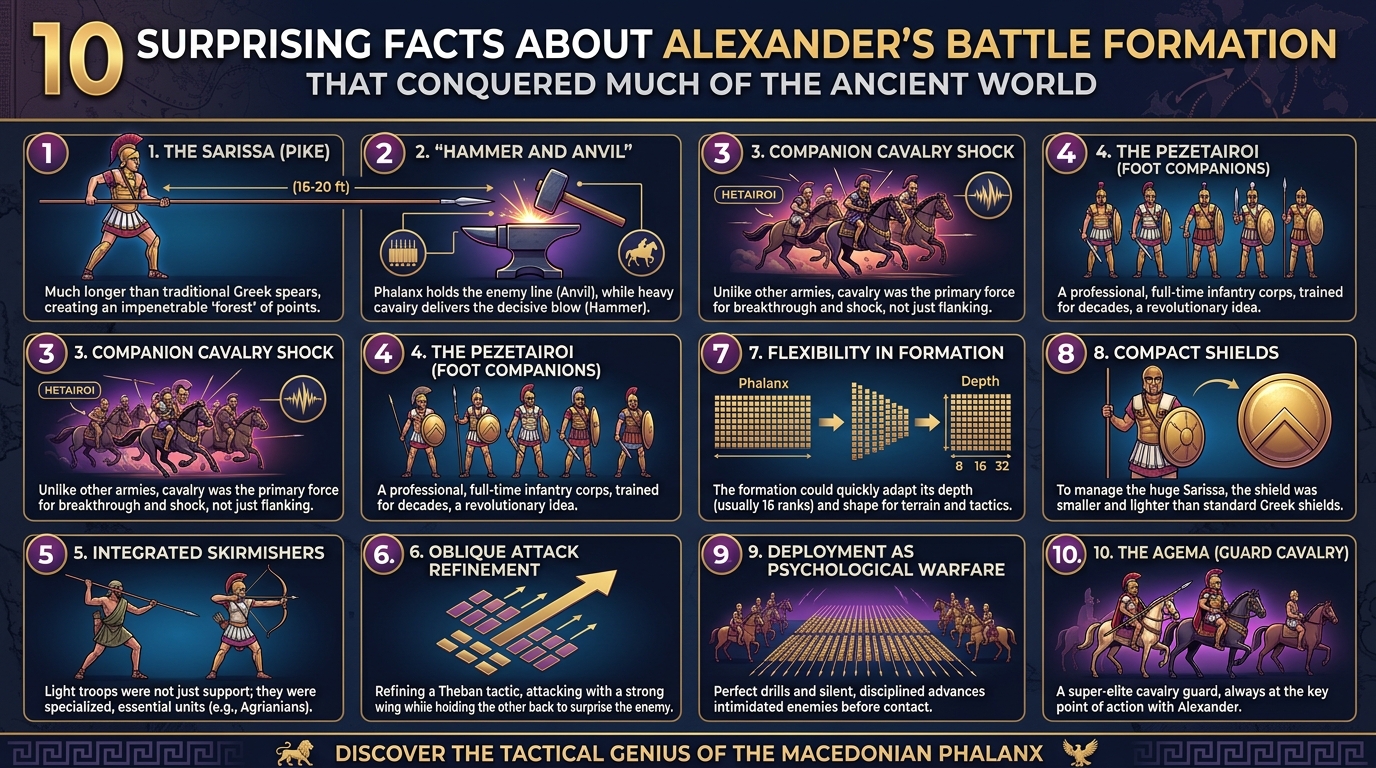
Perhaps the most striking feature of the phalanx was its weapon: the sarissa, a spear that could reach around 18 to 20 feet in length.
The immense size of these weapons allowed several rows of soldiers to project spear points toward the enemy simultaneously. Opponents often found themselves facing a dense forest of spear tips before they could even approach the front line.
The sheer reach of the sarissa gave Alexander’s infantry a significant battlefield advantage.
3. It Required Exceptional Discipline
The phalanx could only function effectively if every soldier moved with precision.
Thousands of men had to maintain formation while marching, turning, and advancing under difficult conditions. A single break in the ranks could expose vulnerable sections of the line and create opportunities for enemy attacks.
This requirement for coordination meant that Macedonian soldiers underwent extensive training and developed remarkable battlefield discipline.
4. The Formation Was Not Invincible on Its Own
Many people imagine the phalanx as an unstoppable military machine, but Alexander understood its limitations.
The formation was highly effective on open terrain but could struggle on rough ground or when attacked from the sides and rear. Its long spears also made rapid changes of direction difficult.
Alexander’s genius lay not simply in using the phalanx but in integrating it with other military units that protected its weaknesses.
5. Cavalry Played a Critical Supporting Role
One of Alexander’s greatest innovations was the close cooperation between infantry and cavalry.
While the phalanx occupied and pressured enemy forces from the front, heavily armed cavalry units attacked vulnerable flanks or exploited weaknesses in enemy lines. These coordinated maneuvers often turned difficult battles into decisive victories.
The combination of different military forces working together was one of Alexander’s most effective strategies.
6. Alexander Frequently Led Cavalry Charges Himself
Unlike many rulers who directed battles from relative safety, Alexander often fought at the front.
He personally led elite cavalry charges and placed himself in dangerous situations during major engagements. His presence inspired his soldiers and allowed him to react quickly to changing battlefield conditions.
The effectiveness of his battle formation was therefore closely linked to his bold and active leadership style.
7. The Formation Conquered Vast Territories
The Macedonian military system helped Alexander achieve an extraordinary series of victories.
His armies defeated the Persian Empire, captured major cities, and crossed enormous distances while continuing to win battles against diverse opponents.
The success of these campaigns demonstrated that Alexander’s military organization was not effective only in one region but could adapt to various environments and enemies.
8. It Relied on Careful Planning and Timing
Ancient battles often appeared chaotic, but Alexander’s victories frequently depended upon precise coordination.
The phalanx needed to advance at the right moment, cavalry had to strike vulnerable positions, and commanders were required to communicate effectively across large battlefields.
The success of the formation was therefore not simply a matter of superior weapons but also of careful planning and disciplined execution.
9. It Influenced Warfare for Generations
Alexander’s military achievements left a profound impact on later armies.
After his death, successor kingdoms continued to use versions of the Macedonian phalanx, and military leaders throughout history studied his campaigns for lessons in strategy and leadership.
The formation’s effectiveness ensured that its influence extended far beyond Alexander’s own lifetime.
10. It Demonstrates the Importance of Adaptability
Perhaps the most surprising fact about Alexander’s battle formation is that its greatest strength was flexibility.
Although the phalanx formed the army’s backbone, Alexander constantly adjusted tactics according to terrain, enemy capabilities, and strategic objectives. He combined infantry, cavalry, archers, and other specialized troops in ways that allowed him to exploit opportunities and overcome obstacles.
His military success was not based on a single formation alone but on the intelligent integration of multiple elements into a highly adaptable fighting force.
Why Alexander’s Battle Formation Still Fascinates Historians
Alexander’s military system continues to captivate historians because it represents one of the most effective combinations of technology, discipline, and leadership in ancient history. The Macedonian phalanx, armed with its towering sarissas, created an intimidating and powerful infantry force. Yet its true effectiveness emerged when combined with cavalry and supported by Alexander’s strategic vision.
The formation helped conquer vast territories and played a major role in reshaping the political and cultural landscape of the ancient world. More importantly, it demonstrated principles that remain relevant even today: preparation, teamwork, adaptability, and the ability to coordinate different strengths toward a common goal.
More than two thousand years after Alexander’s campaigns, his battle formation remains one of history’s most remarkable examples of military innovation. It stands as a reminder that great victories often depend not merely on strength or numbers, but on the intelligent organization of people, resources, and ideas.







