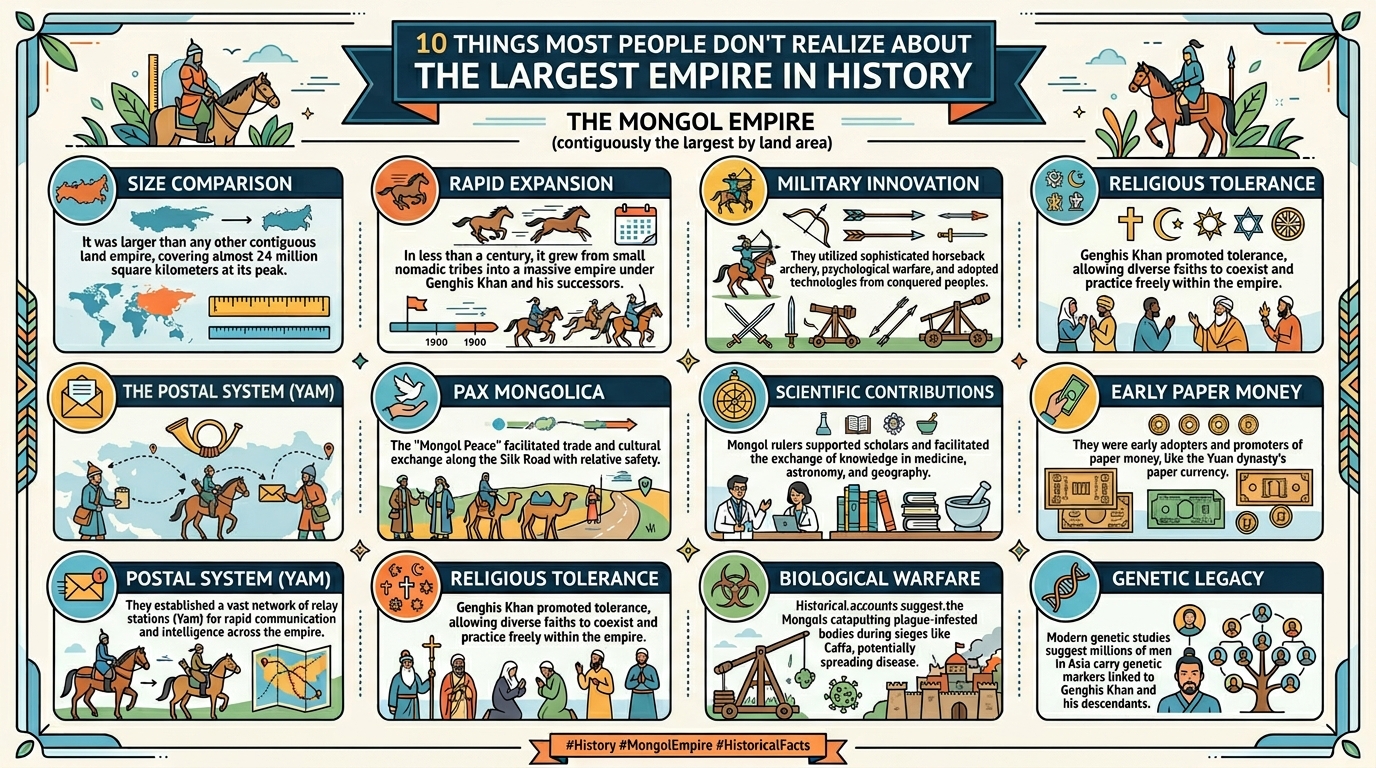
When people hear the phrase “the largest empire in history,” many immediately think of the Romans or the Mongols. Surprisingly, however, the largest empire the world has ever seen was the British Empire. At its peak in the early 20th century, it controlled approximately a quarter of the Earth’s land surface and governed hundreds of millions of people across every inhabited continent.
The empire’s enormous size and global influence shaped politics, economics, technology, languages, and cultures in ways that continue to affect the modern world. Yet many of its most fascinating aspects remain little known.
Here are ten things most people don’t realize about the largest empire in history.
1. It Controlled Nearly a Quarter of the Planet
At its height around 1920, the British Empire covered roughly 35 million square kilometers, making it the largest empire ever assembled.
Its territories stretched across North America, Africa, Asia, the Caribbean, the Middle East, and the Pacific. So vast was its reach that maps of the period often colored British possessions in red, creating the impression that enormous portions of the globe belonged to a single power.
The empire’s sheer size remains difficult to comprehend even today.
2. The Sun Literally Never Set on It
The phrase “the empire on which the sun never sets” was not merely a poetic expression.
Because British territories were spread across so many time zones, daylight was always shining somewhere within the empire. When night fell in one colony, the sun was rising in another thousands of miles away.
This global presence became one of the empire’s defining symbols and reflected its unprecedented geographical reach.
3. It Governed Hundreds of Millions of People
At its peak, the British Empire ruled over approximately 400 million people—about one in every four people on Earth at the time.
Its population included an extraordinary diversity of cultures, religions, languages, and traditions. Managing such a vast and varied population presented enormous administrative challenges and required complex systems of governance.
Few political entities in history have exercised authority over so many people simultaneously.
4. English Became a Global Language Because of It
One of the empire’s most lasting legacies is the widespread use of the English language.
As British influence expanded across continents, English became increasingly important in administration, commerce, education, and international communication. Even after many colonies gained independence, the language remained deeply embedded in government institutions and educational systems.
Today, English is one of the world’s most widely spoken and influential languages largely because of the historical reach of the British Empire.
5. It Helped Shape the Modern Global Economy
The British Empire played a major role in creating international trade networks that connected distant regions of the world.
Goods, resources, and ideas moved between continents on an unprecedented scale. Raw materials from colonies supplied industries in Britain, while manufactured products were distributed throughout imperial markets.
These economic connections contributed significantly to the development of globalization and transformed international commerce.
6. Technology Helped Hold the Empire Together
Maintaining such an enormous empire would have been nearly impossible without technological innovation.
Steamships dramatically reduced travel times, while railways facilitated transportation within colonies. The telegraph revolutionized communication by allowing messages to travel across continents and oceans in minutes rather than weeks.
These technologies enabled imperial administrators to coordinate activities over vast distances and made global governance more practical than ever before.
7. It Was Incredibly Diverse
The British Empire encompassed deserts, rainforests, mountains, tropical islands, and Arctic regions.
Its territories included some of the world’s largest cities as well as remote communities separated by immense distances. People living within the empire practiced numerous religions, spoke hundreds of languages, and maintained countless cultural traditions.
This diversity made the empire less a single society and more an enormous network of interconnected regions with vastly different identities.
8. It Left Lasting Political Influences
Many modern countries retain institutions and legal traditions that developed during British rule.
Parliamentary systems, common law traditions, civil services, and administrative structures in numerous nations have historical links to the empire. In some places, these systems became foundations for modern democratic governance.
The political influence of the empire therefore extends far beyond its official existence.
9. Its Legacy Is Both Remarkable and Controversial
The history of the British Empire is complex and often deeply debated.
Its expansion contributed to advances in trade, infrastructure, science, and global communication. At the same time, imperial rule involved conflict, economic exploitation, inequality, and struggles for independence in many regions.
Historians continue to examine both its achievements and its costs, recognizing that its impact cannot be understood through a single narrative.
10. Its Effects Are Still Visible Today
Although the British Empire formally came to an end during the 20th century, its influence remains evident across the modern world.
English serves as an international language. Many countries maintain parliamentary institutions with historical roots in British governance. Legal systems, transportation networks, educational structures, and cultural exchanges established during the imperial era continue to shape societies today.
Few historical empires have left such an extensive and enduring global footprint.
Why the Largest Empire in History Still Fascinates People
The British Empire continues to captivate historians because of its extraordinary scale and lasting influence. Never before had a single empire stretched across so many continents and governed such a significant portion of the world’s population.
Its story is one of exploration, commerce, technological innovation, cultural exchange, and political transformation. It is also a history marked by conflict, resistance, and ongoing debates about the meaning and consequences of imperial power.
Perhaps most fascinating of all is the realization that many aspects of contemporary life—from the widespread use of English to international trade networks and political institutions—still bear traces of an empire that once covered nearly a quarter of the Earth’s surface.
More than a century after reaching its greatest extent, the largest empire in history continues to shape the world in ways that many people never realize.







