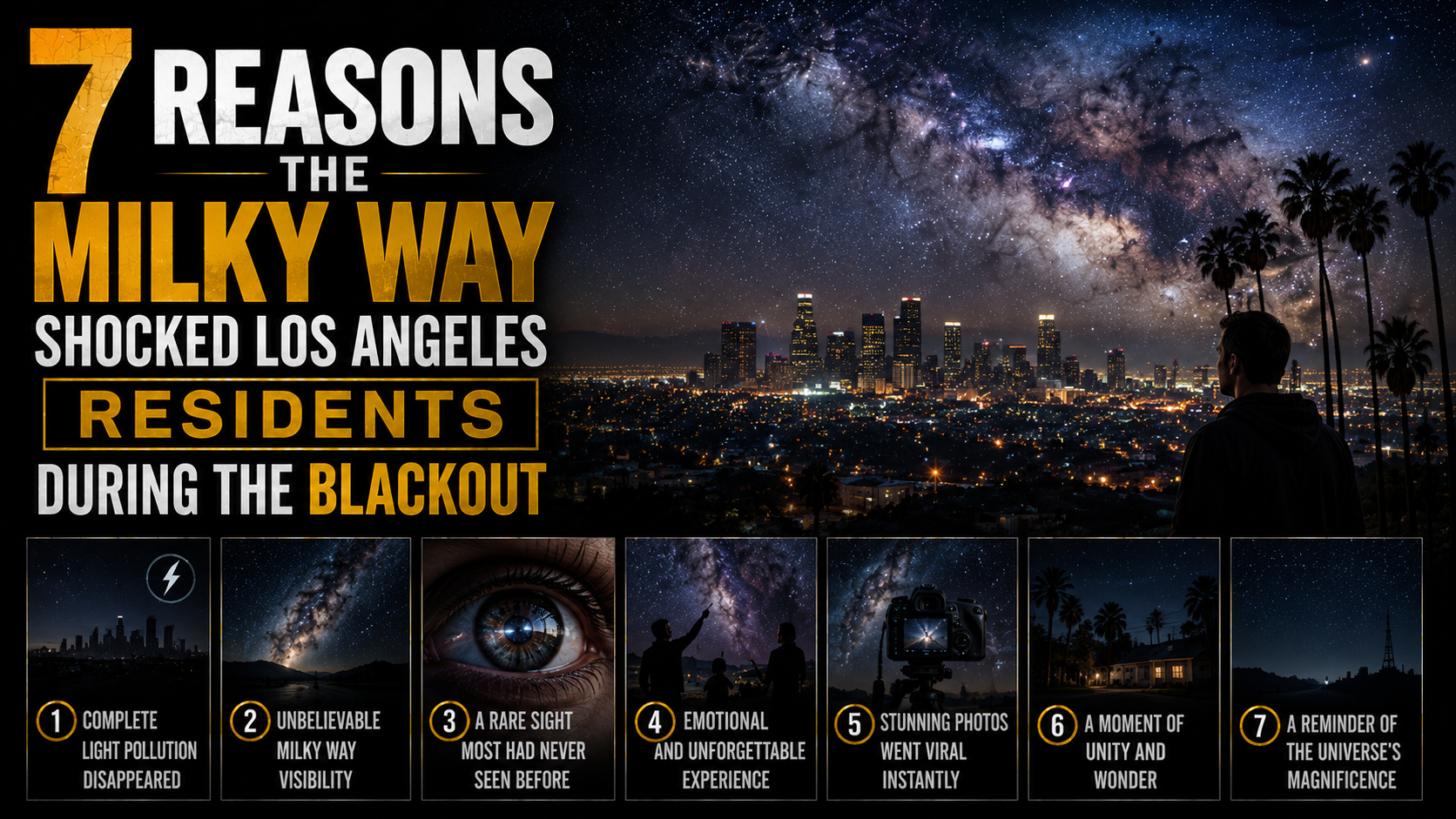
For most people living in a major city like Los Angeles, the night sky is something rarely noticed. Bright streetlights, glowing billboards, and endless city illumination wash out the stars almost completely. But during a rare blackout event, something extraordinary happened—the Milky Way became visible to residents for the first time in years.
What should have been an ordinary night without power turned into an unforgettable cosmic experience. People looked up and saw a sky they often forget exists: dense with stars, glowing bands of light, and the unmistakable structure of our galaxy stretching overhead.
Here are 7 reasons the Milky Way shocked Los Angeles residents during the blackout.
1. Light Pollution Suddenly Disappeared
The biggest reason the Milky Way became visible was the sudden removal of artificial light.
Los Angeles is one of the brightest cities in the world at night.
Billions of photons from streetlights, buildings, and vehicles normally scatter into the sky.
When the blackout hit, this artificial glow vanished almost instantly.
2. The Human Eye Adjusted to True Darkness
Under normal conditions, city lights prevent our eyes from fully adapting to darkness.
During the blackout, residents’ eyes gradually adjusted to natural night conditions.
As vision became more sensitive, faint celestial details began to appear.
This allowed the Milky Way to become visible to the naked eye.
3. The Milky Way Was Always There—Just Hidden
One of the most surprising realizations for many residents was that the Milky Way is always present.
It is our home galaxy, a massive spiral structure filled with billions of stars.
However, in cities, its faint light is completely washed out.
The blackout simply revealed what has always been overhead.
4. Air Quality Played a Supporting Role
Los Angeles often experiences haze and pollution that scatter light and obscure the sky.
During the blackout, reduced human activity temporarily improved visibility conditions in some areas.
Less artificial light combined with slightly clearer air made faint stars easier to see.
This created ideal conditions for sky observation.
5. Many Residents Had Never Seen a Truly Dark Sky
For a large portion of urban populations, especially in major cities, dark skies are unfamiliar.
Many people grow up never seeing the Milky Way at all.
The blackout offered a rare first-time visual experience of the galaxy.
For some, it was emotionally overwhelming and deeply memorable.
6. Social Media Amplified the Experience
As residents began noticing the night sky, many quickly shared photos and reactions online.
Images of the Milky Way over Los Angeles spread rapidly across social media platforms.
This amplified the sense of wonder and surprise.
What began as a local blackout became a shared global moment.
7. It Highlighted the Impact of Urban Lighting on Astronomy
The event also sparked conversations about how city lighting affects our view of the universe.
Astronomers have long warned that excessive artificial light limits our ability to observe the night sky.
The blackout served as a real-world example of this issue.
It reminded people that urban lighting not only brightens cities but also hides the cosmos.
Why the Milky Way Matters
The Milky Way is more than just a band of light in the sky—it is our galactic home.
It contains hundreds of billions of stars, including our Sun.
Seeing it with the naked eye connects people to a much larger cosmic reality.
For many Los Angeles residents, the blackout created a rare moment of perspective.
The Science Behind Seeing the Galaxy
Under dark-sky conditions, the human eye can detect thousands of stars at once.
The Milky Way appears as a faint glowing band because of the dense concentration of stars in our galaxy’s disk.
In cities, sky brightness is often hundreds of times stronger than natural night levels.
Removing that brightness allows the galaxy’s structure to become visible.
The Emotional Impact of the Experience
Many residents described feelings of awe, curiosity, and even disbelief.
For some, it was the first time they realized how vast the universe truly is.
Others felt a renewed interest in astronomy and space science.
Such experiences often leave a lasting emotional impression.
A Reminder of What We Lose to Light Pollution
The blackout also served as a reminder of what urban life obscures.
Light pollution affects not only astronomy but also wildlife and human sleep cycles.
It reduces our ability to experience natural night environments.
Events like this highlight the importance of balancing city lighting with environmental awareness.
Final Thoughts
The unexpected visibility of the Milky Way over Los Angeles during a blackout turned an ordinary disruption into an extraordinary cosmic revelation.
For a brief moment, millions of hidden stars reappeared in the night sky, reminding residents that the universe is always above us—even when we cannot see it.
In the end, the experience was more than just a visual surprise. It was a powerful reminder of our place within a vast and beautiful galaxy, waiting just beyond the glow of city lights.







