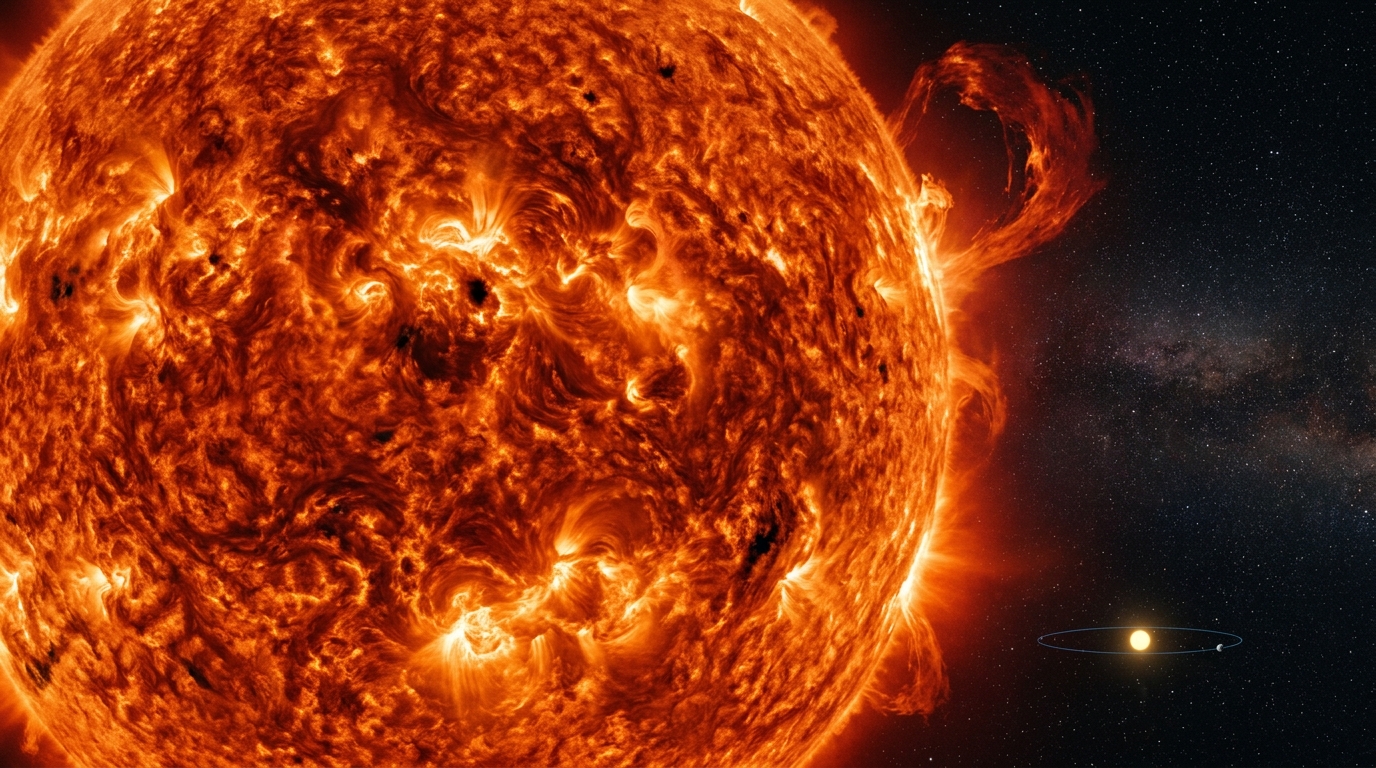
When we look up at the night sky, most stars appear as tiny points of light. Yet some of these distant objects are so enormous that they challenge our understanding of scale. One of the most impressive examples is Antares, a colossal red supergiant that dominates its region of the sky and ranks among the largest stars visible to the naked eye.
Located in the constellation Scorpius, Antares has fascinated astronomers, skywatchers, and ancient civilizations for centuries. Its striking reddish color and immense dimensions make it one of the most recognizable stars in the heavens. While it may look like just another bright star from Earth, Antares is actually a cosmic giant whose size is difficult to imagine.
Here are 12 incredible facts that highlight the astonishing scale and importance of Antares.
1. Antares Is One of the Largest Stars Visible to the Naked Eye
Antares is classified as a red supergiant, a type of star that has expanded dramatically during the later stages of its life.
If placed at the center of our Solar System, Antares would extend far beyond the orbit of Mars and possibly reach the region of Jupiter, depending on how its outer atmosphere is measured. Its sheer size places it among the largest stars that can be seen without a telescope.
This extraordinary scale is one reason Antares has become a favorite target for astronomers studying stellar evolution.
2. Its Name Means “Rival of Mars”
The name Antares comes from ancient Greek and translates roughly to “rival of Mars.”
This title was earned because of the star’s deep reddish-orange appearance, which closely resembles the color of the planet Mars when viewed in the night sky.
Ancient observers often noticed the similarity and recognized Antares as one of the few stars capable of competing with Mars in brightness and color.
3. The Star Is Hundreds of Times Larger Than the Sun
Although exact measurements vary, Antares is estimated to have a radius hundreds of times greater than that of our Sun.
To put this into perspective, if the Sun were reduced to the size of a basketball, Antares would be comparable to a large building. The difference in scale is so dramatic that millions of Suns could fit inside the volume occupied by this giant star.
Its immense dimensions make our own star seem surprisingly modest.
4. Antares Is a Red Supergiant Near the End of Its Life
Stars do not remain the same forever. As they age, they consume the fuel that powers their cores.
Antares has already left the main phase of its life and entered the red supergiant stage. During this period, the star expands enormously while cooling at its surface, giving it the characteristic red color seen from Earth.
Astronomers believe Antares is approaching the final chapters of its stellar existence.
5. It Is Located About 550 Light-Years Away
Despite appearing bright in our sky, Antares is incredibly distant.
The star lies approximately 550 light-years from Earth, meaning the light reaching us today began its journey centuries ago. In other words, when we observe Antares, we are seeing it as it existed hundreds of years in the past.
This remarkable distance highlights both its brightness and its enormous energy output.
6. Antares Is Much More Luminous Than the Sun
While Antares is cooler at its surface than the Sun, it compensates with its immense size.
The star emits tens of thousands of times more energy than our Sun. Its vast surface area radiates enormous amounts of light and heat into space, making it one of the brightest stars in our region of the galaxy.
Without this tremendous luminosity, it would not be visible from such a great distance.
7. It Has a Companion Star
Antares is not alone.
Astronomers have discovered that it is part of a binary star system. Orbiting nearby is a much smaller and hotter companion star known as Antares B.
This companion appears bluish-white in contrast to the deep red glow of Antares itself. The striking color difference creates one of the most visually interesting stellar pairings in the night sky.
8. Its Atmosphere Extends Far Into Space
One of the most fascinating features of Antares is its enormous outer atmosphere.
Unlike a solid object with a clear boundary, a red supergiant possesses layers of gas that stretch far beyond its visible surface. These extended regions can span incredible distances and gradually fade into surrounding space.
The star continually loses material through powerful stellar winds, enriching the galaxy with elements that may eventually become part of future stars and planets.
9. Antares Is Destined to Explode as a Supernova
Because of its large mass, Antares is expected to end its life in a dramatic explosion known as a supernova.
When the star eventually exhausts its nuclear fuel, its core will collapse, triggering one of the most energetic events in the universe. For a brief period, the explosion could outshine entire galaxies.
Fortunately, Antares is far enough away that such an event would pose no danger to Earth.
10. Ancient Cultures Revered the Star
Antares has been known and admired for thousands of years.
Ancient civilizations in Greece, Egypt, Persia, China, and Mesopotamia incorporated the star into myths, calendars, and astronomical traditions. Its brightness and unusual color made it impossible to ignore.
Many cultures associated Antares with warriors, royalty, or powerful celestial beings due to its commanding appearance in the sky.
11. It Forms the Heart of the Scorpion
Antares occupies a prominent position within the constellation Scorpius.
Its location marks the heart of the celestial scorpion, making it the brightest and most recognizable star in the constellation. During summer evenings in the Northern Hemisphere, Scorpius is one of the easiest constellations to identify, thanks largely to Antares.
The star’s vivid reddish glow stands out clearly among surrounding stars.
12. Studying Antares Helps Scientists Understand Stellar Evolution
Astronomers view Antares as a natural laboratory for studying the life cycles of massive stars.
By observing its atmosphere, temperature changes, mass loss, and internal processes, researchers gain valuable insight into what happens when giant stars approach the end of their lives.
The information gathered from Antares helps improve models of stellar evolution and contributes to our understanding of how heavy elements are created and distributed throughout the universe.
How Big Is Antares Compared to the Sun?
The size difference between Antares and the Sun is difficult to comprehend.
If the Sun sat where Antares is today, its outer edge would occupy only a tiny fraction of the red supergiant’s volume. Antares is so vast that if it replaced the Sun at the center of our Solar System, several inner planets would be engulfed within its outer layers.
This comparison illustrates just how extraordinary red supergiant stars can become during the final stages of their evolution.
Why Antares Continues to Fascinate Astronomers
Antares represents one of nature’s most spectacular achievements. It combines immense size, tremendous luminosity, striking color, and a dramatic future. Every observation provides new clues about how massive stars live and die.
Because stars like Antares are relatively rare and short-lived on cosmic timescales, studying them offers a unique opportunity to witness a crucial stage in stellar evolution. Researchers continue to investigate its atmosphere, variability, and mass-loss processes using some of the world’s most advanced telescopes.
Final Thoughts
Antares is much more than a bright red point in the night sky. It is a stellar giant whose dimensions dwarf our Sun and challenge our imagination. From its ancient reputation as the “Rival of Mars” to its future destiny as a supernova, Antares remains one of the most fascinating stars visible from Earth.
Its enormous size, powerful energy output, and critical role in helping scientists understand stellar evolution ensure that it will remain a subject of fascination for generations to come. The next time you spot the reddish glow of Antares shining within Scorpius, remember that you are looking at one of the true giants of our galaxy—a star whose scale is almost beyond human comprehension.







