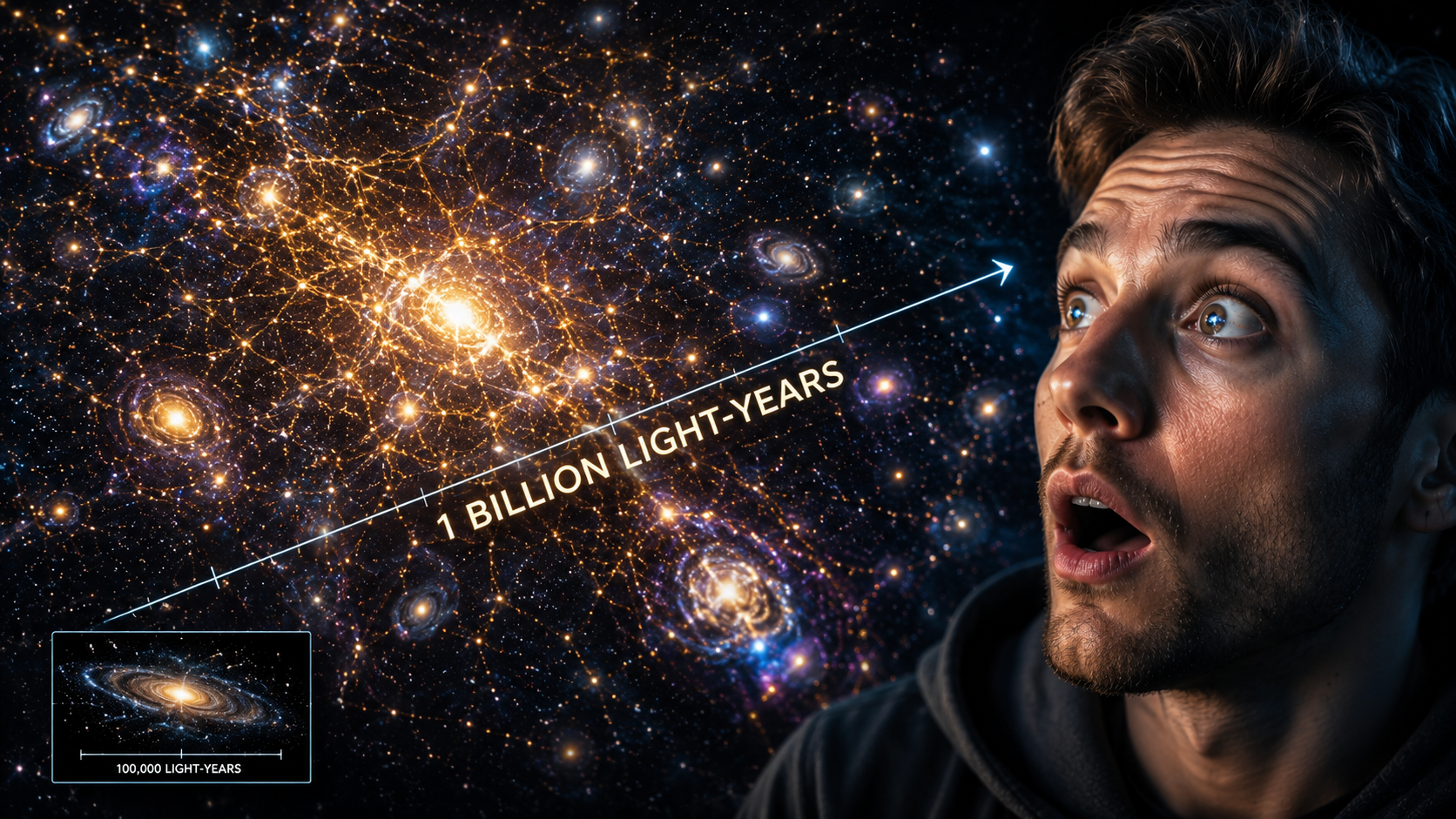
The universe has a way of making even the largest things seem small.
Earth feels enormous when viewed from the ground. Our solar system appears unimaginably vast compared to our planet. Even the Milky Way Galaxy, which contains hundreds of billions of stars, stretches across distances that are difficult for the human mind to grasp.
Yet beyond galaxies lie even larger cosmic structures—vast networks of galaxy clusters connected across unimaginable distances. Among these giant formations is the Boss Supercluster, one of the largest known structures in the observable universe.
Discovered through extensive sky surveys, the Boss Supercluster has become a fascinating subject for astronomers because of its incredible size and what it reveals about the large-scale architecture of the cosmos.
To truly appreciate how extraordinary this structure is, it helps to explore some of the most astonishing facts about it.
Here are seven mind-blowing facts about the Boss Supercluster and its billion-light-year scale.
1. It Stretches Across More Than a Billion Light-Years
The most remarkable feature of the Boss Supercluster is its sheer size.
Astronomers estimate that the structure extends across roughly one billion light-years. To understand how staggering that distance is, consider that light—the fastest thing in the universe—travels about 5.88 trillion miles in a single year.
Now imagine that journey repeated one billion times.
If a beam of light began traveling from one side of the Boss Supercluster to the other today, it would take approximately one billion years to complete the trip.
For comparison, modern humans have existed for only a tiny fraction of that time.
This immense scale immediately places the Boss Supercluster among the largest known structures ever identified in the cosmos.
2. It Contains Countless Galaxies
When people hear the word “supercluster,” they sometimes imagine a single gigantic object.
The reality is even more impressive.
The Boss Supercluster is not one galaxy or even one galaxy cluster. Instead, it consists of numerous galaxy clusters linked together through gravity and cosmic structure.
Each cluster can contain hundreds or even thousands of galaxies. And every galaxy may contain billions of stars.
The numbers become almost impossible to visualize.
If every star within these galaxies were represented by a grain of sand, the total would exceed anything humans could reasonably count.
The Boss Supercluster demonstrates that the universe organizes matter on scales far beyond individual galaxies.
3. It Helps Reveal the Universe’s Cosmic Web
One of the most fascinating discoveries in modern astronomy is that galaxies are not distributed randomly throughout space.
Instead, they form an enormous interconnected network known as the cosmic web.
This structure resembles a three-dimensional web or sponge-like pattern stretching across the observable universe. Dense regions contain galaxy clusters and superclusters, while vast voids occupy the spaces between them.
The Boss Supercluster serves as an important example of this cosmic architecture.
By studying structures like it, astronomers gain insight into how matter has evolved since the universe’s earliest moments.
The existence of such enormous formations helps scientists test theories about gravity, dark matter, and cosmic evolution.
In many ways, superclusters are among the building blocks of the universe’s largest patterns.
4. Its Size Challenges Human Imagination
Even experienced astronomers admit that scales like those of the Boss Supercluster are difficult to comprehend.
Humans evolved to understand distances measured in feet, miles, or kilometers. Even planetary distances push the limits of our intuition.
A billion light-years operates on an entirely different level.
Imagine shrinking Earth to the size of a marble. The Sun would still be several meters away. The nearest stars would remain thousands of kilometers distant. The Milky Way would span an enormous continent-sized area.
Now imagine something large enough to encompass countless galaxies spread across cosmic distances.
The Boss Supercluster forces us to confront scales so extreme that ordinary comparisons quickly become inadequate.
It serves as a powerful reminder of how small our everyday perspective really is.
5. It Formed Over Billions of Years
Structures as large as the Boss Supercluster did not appear overnight.
Their formation required billions of years of cosmic evolution.
Shortly after the Big Bang, matter was distributed relatively evenly throughout the universe. Tiny fluctuations in density eventually allowed gravity to begin pulling material together.
Over vast stretches of time, these slight differences grew larger. Clouds of gas formed stars. Stars gathered into galaxies. Galaxies assembled into clusters. Clusters connected into superclusters.
The Boss Supercluster represents the result of this long process.
Every galaxy within it has its own history involving star formation, collisions, mergers, and evolution.
When astronomers observe the supercluster, they are witnessing the outcome of billions of years of gravitational interactions on an enormous scale.
6. We Are Looking Deep Into the Past
One of the most amazing aspects of astronomy is that distance also means time.
Because light takes time to travel, observing distant objects allows scientists to look backward into cosmic history.
The light reaching Earth from the Boss Supercluster began its journey hundreds of millions or even billions of years ago.
In other words, astronomers do not see the supercluster as it exists today. They see it as it appeared when that light first left its galaxies.
This concept often surprises people because it means telescopes function as time machines.
The farther we look into space, the further back in time we see.
By studying structures like the Boss Supercluster, scientists gain valuable information about earlier stages of the universe’s development.
7. It May Not Even Be the Largest Structure Out There
As extraordinary as the Boss Supercluster is, astronomers continue discovering increasingly massive cosmic formations.
Advances in telescope technology, computer simulations, and sky surveys regularly reveal new structures that challenge previous records.
Some giant formations appear to stretch across even larger distances than initially thought possible.
These discoveries raise important questions.
How large can cosmic structures become? Are there limits imposed by the laws of physics? Do current theories fully explain what astronomers observe?
The Boss Supercluster remains one of the most impressive known examples, but it may represent only a small piece of a much larger cosmic puzzle.
Future observations could uncover structures that make even this giant seem modest by comparison.
Why Superclusters Matter
At first glance, studying gigantic structures millions or billions of light-years away might seem disconnected from everyday life.
In reality, superclusters provide critical clues about how the universe works.
Their distribution helps scientists understand gravity on the largest scales. Their formation offers evidence about the influence of dark matter. Their arrangement provides information about the universe’s expansion and evolution.
Without studying superclusters, many of the biggest questions in cosmology would remain unanswered.
These structures serve as natural laboratories where researchers can test theories about the fundamental forces shaping the cosmos.
Every new discovery adds another piece to the puzzle of understanding our universe.
The Cosmic Web: Nature’s Largest Structure
To fully appreciate the Boss Supercluster, it helps to understand the larger framework in which it exists.
The universe resembles a vast network of filaments connecting clusters and superclusters across enormous distances.
This network is known as the cosmic web.
Computer simulations suggest that dark matter played a crucial role in creating these patterns. Invisible concentrations of matter acted as gravitational scaffolding, guiding the formation of galaxies and larger structures.
Today, the cosmic web represents the largest known arrangement of matter in existence.
The Boss Supercluster occupies a place within this giant network, serving as one of its most impressive nodes.
Studying such structures helps researchers map the universe on its grandest scales.
What the Boss Supercluster Tells Us About Our Place in the Universe
Perhaps the most profound lesson of the Boss Supercluster involves perspective.
Human beings often think in terms of personal experiences, cities, nations, or even planets. Yet structures like this reveal a universe operating on scales far beyond ordinary understanding.
Our entire solar system occupies a tiny corner of the Milky Way. The Milky Way itself is just one galaxy among billions. Those galaxies belong to clusters, which in turn belong to larger structures such as superclusters.
The Boss Supercluster reminds us that we inhabit only a small part of an unimaginably vast cosmic landscape.
Yet there is something inspiring about that realization.
Despite our small size, humanity has developed the tools and knowledge necessary to discover, map, and understand structures extending across a billion light-years of space.
That achievement speaks volumes about human curiosity and scientific progress.
Final Thoughts
The Boss Supercluster stands as one of the most astonishing structures ever identified in the observable universe. Stretching across roughly a billion light-years and containing countless galaxies, it highlights the incredible scale on which the cosmos operates.
Its existence helps astronomers study the cosmic web, investigate the role of gravity and dark matter, and better understand how the universe evolved over billions of years.
Most importantly, the Boss Supercluster challenges our sense of scale. It reminds us that even the largest objects we encounter in everyday life are insignificant compared to the grand architecture of the universe.
As telescopes become more powerful and astronomical surveys continue expanding, scientists will undoubtedly uncover even more breathtaking structures. Until then, the Boss Supercluster remains one of the most remarkable examples of nature’s ability to build on a scale that seems almost beyond imagination.







