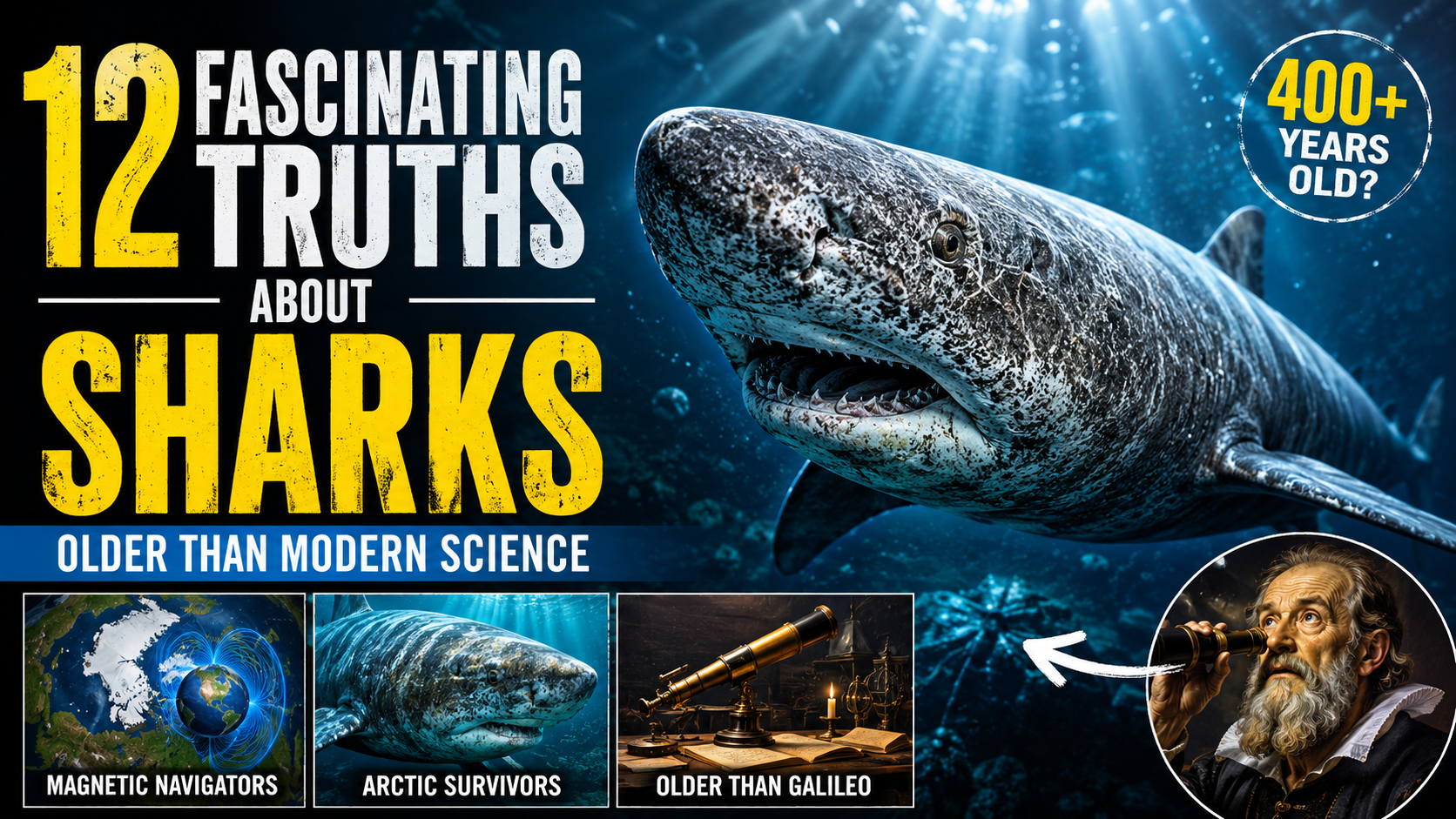
When most people think of sharks, they imagine fast-moving predators patrolling tropical oceans. Images of great white sharks, dramatic hunting scenes, and sleek fins cutting through the water often come to mind. Yet one of the most remarkable sharks on Earth looks nothing like the creatures featured in blockbuster movies.
Hidden beneath the icy waters of the North Atlantic and Arctic Oceans lives a species that has quietly outlasted empires, revolutions, and entire eras of human history. The Greenland shark is one of the longest-living vertebrates ever discovered. Some individuals swimming today may have been alive when Galileo was studying the heavens, when Shakespeare’s plays were first performed, or before the first telescope was even pointed toward the night sky.
Scientists continue to uncover astonishing facts about these ancient animals, and each discovery challenges what we thought we knew about aging, survival, and life in extreme environments.
Here are 12 fascinating truths about sharks that may be older than modern science itself.
1. Some Greenland Sharks Can Live for More Than 400 Years
The most famous fact about Greenland sharks is also the most extraordinary.
Researchers estimate that some individuals can live for over four centuries. This means a shark swimming through Arctic waters today may have hatched sometime during the early 1600s.
To put that into perspective, some Greenland sharks may have already been alive before the invention of calculus, before modern chemistry emerged, and before many nations existed in their current form.
Very few vertebrates on Earth can match such incredible longevity.
2. They Are the Longest-Living Vertebrates Ever Discovered
Many animals are known for their long lifespans.
Giant tortoises can live for more than a century. Some whales may survive for over 200 years.
Greenland sharks, however, hold the record among vertebrates.
Their lifespan exceeds that of most known mammals, birds, reptiles, and fish.
This remarkable longevity has made them a major focus of scientific research, especially among scientists studying aging and lifespan.
3. They Grow at an Extremely Slow Rate
One reason Greenland sharks live so long may be their incredibly slow growth.
Researchers estimate these sharks grow only about one centimeter per year.
That means a shark measuring 16 feet long may have spent centuries reaching that size.
Compared to many other shark species that grow rapidly and mature relatively early, Greenland sharks seem to operate on an entirely different biological clock.
Their slow pace of life may be one of the keys to their exceptional longevity.
4. They Don’t Reach Adulthood for More Than a Century
Imagine not reaching adulthood until after your 100th birthday.
For Greenland sharks, that is close to reality.
Scientists believe females may not become reproductively mature until approximately 150 years of age.
This is one of the slowest life histories ever observed in a vertebrate animal.
Such delayed maturity makes the species particularly vulnerable because populations recover very slowly from declines.
5. They Thrive in One of Earth’s Harshest Environments
The Arctic Ocean is not an easy place to survive.
Temperatures hover near freezing. Food can be scarce. Darkness dominates large portions of the year.
Yet Greenland sharks have adapted perfectly to these conditions.
Their slow metabolism allows them to conserve energy while navigating the cold depths.
What appears to be a harsh environment for most creatures has become an ideal habitat for one of nature’s most enduring survivors.
6. Many Greenland Sharks Are Partially Blind
One of the strangest discoveries about Greenland sharks involves their eyesight.
Many individuals host parasites that attach to their eyes.
These parasites can damage vision and sometimes cause partial blindness.
At first glance, this seems like a serious disadvantage.
Surprisingly, scientists believe vision may not be particularly important for these sharks.
They rely heavily on other senses, including smell and possibly environmental cues, to navigate and locate food.
Their success demonstrates that survival often depends on adaptation rather than perfection.
7. They Move Much More Slowly Than Most Sharks
Hollywood often portrays sharks as fast and aggressive hunters.
Greenland sharks break that stereotype completely.
They are among the slowest-moving shark species ever studied.
Their cruising speed is leisurely compared with many ocean predators.
Yet despite their slow pace, they successfully survive in environments where patience and efficiency matter more than speed.
Their lifestyle highlights an important lesson in biology: evolution favors strategies that work, not necessarily those that seem impressive.
8. Scientists Believe They May Use Earth’s Magnetic Field
Research suggests Greenland sharks may use Earth’s magnetic field to help navigate.
Many animals—including birds, sea turtles, and some fish species—appear capable of sensing magnetic information.
Evidence indicates Greenland sharks may possess similar abilities.
If confirmed, this would help explain how they travel across vast Arctic regions despite poor visibility and extreme conditions.
Nature continues to reveal navigation systems far more sophisticated than once imagined.
9. Their Bodies Contain Natural Antifreeze Compounds
Living in near-freezing water presents serious biological challenges.
Most animals would struggle to function under such conditions.
Greenland sharks have evolved chemical adaptations that help their bodies operate in icy environments.
These compounds allow their tissues to remain functional despite extremely cold temperatures.
Such adaptations are essential for survival in the Arctic and contribute to their unique biological profile.
10. They Are Opportunistic Feeders
Although Greenland sharks are capable predators, they are not particularly selective eaters.
Researchers have found a surprising variety of items in their stomachs, including fish, squid, seals, and even remains of larger animals.
Their willingness to consume available food helps them survive in ecosystems where meals may be unpredictable.
In extreme environments, flexibility often becomes a survival advantage.
Greenland sharks appear to have mastered that principle.
11. They May Hold Clues to Human Aging
One reason scientists are fascinated by Greenland sharks is their potential to reveal secrets about longevity.
How can a vertebrate live for four centuries?
What biological mechanisms slow aging?
How do cells remain functional for so long?
Researchers studying these sharks hope their answers could improve our understanding of aging processes in other animals, including humans.
While practical applications remain uncertain, the potential insights are significant.
Sometimes nature’s greatest mysteries offer the most valuable lessons.
12. They Remind Us How Little We Know About the Oceans
Perhaps the most fascinating truth about Greenland sharks is what they reveal about scientific discovery itself.
For centuries, these animals lived largely unnoticed beneath Arctic waters.
Only recently have scientists begun to understand their remarkable lifespan and biology.
Their story serves as a reminder that Earth’s oceans still contain countless mysteries.
Even in an age of satellites, artificial intelligence, and advanced technology, nature continues to surprise us.
The deep sea remains one of the least explored environments on the planet.
Why Greenland Sharks Fascinate Researchers
Greenland sharks occupy a unique position in marine science.
They are simultaneously ancient, mysterious, and scientifically valuable.
Researchers study them to better understand:
- Longevity
- Adaptation
- Arctic ecosystems
- Evolution
- Aging processes
- Marine conservation
Every new discovery contributes to a broader understanding of how life survives under extreme conditions.
In many ways, Greenland sharks function as living archives of environmental history.
What Their Longevity Tells Us About Survival
Many people assume survival belongs to the strongest, fastest, or most aggressive species.
Greenland sharks suggest a different possibility.
Their success comes from patience, efficiency, and adaptation.
They move slowly.
They grow slowly.
They reproduce slowly.
Yet they have endured for centuries.
Their strategy demonstrates that survival can take many forms.
Sometimes longevity results not from speed but from stability.
Conservation Challenges
Despite their impressive lifespan, Greenland sharks face modern threats.
Because they mature so slowly, populations recover gradually from losses.
Accidental capture in fishing operations remains a concern in some regions.
Climate change may also affect Arctic ecosystems in ways scientists do not yet fully understand.
Protecting these ancient animals requires careful management and continued research.
Losing creatures that have survived for centuries would mean losing valuable pieces of Earth’s natural heritage.
Lessons From an Ocean Time Traveler
The Greenland shark offers a rare perspective on time.
While human lives span decades, these animals experience centuries.
A single shark may witness environmental changes, climate shifts, and human developments across generations.
Their existence challenges our usual sense of time and reminds us that nature often operates on scales far larger than our own.
In a world obsessed with speed, Greenland sharks represent the power of patience.
Final Thoughts
The Greenland shark is one of the most extraordinary animals ever discovered. With lifespans exceeding 400 years, slow growth, remarkable adaptations, and a mysterious existence in Arctic waters, these sharks challenge conventional ideas about aging and survival.
They are more than just long-lived fish. They are living connections to history, biological marvels that have quietly persisted while human civilization transformed around them.
As scientists continue studying these ancient creatures, they may uncover insights that deepen our understanding of life itself. Until then, Greenland sharks remain among the most fascinating reminders that Earth’s greatest wonders often lie hidden beneath the surface, waiting to be discovered.







