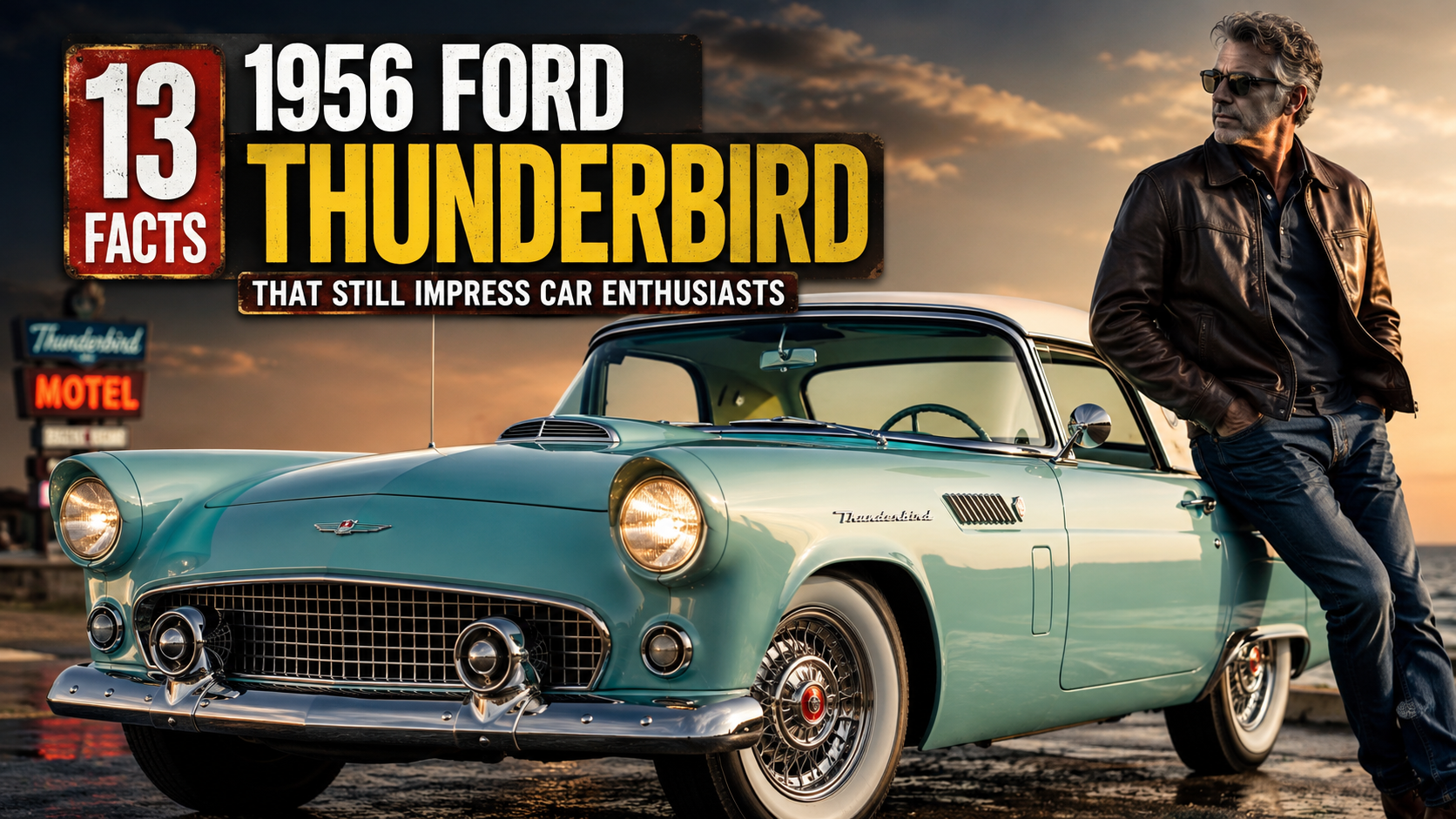
Few automobiles have achieved the legendary status of the 1956 Ford Thunderbird. More than just a stylish two-seater, the Thunderbird helped define an entirely new category of American automobiles and established itself as one of the most recognizable classics ever produced.
When Ford introduced the Thunderbird in the mid-1950s, it wasn’t trying to build a pure sports car. Instead, the company sought to create a vehicle that blended performance, comfort, luxury, and eye-catching design into one attractive package. The result was an instant success that continues to captivate collectors and automotive enthusiasts decades later.
Today, the 1956 Thunderbird remains a centerpiece at classic car shows, auctions, and enthusiast gatherings. Its combination of timeless styling, historical significance, and innovative features ensures that it still commands attention wherever it appears.
Here are 13 fascinating facts about the 1956 Ford Thunderbird that continue to impress car lovers around the world.
1. It Helped Create the “Personal Luxury Car” Segment
One of the Thunderbird’s most important contributions to automotive history was the role it played in establishing an entirely new type of vehicle.
Unlike traditional sports cars that focused primarily on performance, the Thunderbird offered a blend of comfort, elegance, and spirited driving characteristics.
Ford recognized that many buyers wanted something stylish and enjoyable without sacrificing everyday usability. The Thunderbird answered that demand perfectly.
This concept eventually evolved into what became known as the personal luxury car market—a segment that influenced countless vehicles in the decades that followed.
Its impact can still be seen in many modern grand touring and luxury-performance cars.
2. The 1956 Model Introduced the Famous Continental Spare Tire Kit
Among Thunderbird enthusiasts, one of the most recognizable features of the 1956 model is the external rear-mounted spare tire.
Often referred to as the Continental kit, this addition wasn’t purely cosmetic.
The original 1955 Thunderbird faced criticism for having limited trunk space. By relocating the spare tire to the rear of the vehicle, Ford engineers freed up valuable storage room inside the trunk.
The solution improved practicality while also giving the car a distinctive appearance that became one of its defining visual traits.
Today, the Continental kit remains one of the most sought-after features among collectors.
3. It Was Designed to Compete with the Corvette—But Took a Different Path
When Chevrolet introduced the Corvette in the early 1950s, it attracted significant attention.
Ford responded with the Thunderbird, but instead of creating a direct sports-car rival, the company chose a different strategy.
The Thunderbird emphasized comfort, luxury, and refinement alongside performance.
This approach appealed to buyers who wanted excitement behind the wheel without sacrificing convenience.
As a result, the Thunderbird often attracted customers who appreciated sporty styling but preferred a more relaxed and comfortable driving experience.
That unique positioning helped distinguish it from competitors and contributed significantly to its commercial success.
4. The Porthole Hardtop Became an Iconic Design Feature
One of the most memorable visual elements associated with the 1956 Thunderbird is the optional removable hardtop featuring round porthole windows.
These windows added character and style while improving rearward visibility.
The design quickly became a signature Thunderbird feature and remains one of the details most often associated with first-generation models.
For many enthusiasts, the porthole hardtop represents the perfect blend of functionality and 1950s automotive flair.
Even today, it remains one of the vehicle’s most photographed and admired characteristics.
5. It Combined Performance with Everyday Comfort
Many sports-oriented cars of the 1950s prioritized speed at the expense of comfort.
The Thunderbird took a more balanced approach.
Drivers enjoyed responsive performance while benefiting from features designed to make long-distance travel more enjoyable. Comfortable seating, refined styling, and a smoother ride helped make the Thunderbird suitable for both weekend adventures and daily use.
This combination broadened its appeal and helped attract buyers who might not have considered a traditional sports car.
Its versatility remains one of the reasons enthusiasts continue to appreciate it today.
6. Its Styling Captured the Spirit of the 1950s
The 1950s were a decade defined by optimism, innovation, and bold design.
The Thunderbird embodied all three.
Its long hood, low profile, sweeping lines, chrome accents, and confident stance reflected the era’s fascination with progress and modernity.
The car managed to look elegant without appearing excessive, a balance many designers strive to achieve.
More than 65 years later, its appearance remains remarkably attractive and instantly recognizable.
Few vehicles capture the visual essence of 1950s America quite as effectively.
7. It Offered Multiple Engine Choices
Ford understood that buyers had different expectations when it came to performance.
As a result, the 1956 Thunderbird was available with several V8 engine options that allowed customers to tailor the driving experience to their preferences.
These engines provided strong performance for the era and contributed to the Thunderbird’s reputation as a capable touring machine.
Enthusiasts continue to admire the car’s combination of power and smooth operation.
The availability of different engine configurations also adds an interesting layer of variety for collectors today.
8. It Became an Instant Sales Success
Some classic cars achieve legendary status years after production ends.
The Thunderbird enjoyed success almost immediately.
Consumers responded enthusiastically to its unique blend of luxury, performance, and style. Sales figures demonstrated that Ford had correctly identified a gap in the market.
The car’s popularity helped secure the Thunderbird’s future and encouraged Ford to continue developing the model line.
Its early commercial success remains one of the clearest indicators of how well its concept resonated with buyers.
9. It Influenced Future Automotive Design
Great automobiles often inspire future generations of designers.
The Thunderbird’s impact extended far beyond its own production years.
Its proportions, styling cues, and emphasis on combining luxury with performance influenced numerous vehicles that followed.
Many automotive historians view the Thunderbird as an important stepping stone in the evolution of American personal luxury cars.
Designers continue to study classic vehicles like the Thunderbird because they demonstrate how thoughtful styling can remain appealing long after trends have changed.
10. It Remains Highly Collectible
The classic car market includes countless desirable vehicles, yet the 1956 Thunderbird consistently ranks among the most sought-after American classics.
Collectors value it for several reasons:
- Historical significance
- Distinctive styling
- Strong enthusiast support
- Limited production compared to modern vehicles
- Lasting cultural appeal
Well-maintained examples often attract considerable attention at auctions and car shows.
The Thunderbird’s enduring popularity helps ensure that demand remains strong among collectors and enthusiasts alike.
11. It Offers a Pure Driving Experience
Modern automobiles are packed with technology designed to improve comfort, convenience, and safety.
While these innovations are valuable, they also create a very different driving experience.
The 1956 Thunderbird represents an era when driving required greater involvement from the person behind the wheel.
There are no advanced driver-assistance systems, digital displays, or complex electronic controls.
Instead, drivers experience a direct connection to the road and the machine itself.
For many enthusiasts, this simplicity is part of the car’s enduring charm.
It provides a reminder of what motoring felt like during a different era.
12. It Represents Ford at Its Creative Peak
The Thunderbird emerged during a period when American automakers were experimenting with bold ideas and innovative designs.
Ford’s willingness to take risks played a major role in the vehicle’s success.
Rather than simply following industry trends, the company developed a car that occupied a unique position in the market.
This creativity helped establish the Thunderbird as more than just another model—it became a symbol of innovation and confidence.
Many enthusiasts view the 1956 Thunderbird as one of Ford’s finest achievements from the postwar automotive era.
13. Its Legacy Remains Strong Decades Later
Perhaps the most impressive fact about the 1956 Thunderbird is how relevant it remains today.
Many vehicles disappear from public memory after a few decades. The Thunderbird has done the opposite.
Its influence can still be seen in modern automotive design, collector culture, and discussions about classic American cars.
Younger generations continue discovering and appreciating the model, ensuring that its legacy endures.
The fact that people remain passionate about a car introduced nearly seventy years ago speaks volumes about its importance.
Why the 1956 Thunderbird Still Matters
Automotive technology has advanced dramatically since the mid-1950s.
Modern vehicles are faster, safer, more efficient, and packed with sophisticated features. Yet despite these advancements, the Thunderbird continues to occupy a special place in the hearts of enthusiasts.
Its appeal goes beyond performance numbers or technical specifications.
The Thunderbird represents an era when style, personality, and innovation were central to automotive design. It reminds enthusiasts that great cars are remembered not only for what they could do but also for how they made people feel.
Every curve, chrome accent, and engineering decision contributes to a vehicle that remains memorable decades after leaving the factory.
More Than a Classic Car
For many owners, the 1956 Thunderbird is more than transportation or even a collectible.
It serves as a rolling piece of history.
Driving one provides a glimpse into a period when American automotive design was rapidly evolving and manufacturers competed to create vehicles that inspired excitement and imagination.
That connection to history helps explain why the Thunderbird continues attracting attention at every event it attends.
It represents a moment when innovation, style, and optimism came together in a uniquely American way.
Final Thoughts
The 1956 Ford Thunderbird remains one of the most admired vehicles of the classic car era. From its role in creating the personal luxury car segment to its iconic Continental kit, porthole hardtop, and timeless styling, the car continues to impress enthusiasts across generations.
Its enduring popularity is no accident. The Thunderbird combined performance, comfort, innovation, and visual appeal in a way that few automobiles have managed to replicate.
More than six decades after its debut, it still captures attention, sparks conversations, and inspires admiration wherever it appears. That lasting influence is what transforms a good car into a true automotive legend.







