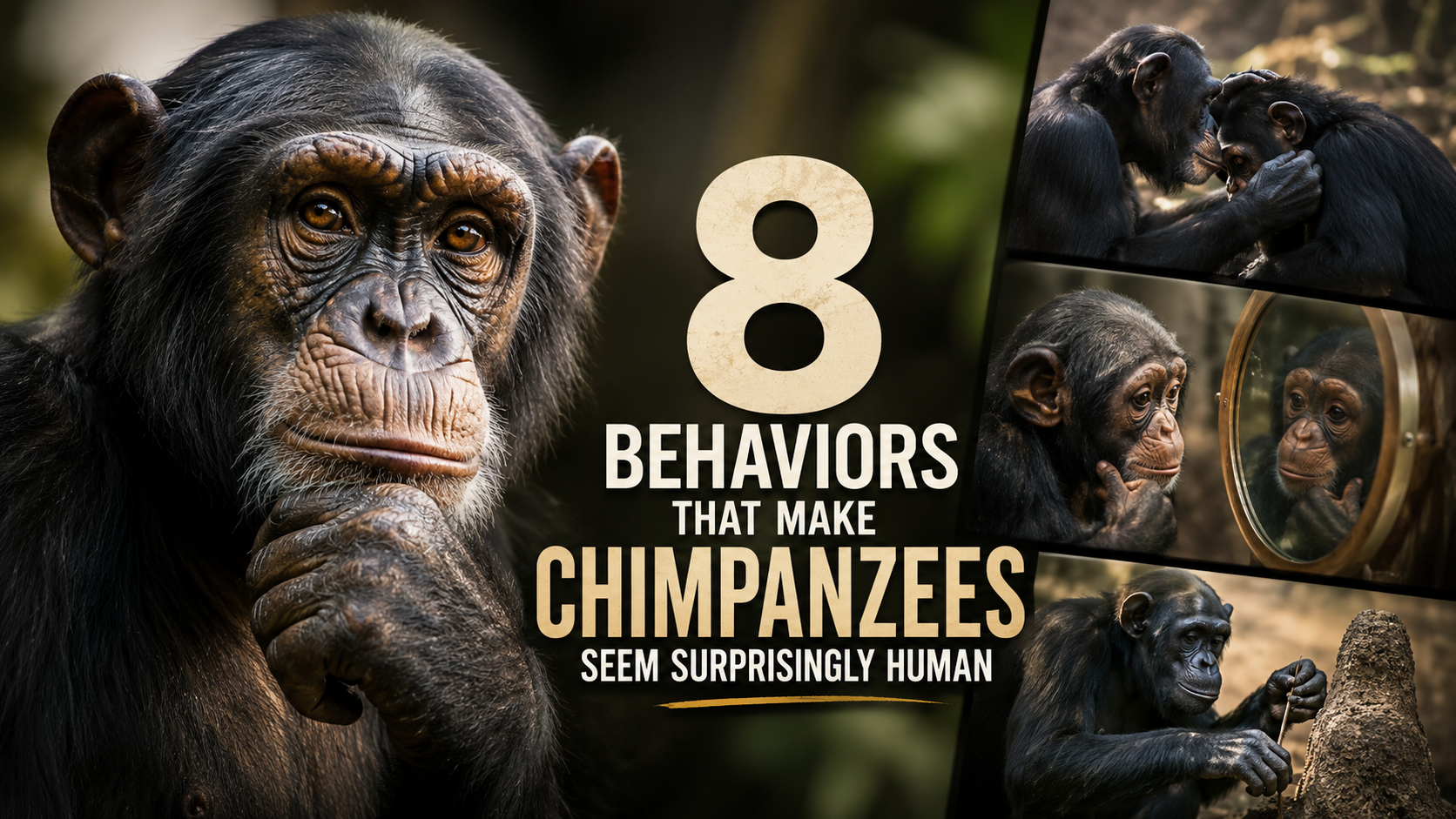
Chimpanzees have fascinated scientists and animal lovers for generations. As our closest living relatives in the animal kingdom, they share a significant portion of their DNA with humans and display a remarkable range of behaviors that often feel strikingly familiar. Watching a chimpanzee interact with family members, solve a problem, or express emotion can sometimes feel like looking into a distant mirror of our own evolutionary past.
While chimpanzees are undoubtedly wild animals with their own unique social systems and instincts, research has revealed countless examples of behavior that resemble human actions, emotions, and relationships. These similarities have helped scientists better understand both chimpanzee societies and the origins of human behavior.
Here are eight fascinating behaviors that make chimpanzees seem surprisingly human.
1. They Form Deep Family Bonds
One of the most human-like traits observed in chimpanzees is the strength of their family relationships.
Chimpanzee mothers invest enormous amounts of time and energy raising their offspring. Young chimps remain dependent on their mothers for years, learning essential survival skills, social behaviors, and group dynamics.
Mothers often comfort, protect, and nurture their young in ways that closely resemble human parenting. Siblings may also develop lasting social bonds that continue into adulthood.
These strong family connections play a critical role in chimpanzee society and highlight the importance of relationships in their lives.
2. They Use Tools to Solve Problems
For many years, humans were thought to be the only species capable of making and using tools.
That belief changed when researchers observed chimpanzees modifying sticks to extract termites from mounds, using stones to crack open nuts, and creating simple tools for a variety of purposes.
Tool use requires planning, learning, and adaptability—traits often associated with human intelligence.
Different chimpanzee communities even develop distinct tool-using traditions, suggesting a form of cultural knowledge passed from one generation to the next.
3. They Communicate Through Complex Social Signals
Chimpanzees communicate using a combination of vocalizations, facial expressions, gestures, and body language.
A raised hand, a particular facial expression, or a specific call can convey information about danger, excitement, submission, or social intentions.
Many of these signals appear surprisingly familiar to human observers. Expressions associated with play, fear, frustration, and affection can often be recognized across species.
Their sophisticated communication system helps maintain social order and strengthen group relationships.
4. They Show Empathy and Compassion
Research has documented numerous examples of chimpanzees displaying empathy toward others.
Individuals may comfort distressed group members through gentle touching, grooming, or close physical contact. Some have been observed assisting injured companions or offering reassurance after conflicts.
These behaviors suggest an awareness of the emotional states of others and a willingness to respond supportively.
While human empathy is more complex in many respects, these observations indicate that the roots of compassionate behavior may run deep within our shared evolutionary history.
5. They Establish Friendships
Chimpanzee relationships extend beyond family ties.
Many individuals form long-term friendships based on trust, cooperation, and repeated social interaction. Friends often spend time grooming one another, sharing space, and supporting each other during social disputes.
Researchers have found that strong social bonds can improve an individual’s standing within the group and may even contribute to overall well-being.
The value chimpanzees place on friendship mirrors an important aspect of human social life.
6. They Engage in Play Throughout Their Youth
Young chimpanzees spend a considerable amount of time playing.
They chase one another, wrestle, climb, swing, and invent games that appear strikingly similar to the playful activities of human children. Through play, they develop physical skills, social awareness, and problem-solving abilities.
Play also helps strengthen social relationships and teaches important lessons about cooperation and boundaries.
Watching young chimpanzees interact often highlights how essential play is to learning and development across species.
7. They Experience a Wide Range of Emotions
Chimpanzees display emotional responses that can seem remarkably familiar.
Researchers have observed behaviors associated with joy, excitement, fear, anger, grief, jealousy, and affection. They celebrate social victories, react to losses, and form attachments that influence their behavior.
Some studies have documented signs of mourning when group members die, while others have recorded enthusiastic displays during reunions with close companions.
Although animal emotions should not be viewed as identical to human emotions, the similarities can be striking.
8. They Learn Through Observation and Teaching
Chimpanzees are skilled observational learners.
Young individuals spend years watching experienced adults perform tasks such as tool use, food gathering, nest building, and social interaction. They gradually acquire these skills through imitation and practice.
In some cases, adults appear to facilitate learning by allowing younger chimpanzees to observe closely or by demonstrating behaviors repeatedly.
This transfer of knowledge across generations resembles one of the key foundations of human culture and education.
Why Chimpanzees Matter to Science
Chimpanzees occupy a unique position in scientific research because of their close evolutionary relationship to humans.
Studying their behavior helps researchers explore questions about intelligence, communication, social organization, cooperation, and the origins of human traits. Observations of chimpanzees provide valuable clues about how certain behaviors may have evolved over millions of years.
Their societies offer a living window into aspects of our shared ancestry.
Similarities and Differences
While chimpanzees display many human-like characteristics, it is important to remember that they are not humans.
Their social structures, communication systems, and cognitive abilities differ in significant ways from our own. Human culture, language, technology, and abstract reasoning have developed to a far greater degree.
At the same time, the similarities are meaningful because they reveal common evolutionary roots.
Recognizing both the similarities and differences allows scientists to better understand the unique paths taken by humans and chimpanzees since their evolutionary split.
What Their Behavior Teaches Us
Chimpanzees remind us that many traits often considered uniquely human may have deeper biological origins.
Cooperation, emotional bonds, social learning, friendship, and problem-solving are not exclusive to our species. Instead, they appear to exist on a continuum across the animal kingdom.
Studying these behaviors encourages a broader appreciation for animal intelligence and the complexity of life on Earth.
It also challenges assumptions about the boundaries between humans and other animals.
The Importance of Conservation
Chimpanzees face numerous threats in the wild, including habitat loss, hunting, disease, and illegal wildlife trade.
Protecting chimpanzee populations is important not only for biodiversity but also for scientific understanding. Every population represents a valuable source of knowledge about behavior, ecology, and evolution.
Conservation efforts help ensure that future generations can continue learning from these extraordinary animals.
Conclusion
Chimpanzees seem surprisingly human because they share many behaviors that people recognize in themselves. From forming close family bonds and friendships to using tools, expressing emotions, and learning through observation, they demonstrate a level of social and cognitive complexity that continues to impress researchers.
These similarities do not diminish what makes humans unique, but they do highlight the deep evolutionary connections that link us to the natural world. By studying chimpanzees, scientists gain insights into the origins of human behavior while reminding us that intelligence, emotion, and social cooperation are not solely human traits.
The more we learn about chimpanzees, the more we appreciate both the remarkable nature of our closest relatives and the shared heritage that connects all life on Earth.







