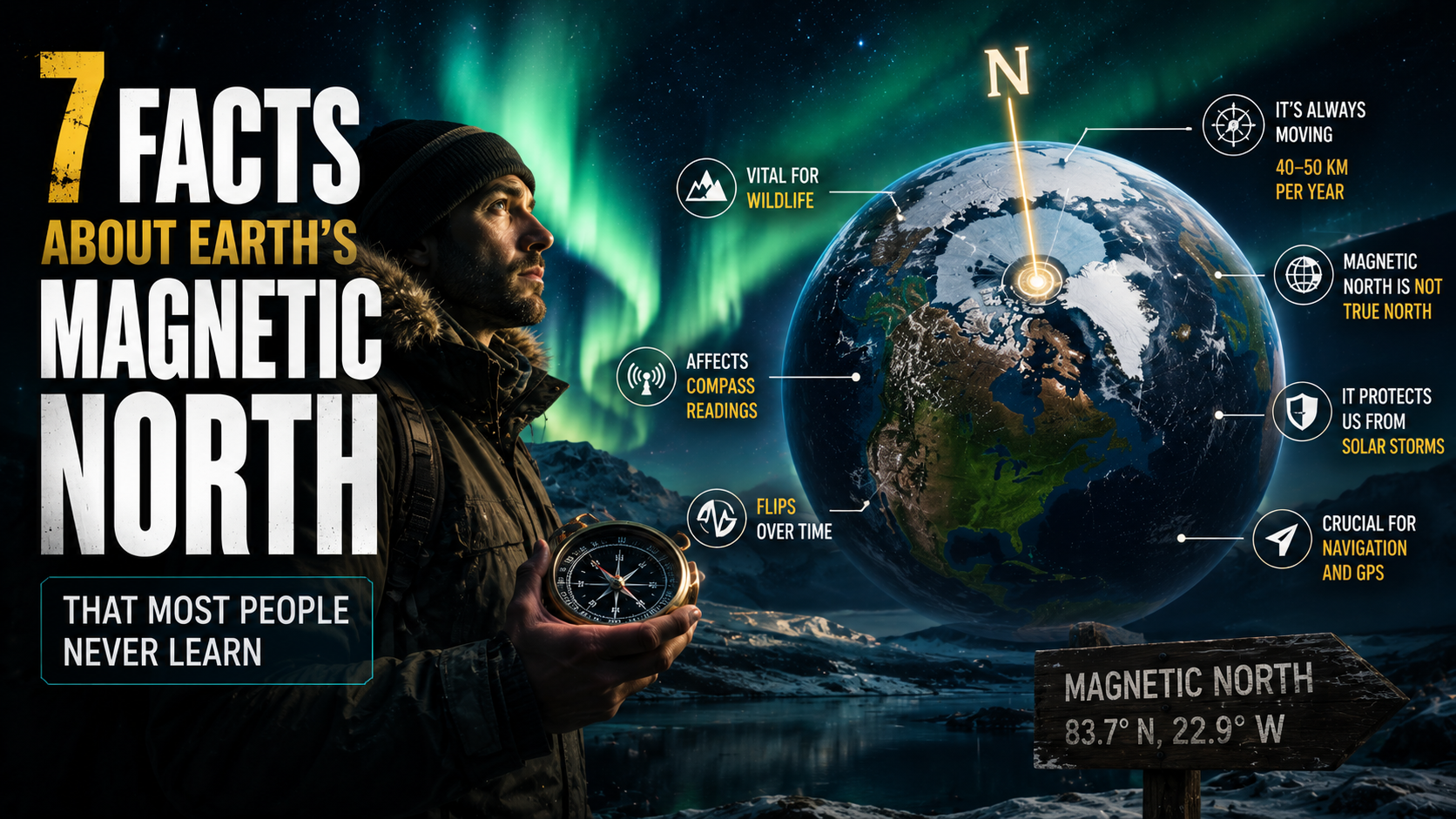
Most of us learn in school that a compass points north. It sounds simple enough: find north, orient yourself, and navigate from there. But the truth behind Earth’s magnetic north is far more fascinating than many people realize.
Unlike the geographic North Pole, which is fixed at the northern end of Earth’s rotational axis, magnetic north is constantly on the move. It shifts across the Arctic, changes speed, influences modern technology, and reveals important clues about what is happening deep inside our planet.
For centuries, explorers, sailors, scientists, and navigators have relied on Earth’s magnetic field. Today, the same magnetic forces help guide everything from airplanes and ships to smartphones and satellites.
Yet despite its importance, magnetic north remains one of the least understood features of our planet.
Here are seven remarkable facts about Earth’s magnetic north that most people never learn.
1. Magnetic North Is Always Moving
Many people assume magnetic north stays in one place.
In reality, it is constantly shifting.
Earth’s magnetic field is generated by the movement of molten iron and nickel within the planet’s outer core. Because these liquid metals are continually flowing, the magnetic field they create changes over time.
As a result, the location of magnetic north gradually drifts.
For much of the twentieth century, magnetic north moved relatively slowly across northern Canada. However, in recent decades, scientists observed it accelerating toward Siberia at a surprisingly rapid pace.
This movement is so significant that researchers must regularly update navigation models to keep maps and positioning systems accurate.
In other words, the north your compass points to today is not exactly the same north it pointed to a few decades ago.
2. Magnetic North and True North Are Not the Same Thing
One of the most common misconceptions involves the difference between magnetic north and geographic north.
Geographic north, often called true north, marks the point where Earth’s axis of rotation intersects the planet’s surface.
Magnetic north is something entirely different.
It represents the point toward which magnetic field lines converge in the Northern Hemisphere.
Because these locations are separate, a compass does not point directly toward the geographic North Pole.
The difference between the two is known as magnetic declination.
Depending on where you are in the world, that difference can range from almost zero to several degrees.
Professional navigators, pilots, surveyors, and military personnel must account for this variation when determining directions.
Without these corrections, long-distance navigation errors can accumulate quickly.
3. The Magnetic Field Starts Deep Inside Earth
What makes magnetic north possible is one of the most extraordinary processes occurring inside our planet.
Thousands of miles beneath our feet lies Earth’s outer core—a vast ocean of liquid iron and nickel.
Temperatures there rival those found on the surface of the Sun.
As this molten metal moves and circulates, it generates electric currents. Those currents create Earth’s magnetic field through a process known as the geodynamo.
Although we cannot directly observe the outer core, scientists use seismic waves, magnetic measurements, and computer simulations to understand how it behaves.
Every compass needle on Earth responds to forces generated deep within this hidden metallic layer.
In a sense, the movement of magnetic north provides a glimpse into processes occurring far below the planet’s surface.
4. Earth’s Magnetic Field Protects Life
Most people think of magnetic north as a navigation tool, but its importance extends far beyond helping people find directions.
Earth’s magnetic field acts as a protective shield against charged particles arriving from space.
The Sun constantly releases streams of energetic particles known as the solar wind. Without a magnetic field, many of these particles could directly impact Earth’s atmosphere.
The magnetosphere—the region dominated by Earth’s magnetic field—helps deflect much of this incoming radiation.
This protection plays a crucial role in preserving the atmosphere and reducing exposure to harmful space weather.
Scientists believe Earth’s magnetic field has contributed significantly to the planet’s long-term habitability.
Without it, life on Earth might look very different today.
5. Magnetic North Has Flipped Before
One of the most surprising discoveries in geophysics is that Earth’s magnetic poles have reversed many times throughout history.
These events are called geomagnetic reversals.
During a reversal, magnetic north and magnetic south effectively swap places.
Evidence for these flips comes from volcanic rocks and ocean-floor formations that preserve records of ancient magnetic fields.
Researchers have identified hundreds of reversals spanning millions of years.
The most recent major reversal occurred roughly 780,000 years ago.
Although some people worry whenever magnetic north shifts rapidly, scientists emphasize that pole movement does not necessarily indicate an imminent reversal.
Reversals unfold over long periods and remain an active area of scientific research.
Still, the fact that Earth’s magnetic poles are not permanent surprises many people.
6. Animals Use Magnetic North for Navigation
Humans are not the only creatures that rely on Earth’s magnetic field.
Numerous animal species appear capable of sensing magnetic information.
Birds are perhaps the most famous example.
Many migratory birds travel thousands of miles during seasonal journeys and use a combination of visual cues, celestial navigation, and magnetic sensing to find their way.
Sea turtles, salmon, whales, bats, and certain insects also appear sensitive to magnetic fields.
Scientists continue investigating exactly how these biological navigation systems work.
Some theories suggest specialized cells or chemical reactions help animals detect magnetic information.
Regardless of the mechanism, Earth’s magnetic field serves as a natural navigation network used by countless species.
This hidden connection between biology and planetary physics remains one of nature’s most fascinating mysteries.
7. Modern Technology Depends on Accurate Magnetic Models
In today’s digital world, it is easy to assume that GPS has replaced magnetic navigation entirely.
The reality is more complicated.
Many technologies still rely on accurate magnetic-field information.
Aircraft navigation systems, military operations, drilling equipment, smartphone compasses, marine navigation systems, and scientific instruments all use magnetic models in various ways.
Because magnetic north continually shifts, scientists regularly update global magnetic field maps.
These updates ensure that navigation systems remain reliable.
When researchers discovered that magnetic north was moving faster than expected, they accelerated updates to the World Magnetic Model used by organizations around the globe.
This demonstrates how changes occurring deep inside Earth can affect technologies people use every day.
Why Magnetic North Is Moving Faster Than Before
One of the biggest questions scientists have been studying involves the recent acceleration of magnetic north’s movement.
For decades, researchers tracked a relatively steady drift.
Then the pace increased.
Current evidence suggests that changes in molten iron flow within Earth’s outer core are responsible.
Scientists have identified complex interactions between magnetic regions beneath Canada and Siberia that appear to influence the pole’s movement.
As conditions inside the core evolve, the magnetic field responds.
Although researchers continue refining their understanding, these observations highlight the dynamic nature of Earth’s interior.
Our planet is far from static.
Even processes occurring thousands of miles below the surface can influence global systems.
How Scientists Track Magnetic North
Monitoring magnetic north requires a combination of advanced technologies.
Ground-based observatories continuously measure magnetic field strength and direction.
Satellites provide global coverage and help scientists detect subtle changes that would be difficult to observe from the surface alone.
By combining these measurements, researchers create detailed models describing Earth’s magnetic field.
These models support navigation, scientific research, and space-weather forecasting.
Without ongoing monitoring, important changes could go unnoticed.
The ability to track magnetic north in near real time represents one of the many ways modern technology helps us understand our planet.
What Happens During Magnetic Storms?
Earth’s magnetic field is not influenced only by processes inside the planet.
Activity on the Sun can also affect magnetic conditions.
Solar flares and coronal mass ejections release enormous amounts of energy into space.
When these events interact with Earth’s magnetosphere, they can produce magnetic storms.
Such storms may disrupt radio communications, interfere with satellites, affect power grids, and create spectacular auroras near the poles.
These events demonstrate that Earth’s magnetic environment is connected to broader activity throughout the solar system.
Magnetic north exists within a dynamic and constantly changing space environment.
The Connection Between Magnetic North and the Aurora
One of the most beautiful consequences of Earth’s magnetic field is the aurora.
Known as the Northern Lights in the Arctic and the Southern Lights in Antarctica, these displays occur when charged solar particles interact with atmospheric gases.
Earth’s magnetic field guides many of these particles toward the polar regions.
As they collide with oxygen and nitrogen in the atmosphere, colorful displays appear in the night sky.
The location and intensity of auroras are closely tied to magnetic field behavior.
In this way, magnetic north helps shape one of nature’s most spectacular phenomena.
Why Magnetic North Matters More Than Ever
As technology becomes increasingly dependent on precise navigation and satellite-based systems, understanding Earth’s magnetic field grows more important.
Space weather forecasting, aviation safety, telecommunications, military operations, scientific research, and environmental monitoring all benefit from accurate magnetic data.
Meanwhile, ongoing changes in magnetic north provide valuable clues about the hidden processes occurring within our planet.
By studying these movements, scientists gain insight into Earth’s interior, magnetic history, and long-term evolution.
Magnetic north is far more than a curiosity—it is a key part of the system that makes our planet function.
Final Thoughts
Earth’s magnetic north is one of the most dynamic and fascinating features of our planet. It moves constantly, differs from geographic north, influences animal migration, protects Earth from harmful solar radiation, and plays a vital role in modern navigation.
Perhaps most surprisingly, it offers a direct connection to processes unfolding deep inside Earth’s molten core—an environment humans will never visit but can still study through its effects.
The next time you see a compass needle pointing north, remember that it is responding to invisible forces generated thousands of miles beneath the surface. Those forces shape navigation, influence technology, guide migrating animals, and help shield our world from the hazards of space.
What seems like a simple direction on a map is actually part of a complex planetary system that continues to evolve every day.