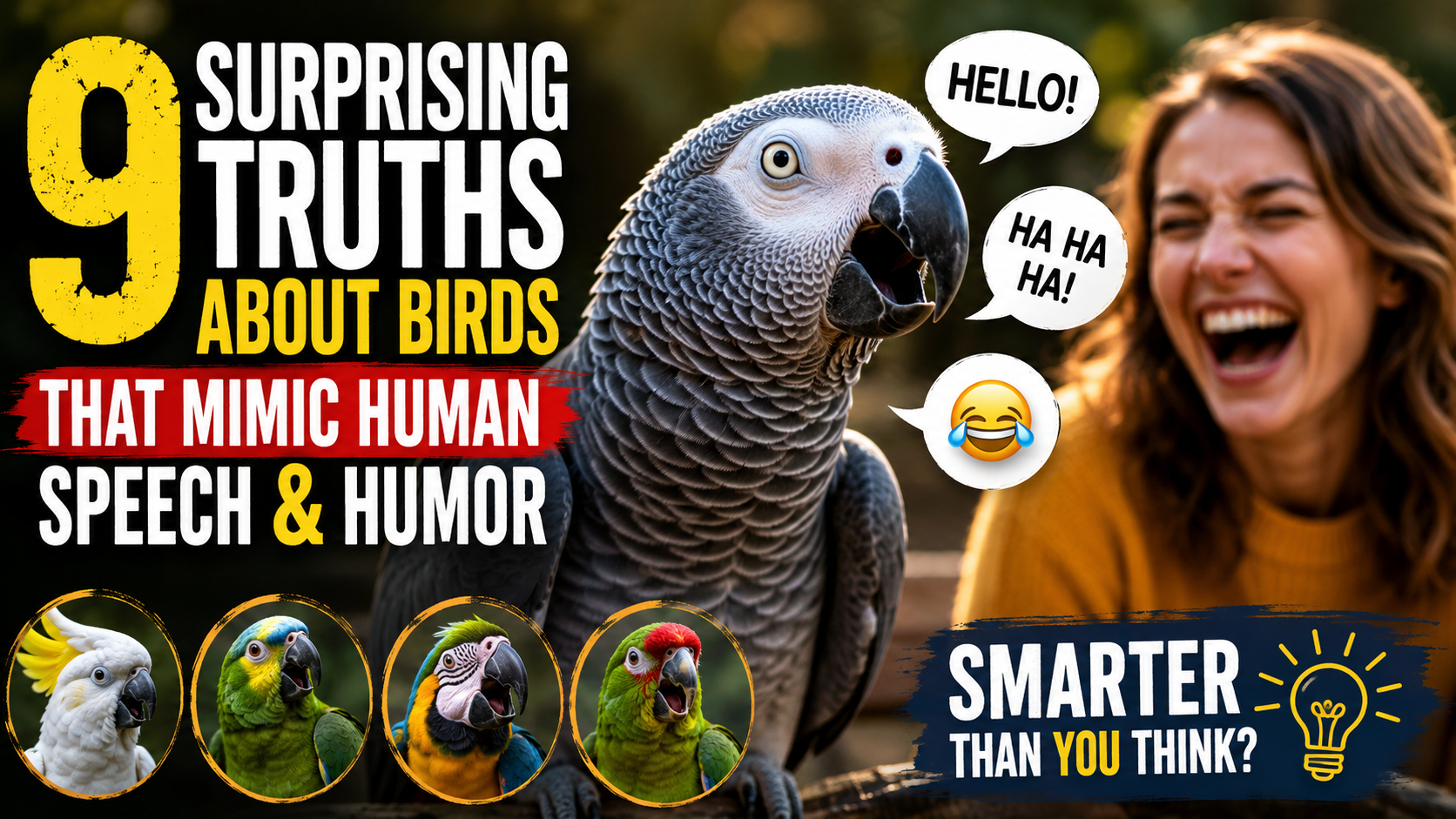
Birds that can mimic human speech have fascinated people for centuries. From ancient civilizations to modern-day pet owners and researchers, talking birds have always sparked curiosity, amusement, and even a sense of mystery.
Among them, African Grey Parrots and a few other intelligent bird species stand out for their exceptional ability not only to copy human words but also to use tone, timing, and repetition in ways that sometimes appear surprisingly intentional—even humorous.
While birds do not “understand humor” in the human sense, their cognitive abilities, social intelligence, and vocal learning skills create behaviors that can seem remarkably similar to it.
Here are nine surprising truths about birds that mimic human speech and appear to display humorous behavior.
1. Birds Don’t Just Repeat Words—They Learn Patterns
One of the most misunderstood aspects of talking birds is the belief that they simply repeat sounds without purpose.
In reality, many species capable of vocal mimicry, especially parrots, are highly skilled pattern learners.
They don’t just copy isolated words; they often associate sounds with specific situations, tones, or responses.
For example, a bird might learn to say “hello” when someone enters a room or repeat laughter after hearing humans laugh.
This ability to connect sounds with context is part of what makes their behavior seem so human-like.
2. African Grey Parrots Are Among the Most Intelligent Birds
African Grey Parrots are widely considered one of the most intelligent bird species on Earth.
Scientific studies have shown that they can:
- Recognize shapes and colors
- Understand basic concepts like quantity
- Associate words with meanings
- Solve simple puzzles
Their intelligence allows them to go beyond mimicry and develop complex vocal behavior that appears surprisingly purposeful.
Because of this cognitive ability, they often become the most famous “talking birds” in zoos and homes.
3. Birds Use Vocal Mimicry as a Social Tool
In the wild, vocal learning plays an important role in communication.
Parrots and similar birds live in social groups where sound is essential for bonding, warning, and interaction.
Mimicking sounds—whether from other birds or humans—can help them fit into their social environment.
In captivity, humans become part of that social structure. As a result, birds begin copying human speech as part of their attempt to engage with their “flock.”
This is why they often repeat phrases they hear frequently in their environment.
4. What Sounds Like Humor May Be Social Reinforcement
Bird behavior that appears humorous—such as laughing sounds or repeated phrases at odd moments—is usually a form of learned reinforcement.
When a bird makes a sound that gets attention or causes humans to react, it is more likely to repeat it.
If a parrot says something funny and people laugh, the bird may associate that sound with positive attention.
Over time, this creates the illusion of intentional humor.
In reality, it is a powerful feedback loop between bird and human interaction.
5. Timing and Tone Matter More Than Words
Birds are extremely sensitive to sound patterns, including tone, pitch, and rhythm.
This means that even if they don’t fully understand language, they can imitate emotional expression.
A parrot may mimic laughter, anger, or excitement simply by copying the sound pattern it hears.
This is one reason why their speech often feels emotionally expressive, even when the words themselves are random or out of context.
Tone gives meaning where vocabulary may not exist.
6. Some Birds Can Learn Hundreds of Words
Certain species of parrots, especially African Greys and Amazons, can learn hundreds of words and phrases over their lifetime.
However, the number of words is less important than how they use them.
Some birds appear to combine sounds creatively, producing new sequences that surprise even experienced bird owners.
While this is not language in the human sense, it demonstrates impressive cognitive flexibility.
It also contributes to the perception that birds are “joking” or improvising speech.
7. Birds Imitate More Than Just Human Voices
Talking birds are not limited to human speech.
They can also mimic:
- Doorbells
- Phone rings
- Laughter
- Other animals
- Environmental sounds
This broad imitation ability shows how adaptable their vocal system is.
In the wild, such mimicry may help them blend into their environment or confuse predators.
In human settings, it leads to entertaining and sometimes unpredictable behavior.
8. Social Environment Strongly Shapes Bird Communication
A bird’s environment plays a major role in how it develops vocal behavior.
Birds raised in quiet or isolated settings may develop fewer vocalizations, while those in active households often become highly vocal.
They pick up sounds from:
- Family conversations
- TV and radio
- Everyday household noises
Over time, their vocal repertoire reflects the environment they are exposed to daily.
This is why no two talking birds sound exactly the same.
Each one develops a unique “sound personality.”
9. Their Intelligence Is Still Not Fully Understood
Despite decades of research, scientists are still uncovering how birds process language-like sounds.
What is clear is that birds with vocal learning abilities have brain structures that differ significantly from those of non-mimicking species.
These brain regions allow them to:
- Learn sounds from memory
- Reproduce complex vocal patterns
- Adjust sounds based on feedback
However, the full extent of their cognitive abilities is still being studied.
Some researchers believe we may be underestimating how sophisticated bird communication truly is.
Why Birds Seem Humorous to Humans
The perception that birds are funny comes from the intersection of intelligence, mimicry, and timing.
When a bird repeats a phrase at the right moment—or unexpectedly—it creates a humorous effect for humans.
But the bird is not intentionally joking. Instead, it is responding to patterns it has learned from its environment.
Humor, in this case, is a human interpretation of intelligent mimicry.
The Role of Bonding in Bird Communication
Talking birds often develop strong emotional bonds with their caretakers.
This bond influences how they communicate.
They may:
- Call for attention
- Repeat familiar phrases when alone
- Respond to emotional tone in human voices
These interactions reinforce their vocal behavior and deepen their connection with humans.
In many ways, talking birds become active participants in household communication.
Conservation and Ethical Considerations
While talking birds are entertaining and intelligent, many species face threats in the wild due to habitat loss and illegal trade.
African Grey Parrots, in particular, have experienced population declines in some regions.
Understanding their intelligence also highlights the importance of protecting them in natural ecosystems.
Responsible ownership and conservation efforts play a key role in ensuring their survival.
Final Thoughts
Birds that mimic human speech are far more than simple imitators. They are intelligent, socially aware creatures capable of learning, adapting, and responding to complex environments.
While their behavior may appear humorous or intentional at times, it is rooted in deep cognitive abilities and social learning processes.
From African Grey Parrots to other vocal learners, these birds continue to challenge what we think we know about animal intelligence.
Their ability to connect with humans through sound makes them one of the most fascinating examples of communication in the natural world.
In the end, their “humor” may not come from understanding jokes—but from the remarkable way they bridge the gap between animal communication and human interaction.







