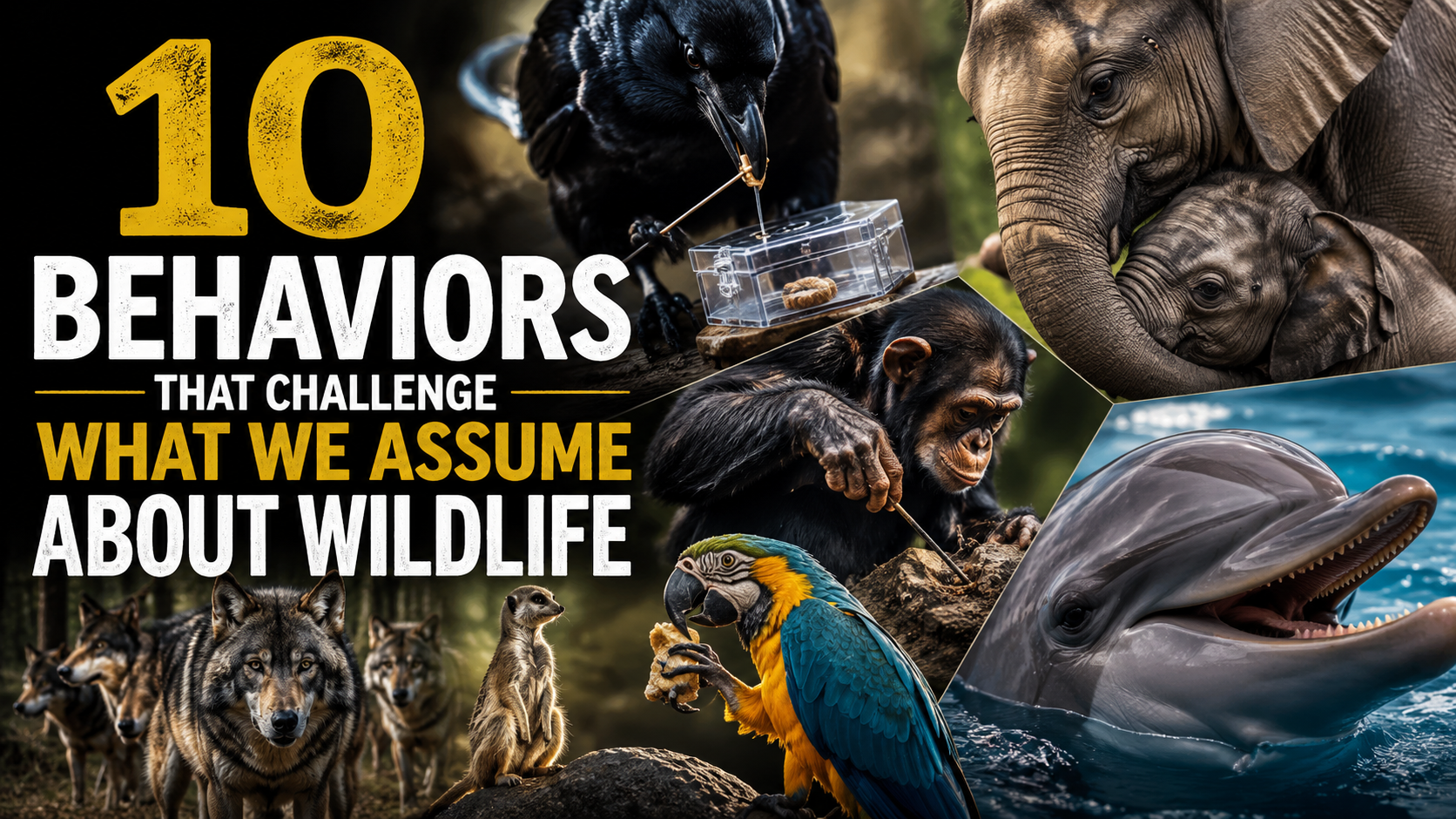
When most people think about wildlife, they often imagine creatures driven purely by instinct. Animals hunt, eat, reproduce, and survive—that’s the traditional view many of us grow up with. But modern research and countless observations from scientists, conservationists, and nature enthusiasts continue to reveal a much more complex picture.
Across the globe, wild animals regularly display behaviors that surprise researchers and challenge long-held assumptions about intelligence, emotions, communication, and social relationships. From problem-solving crows to compassionate elephants, wildlife often demonstrates abilities that blur the line between what humans once believed was uniquely our own.
As technology improves and scientists gain more opportunities to study animals in their natural environments, we’re learning that the natural world is far more sophisticated than we once imagined.
Here are 10 remarkable behaviors that challenge what many people assume about wildlife.
1. Animals Sometimes Help Individuals Outside Their Immediate Group
Many people assume animals only help close relatives because doing so improves their chances of passing on shared genes. While this often happens, researchers have observed numerous examples of animals assisting unrelated individuals.
Dolphins have been seen supporting injured pod members by helping them reach the surface to breathe. Elephants have been observed assisting weaker herd members during difficult journeys. Certain primates even share food with individuals that are not closely related.
These actions suggest that cooperation in nature can extend beyond simple survival calculations.
While scientists continue debating the motivations behind such behaviors, they clearly demonstrate that wildlife social dynamics can be far more complex than many people expect.
2. Wildlife Can Solve Problems in Creative Ways
One of the biggest misconceptions about animals is that they only follow rigid instinctive patterns.
In reality, many species display impressive flexibility when faced with challenges.
Crows have become famous for solving multi-step puzzles, using tools, and even dropping nuts onto roads so passing vehicles can crack them open. Octopuses have escaped enclosures by navigating complicated routes. Some primates modify objects to make food gathering easier.
These examples reveal an ability to adapt behavior to changing circumstances.
Rather than simply reacting automatically, many animals actively explore solutions and learn from experience.
3. Some Species Appear to Plan Ahead
Planning for the future was once considered a uniquely human ability.
However, research increasingly suggests that certain animals may anticipate future needs.
Some birds store food in multiple locations and remember where they placed it weeks later. Certain primates save tools for future use. Squirrels carefully organize food caches that will support them through difficult seasons.
These behaviors indicate more than simple instinct.
They suggest an awareness that future conditions may differ from the present and that preparation can improve survival.
4. Animals Form Long-Term Friendships
Friendship is often viewed as a distinctly human concept, yet many species maintain strong social bonds that last for years.
Elephants frequently seek out familiar companions and show clear preferences for specific individuals. Dolphins build long-term alliances. Primates develop enduring relationships that influence grooming, cooperation, and protection.
These social connections often provide benefits beyond reproduction or immediate survival.
In many cases, animals appear to value trusted companions and maintain those relationships over extended periods.
Such behavior challenges the idea that wildlife interactions are purely transactional.
5. Wildlife Displays Individual Personalities
Not all animals behave the same way.
Researchers studying various species have repeatedly documented personality differences among individuals.
Some animals are naturally bold, while others are cautious. Some are highly social, while others prefer solitude. Certain individuals display curiosity and exploration, while others avoid unfamiliar situations.
Scientists have identified personality traits in animals ranging from birds and fish to mammals and reptiles.
Recognizing personality differences helps explain why members of the same species sometimes behave in surprisingly different ways.
It also challenges the assumption that animals are interchangeable representatives of their species.
6. Animals Can Learn by Watching Others
Learning through observation is another behavior that has transformed our understanding of wildlife.
Young animals often acquire important skills by watching experienced individuals.
Chimpanzees observe tool use. Orcas learn hunting techniques from older pod members. Birds copy songs from adults. Meerkats teach younger members how to handle prey safely.
This process allows knowledge to spread through animal populations.
In some cases, researchers have even identified regional behavioral traditions that resemble simple forms of culture.
The idea that animals can pass learned behaviors across generations challenges older views of animal intelligence.
7. Wildlife Sometimes Shows Signs of Empathy
Empathy remains one of the most debated topics in animal behavior research.
While scientists are careful about assigning human emotions to animals, numerous observations suggest that some species respond to the distress of others in meaningful ways.
Elephants have been seen comforting upset herd members. Primates sometimes console companions after conflicts. Dolphins may assist injured individuals.
These behaviors raise fascinating questions about emotional awareness in animals.
Although researchers continue exploring exactly how these responses work, they clearly indicate that social and emotional lives in wildlife may be richer than previously assumed.
8. Animals Adapt Quickly to Human-Altered Environments
Many people think wildlife struggles to adjust to changing conditions.
While habitat loss remains a serious challenge for countless species, some animals display remarkable adaptability.
Urban foxes navigate city streets with ease. Crows use traffic patterns to access food. Peregrine falcons nest on skyscrapers. Certain monkey populations learn to exploit entirely new food sources.
These examples demonstrate flexibility, innovation, and problem-solving.
Rather than simply surviving in changing environments, some species actively discover new opportunities.
Their adaptability reveals a level of behavioral sophistication that often surprises researchers.
9. Communication in Nature Is More Complex Than We Thought
For decades, animal communication was viewed as relatively simple.
Modern studies tell a different story.
Whales produce elaborate vocalizations that can travel vast distances. Dolphins use signature whistles that function somewhat like individual names. Prairie dogs appear capable of communicating detailed information about potential threats.
Bird songs can contain regional variations, and some species adjust their communication methods depending on environmental conditions.
While animal communication differs greatly from human language, it is often far more nuanced than many people realize.
This growing understanding continues to reshape how scientists view animal cognition.
10. Wildlife Frequently Demonstrates Curiosity
Perhaps one of the most overlooked traits in animals is curiosity.
Many species actively investigate unfamiliar objects, environments, and situations.
Dolphins examine floating items. Ravens explore new objects. Elephants inspect unusual scents and sounds. Primates experiment with unfamiliar materials.
Curiosity plays a vital role in learning and adaptation.
Animals willing to explore the unknown often gain valuable information that improves their chances of survival.
This drive to investigate and understand the world is something humans readily recognize because it mirrors one of our own most important traits.
Why These Behaviors Matter
The growing body of evidence surrounding animal behavior is changing how we think about wildlife.
For centuries, people tended to place humans and animals into completely separate categories. Humans were considered intelligent, emotional, social, and adaptable, while animals were often viewed as creatures guided almost entirely by instinct.
Modern research paints a more nuanced picture.
While humans remain unique in many ways, we now know that numerous traits once considered exclusively human exist elsewhere in nature as well.
Animals solve problems.
They form relationships.
They communicate.
They learn.
They adapt.
And in some cases, they even surprise the scientists studying them.
The Importance of Avoiding Assumptions
One of the biggest lessons wildlife research has taught us is the danger of making assumptions.
The natural world is incredibly diverse, and animal behavior often defies simple explanations.
Scientists continue discovering new examples of intelligence, cooperation, and innovation across a wide range of species. Behaviors that once seemed impossible are now regularly documented through careful observation and advanced technology.
Each discovery reminds us that there is still much to learn.
The more we study wildlife, the more complex and fascinating it becomes.
What These Discoveries Teach Us About Nature
Understanding animal behavior isn’t just interesting—it has practical importance.
Better knowledge of wildlife helps improve conservation efforts, protect endangered species, and create more effective environmental policies.
It also encourages greater respect for the living world.
When people recognize that animals possess complex social lives, learning abilities, and adaptive behaviors, they often develop a deeper appreciation for nature.
This appreciation can inspire stronger support for conservation and environmental protection.
Final Thoughts
Wildlife continues to challenge many of our assumptions about intelligence, emotion, and behavior.
From forming friendships and solving problems to communicating in sophisticated ways and displaying remarkable curiosity, animals consistently reveal capabilities that surprise even experienced researchers.
These 10 behaviors remind us that the natural world is far more intricate than it first appears.
Rather than viewing animals as simple creatures acting solely on instinct, we are increasingly discovering a world filled with learning, adaptation, cooperation, and individuality.
The more we explore that world, the more we realize that nature still has countless secrets waiting to be uncovered.







