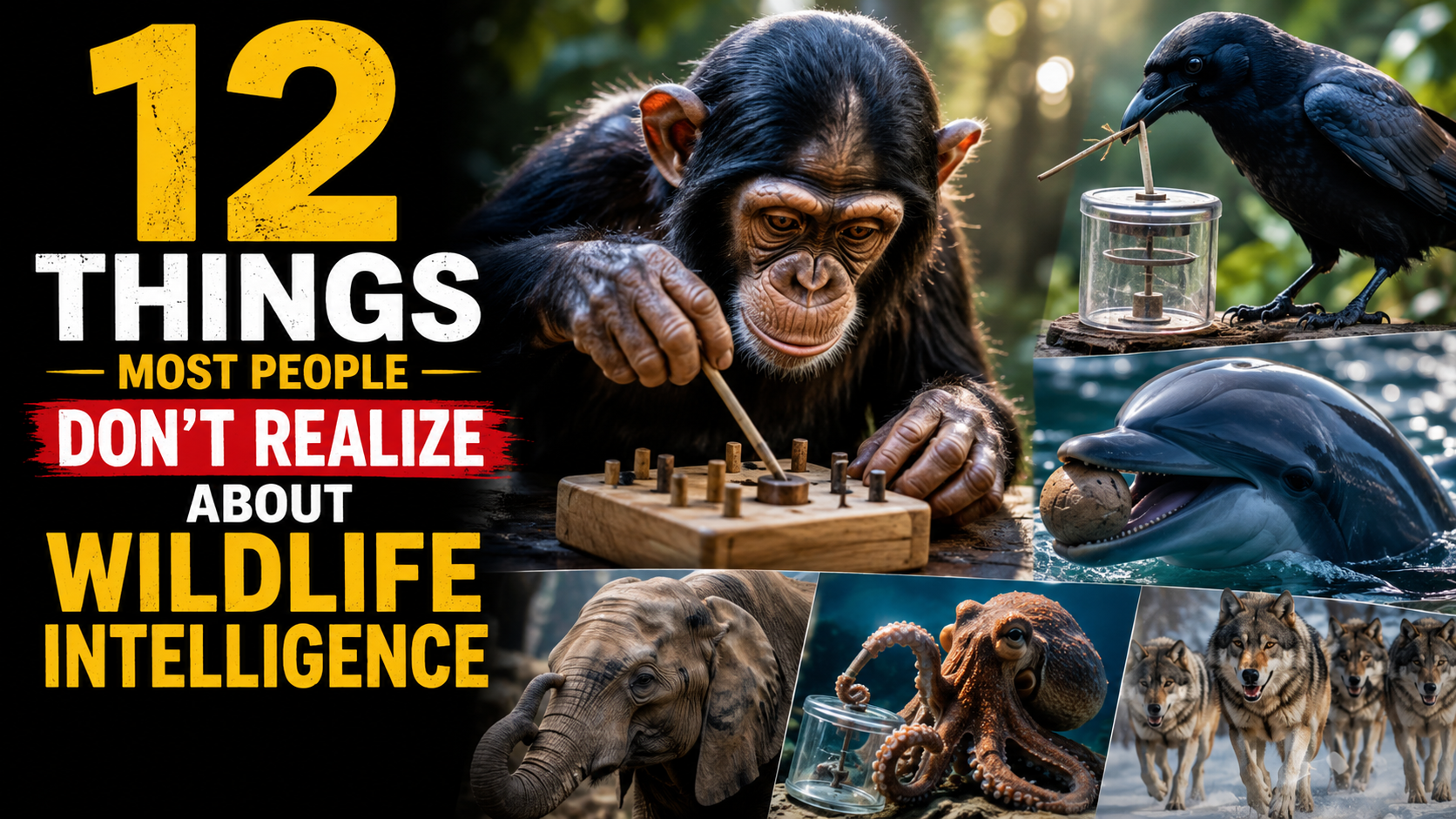
When people think about intelligence, they often picture human achievements—advanced technology, language, mathematics, and complex problem-solving. For a long time, scientists also viewed intelligence through a largely human-centered lens, assuming that other animals operated mostly on instinct.
However, decades of research have transformed our understanding of the animal kingdom. From crows crafting tools to dolphins recognizing themselves in mirrors, evidence continues to show that many wild animals possess mental abilities far more sophisticated than most people realize.
Wildlife intelligence does not look exactly like human intelligence, nor should we expect it to. Different species evolved to solve different challenges. As a result, intelligence appears in many forms throughout nature. Some animals excel at memory, others at communication, social cooperation, navigation, or problem-solving.
The more researchers study wildlife, the more surprising discoveries emerge. Here are 12 fascinating things most people don’t realize about wildlife intelligence.
1. Intelligence Comes in Many Different Forms
One of the biggest misconceptions about animal intelligence is the idea that there is only one way to be smart.
Humans often judge intelligence based on skills that matter to us, such as language, mathematics, or abstract reasoning. But in nature, intelligence is often tied to survival.
A migratory bird that can navigate thousands of miles with remarkable accuracy demonstrates a different type of intelligence than a primate solving a puzzle. Likewise, an octopus escaping a complex enclosure uses abilities that differ from those of a wolf coordinating a hunt.
Scientists increasingly recognize that intelligence is not a single scale. Instead, it consists of multiple abilities shaped by each species’ environment and needs.
2. Some Animals Can Solve Complex Problems
Problem-solving is no longer considered a uniquely human trait.
Researchers have observed numerous species tackling challenges that require creativity and flexibility.
Crows can bend wires into hooks to retrieve food. Octopuses have opened containers, navigated mazes, and escaped aquariums. Certain primates use tools to access food hidden inside difficult-to-reach spaces.
What makes these examples impressive is that the animals often adapt their behavior when initial attempts fail. Rather than relying solely on instinct, they experiment, learn, and modify their approach.
This ability to solve unfamiliar problems is a hallmark of advanced cognition.
3. Wildlife Can Learn From Experience
Learning is one of the clearest signs of intelligence.
Many animals improve their behavior based on previous experiences. They remember successful strategies, avoid past mistakes, and adjust to changing circumstances.
For example, predators may refine hunting techniques over time. Birds can learn which food sources are most reliable. Mammals often alter their behavior after encountering risks or obstacles.
This capacity for learning allows animals to become more efficient and adaptable throughout their lives.
It also demonstrates that wildlife behavior is often far more flexible than many people assume.
4. Some Species Use Tools
Tool use was once considered a defining characteristic of human intelligence.
That assumption changed dramatically when scientists documented animals using objects to achieve specific goals.
Chimpanzees use sticks to extract insects from nests. Sea otters crack shellfish with rocks. Certain birds craft and modify tools to reach food hidden in narrow spaces.
In some cases, animals even improve or customize their tools, suggesting an understanding of cause and effect.
Tool use highlights the ability to solve problems creatively rather than relying solely on physical abilities.
5. Animals Often Possess Extraordinary Memory
Memory plays a critical role in survival, and many animals possess astonishing recall abilities.
Some birds can remember the locations of thousands of food caches months after hiding them. Elephants are known for recognizing migration routes and water sources over vast distances. Dolphins remember social partners for years.
Strong memory allows animals to navigate complex environments, maintain relationships, and respond effectively to changing conditions.
In many cases, their memory skills rival or exceed what humans could accomplish under similar circumstances.
6. Social Intelligence Exists Throughout Nature
Living in groups often requires sophisticated social skills.
Many species must recognize individuals, understand social hierarchies, cooperate with others, and respond appropriately to changing group dynamics.
Wolves coordinate hunting efforts. Dolphins form alliances. Elephants maintain intricate family networks. Primates navigate complex social relationships that can influence access to resources and protection.
These interactions require awareness, communication, and decision-making.
Social intelligence is one of the most fascinating and widespread forms of animal cognition.
7. Communication Is More Advanced Than Most People Think
Animal communication goes far beyond simple sounds or signals.
Researchers have discovered increasingly sophisticated forms of communication across numerous species.
Whales produce elaborate songs that travel great distances. Dolphins use unique whistles associated with specific individuals. Prairie dogs appear capable of communicating detailed information about potential threats.
Birds modify calls depending on environmental conditions, and some species even learn vocalizations from one another.
While animal communication differs from human language, it often contains more complexity than previously believed.
8. Wildlife Can Learn by Watching Others
Observation is an efficient way to acquire knowledge, and many animals use it effectively.
Young animals frequently learn important survival skills by watching experienced members of their group.
Chimpanzees observe tool use. Young predators study hunting techniques. Birds learn songs from adults. Orcas pass hunting strategies from one generation to the next.
This process allows valuable information to spread without every individual needing to learn through trial and error.
The ability to learn socially is considered an important indicator of cognitive sophistication.
9. Some Animals Display Remarkable Curiosity
Curiosity drives exploration, discovery, and learning.
Many wild animals actively investigate unfamiliar objects, locations, and situations.
Ravens inspect new items. Dolphins explore unusual objects in the water. Elephants often approach unfamiliar scents and sounds with noticeable interest.
Curiosity encourages animals to gather information about their surroundings and adapt to changing environments.
Far from being passive creatures, many species appear motivated to explore and understand the world around them.
10. Adaptability Is a Powerful Sign of Intelligence
One of the strongest indicators of intelligence is the ability to adjust when circumstances change.
Animals that can adapt quickly often thrive in challenging environments.
Urban crows use traffic to crack nuts. Foxes navigate cities successfully. Some birds modify nesting behavior to accommodate human development.
These examples demonstrate flexibility rather than rigid instinct.
Adaptable animals evaluate new situations and alter their behavior accordingly, a skill that greatly improves survival chances.
11. Individual Animals Have Distinct Personalities
Scientists once assumed members of the same species behaved largely the same way.
Research now shows that individual personalities exist across a wide range of animals.
Some are bold and adventurous. Others are cautious and reserved. Certain individuals are highly social, while others prefer independence.
Personality differences influence how animals respond to challenges, interact with others, and explore their environments.
Recognizing these individual traits helps explain why behavior can vary dramatically even within a single species.
12. Wildlife Intelligence Continues to Surprise Researchers
Perhaps the most important thing people don’t realize is how much remains unknown.
Every year, new studies reveal unexpected abilities in species that were previously underestimated.
Scientists continue discovering advanced memory skills, innovative problem-solving behaviors, sophisticated communication systems, and social strategies across the animal kingdom.
Many assumptions that seemed reasonable decades ago have been overturned by careful observation and research.
The story of wildlife intelligence is still being written, and each discovery expands our understanding of life on Earth.
Why Wildlife Intelligence Matters
Understanding animal intelligence is about more than satisfying curiosity.
It changes how we view the natural world and our place within it.
When we recognize that animals can learn, remember, solve problems, communicate, and adapt, we gain a deeper appreciation for the complexity of ecosystems. Wildlife is no longer seen as a collection of simple creatures acting purely on instinct. Instead, it becomes a community of diverse species equipped with unique cognitive abilities.
This shift in perspective can also influence conservation efforts. People are often more motivated to protect animals when they understand how sophisticated and remarkable those animals truly are.
The Challenge of Measuring Animal Intelligence
Studying intelligence in wildlife is not always straightforward.
Animals evolved under different environmental pressures than humans. As a result, traditional human-based intelligence tests often fail to capture their strengths.
A crow may excel at solving mechanical problems, while a dolphin may thrive in social communication. An elephant may demonstrate exceptional memory, while an octopus displays extraordinary adaptability.
Comparing these abilities directly is difficult because each species faces unique challenges.
Scientists increasingly focus on understanding intelligence within the context of an animal’s natural environment rather than measuring it against human standards.
What These Discoveries Teach Us
The growing body of research on wildlife intelligence carries an important lesson: intelligence is not exclusive to humans.
Nature has produced countless solutions to survival challenges, resulting in a wide variety of cognitive abilities across different species.
Some animals navigate oceans without maps. Others remember thousands of locations, solve complex puzzles, coordinate group activities, or communicate through sophisticated signals.
These achievements remind us that intelligence can take many forms.
The natural world is filled with minds that operate differently from our own, yet are no less fascinating.
Final Thoughts
Wildlife intelligence is far richer and more diverse than most people realize. From problem-solving and tool use to communication, memory, curiosity, and social learning, animals continue to demonstrate abilities that challenge traditional assumptions about cognition.
The more scientists explore the animal kingdom, the clearer it becomes that intelligence exists on a broad spectrum. Different species excel in different ways, shaped by millions of years of evolution and adaptation.
Rather than asking whether animals are intelligent in the same way humans are, a better question may be this: how many different forms of intelligence exist in nature?
The answer continues to grow with every new discovery, revealing a world that is far more complex, connected, and remarkable than we once imagined.







