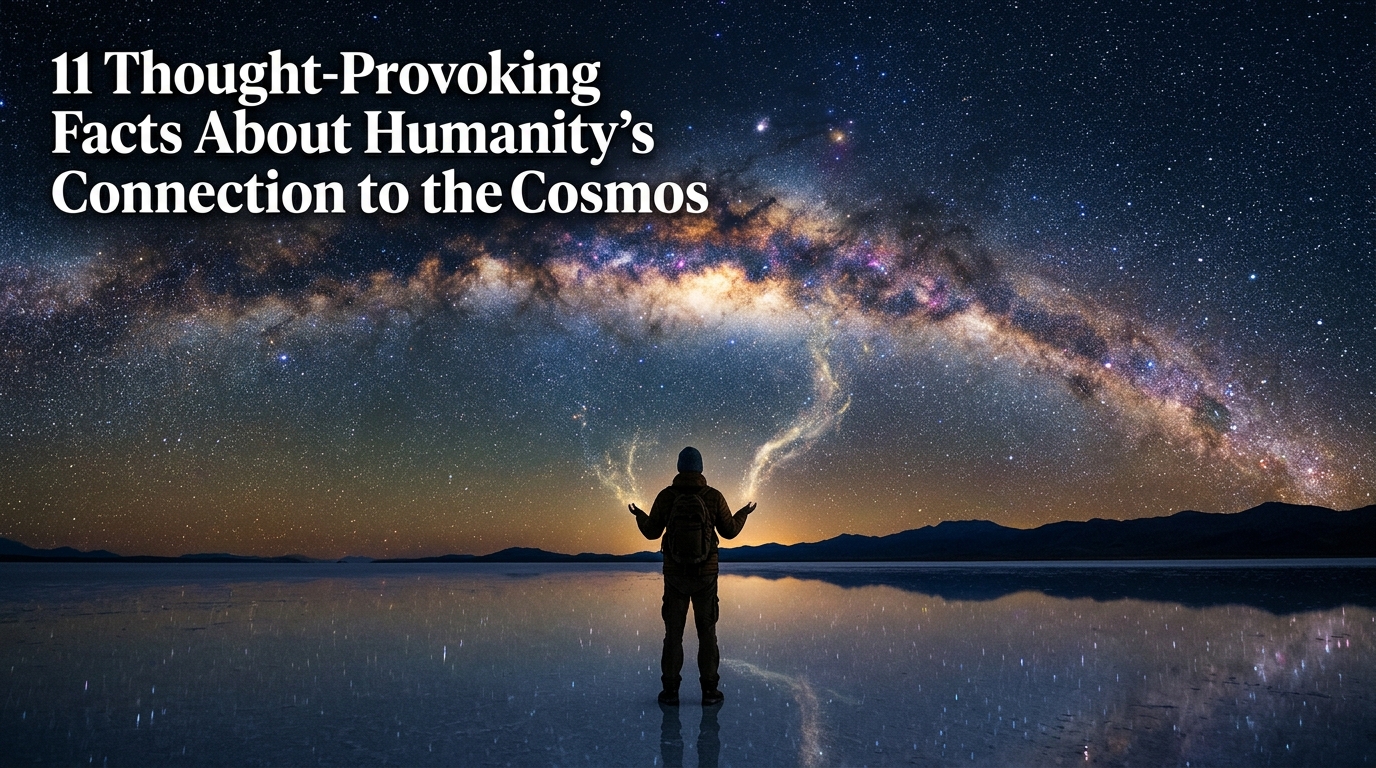
For most of human history, people have looked up at the night sky with a mixture of curiosity, wonder, and awe. Ancient civilizations built monuments aligned with the stars, navigators crossed oceans using celestial landmarks, and philosophers pondered humanity’s place in the universe. Today, modern science has revealed that our connection to the cosmos is far deeper than our ancestors could have imagined.
From the atoms that make up our bodies to the physical laws governing life on Earth, countless links tie humanity to the vast universe beyond our planet. Astronomy, physics, chemistry, and biology continue to uncover remarkable evidence that we are not separate from the cosmos—we are a product of it.
Here are 11 thought-provoking facts about humanity’s connection to the cosmos.
1. Every Person Is Made From Ancient Stardust
One of the most extraordinary discoveries in modern science is that many of the elements found in the human body originated inside stars.
Carbon, oxygen, nitrogen, calcium, iron, and numerous other elements essential for life were forged through nuclear reactions within stars billions of years ago. When those stars reached the ends of their lives, they released these materials into space, where they later became part of new stars, planets, and living organisms.
In a very real sense, every human being is made from recycled stellar material.
2. The Hydrogen in Your Body Predates the Solar System
Hydrogen, the simplest and most abundant element in the universe, has an even older story.
Scientists believe most hydrogen atoms formed shortly after the Big Bang approximately 13.8 billion years ago. Many of the hydrogen atoms found in the water molecules within your body have existed for nearly the entire history of the universe.
This means part of you traces its origins back to the earliest moments of cosmic existence.
3. Earth Is Built From the Remains of Ancient Stars
Our planet itself owes its existence to generations of stars that lived and died long before the Sun formed.
The cloud of gas and dust that eventually became the solar system contained heavy elements produced by earlier stellar generations. Without those ancient stars enriching the universe with carbon, oxygen, silicon, iron, and other elements, rocky planets like Earth could never have formed.
The very ground beneath our feet is part of an ongoing cosmic story.
4. The Same Physical Laws Apply Everywhere
Whether scientists study distant galaxies, black holes, planets, or atoms, the same fundamental laws of physics appear to operate throughout the observable universe.
Gravity, electromagnetism, and the principles of quantum mechanics influence both the largest structures in space and the smallest particles in the human body.
This remarkable consistency connects humanity to every corner of the cosmos through a shared set of natural rules.
5. Your Body Contains Atoms Older Than Earth
Earth formed about 4.5 billion years ago, but many of the atoms in your body are even older.
The carbon in your cells, the oxygen you breathe, and the calcium in your bones may have traveled through multiple stars before becoming part of our solar system. These atoms survived stellar explosions, interstellar journeys, and planetary formation before ultimately becoming part of you.
Your personal history is intertwined with events that occurred billions of years before human civilization emerged.
6. Life Depends on Cosmic Processes
The existence of life on Earth is linked to numerous astronomical events and conditions.
The Sun provides the energy that drives ecosystems and climate systems. Earth’s position within the solar system allows liquid water to exist. The Moon helps stabilize Earth’s axial tilt, contributing to long-term climate stability.
Without these cosmic factors, life as we know it might never have developed.
7. Every Breath Connects You to the Universe
The oxygen you inhale has an extraordinary origin story.
Like many elements essential to life, oxygen was produced inside stars through nuclear fusion. Over billions of years, these atoms became incorporated into planets, oceans, living organisms, and Earth’s atmosphere.
Every breath is a reminder that the chemistry sustaining life began in distant stellar furnaces.
8. Human Bodies Follow the Same Chemistry as the Stars
Although stars and humans appear vastly different, both are governed by the same chemical principles.
Atoms combine according to universal rules, whether they are forming molecules in living cells or participating in reactions within stars. The periodic table applies equally to galaxies, planets, oceans, and biological organisms.
This shared chemistry highlights the deep connection between life and the wider universe.
9. We Are Observing the Universe Looking Back at Itself
Some scientists and philosophers have noted a fascinating idea: through conscious beings, the universe has developed the ability to observe and study itself.
Humanity is composed of matter that originated within the cosmos, yet that same matter has evolved the capacity to ask questions about its own origins. Telescopes, spacecraft, and scientific instruments allow us to investigate the universe from which we emerged.
It is a unique and thought-provoking perspective on our place in existence.
10. The Night Sky Contains Our Deep History
When astronomers observe distant stars and galaxies, they are effectively looking back in time.
Because light takes time to travel across space, telescopes reveal objects as they appeared years, centuries, millions, or even billions of years ago. By studying the cosmos, scientists can reconstruct the history of the universe and better understand the processes that ultimately made life possible.
The night sky serves as a vast archive of cosmic history.
11. Humanity Shares a Common Cosmic Origin
Despite differences in nationality, culture, language, or background, every person on Earth shares the same fundamental cosmic heritage.
The atoms that make up all human beings originated through the same universal processes. Every person traces their existence to the same planet, the same solar system, and ultimately the same cosmic beginnings.
This shared origin offers a powerful reminder of our interconnectedness—not only with one another but with the universe itself.
Why Our Cosmic Connection Matters
Understanding humanity’s relationship with the cosmos can change how we view ourselves and our world. Rather than existing apart from nature, we are deeply embedded within a vast cosmic system that spans billions of years and unimaginable distances.
Scientific discoveries continue to reveal that many aspects of our existence—from the elements in our bodies to the conditions that support life—are tied to events that occurred long before Earth formed. These connections help place human life within a broader context and inspire a greater appreciation for the universe we inhabit.
For many people, this perspective fosters a sense of wonder, curiosity, and humility.
Conclusion
Humanity’s connection to the cosmos extends far beyond simply living on a planet that orbits a star. The atoms in our bodies were forged in ancient stars, our existence depends on cosmic processes, and the same physical laws govern both the universe and ourselves.
From the earliest moments after the Big Bang to the formation of Earth and the evolution of life, our story is inseparable from the story of the cosmos. Every person carries within them a history that stretches across billions of years and countless celestial events.
The next time you look at the stars, remember that the connection is more than symbolic. The universe is not merely something we observe from afar—it is the very source of the matter, energy, and history that make our existence possible.