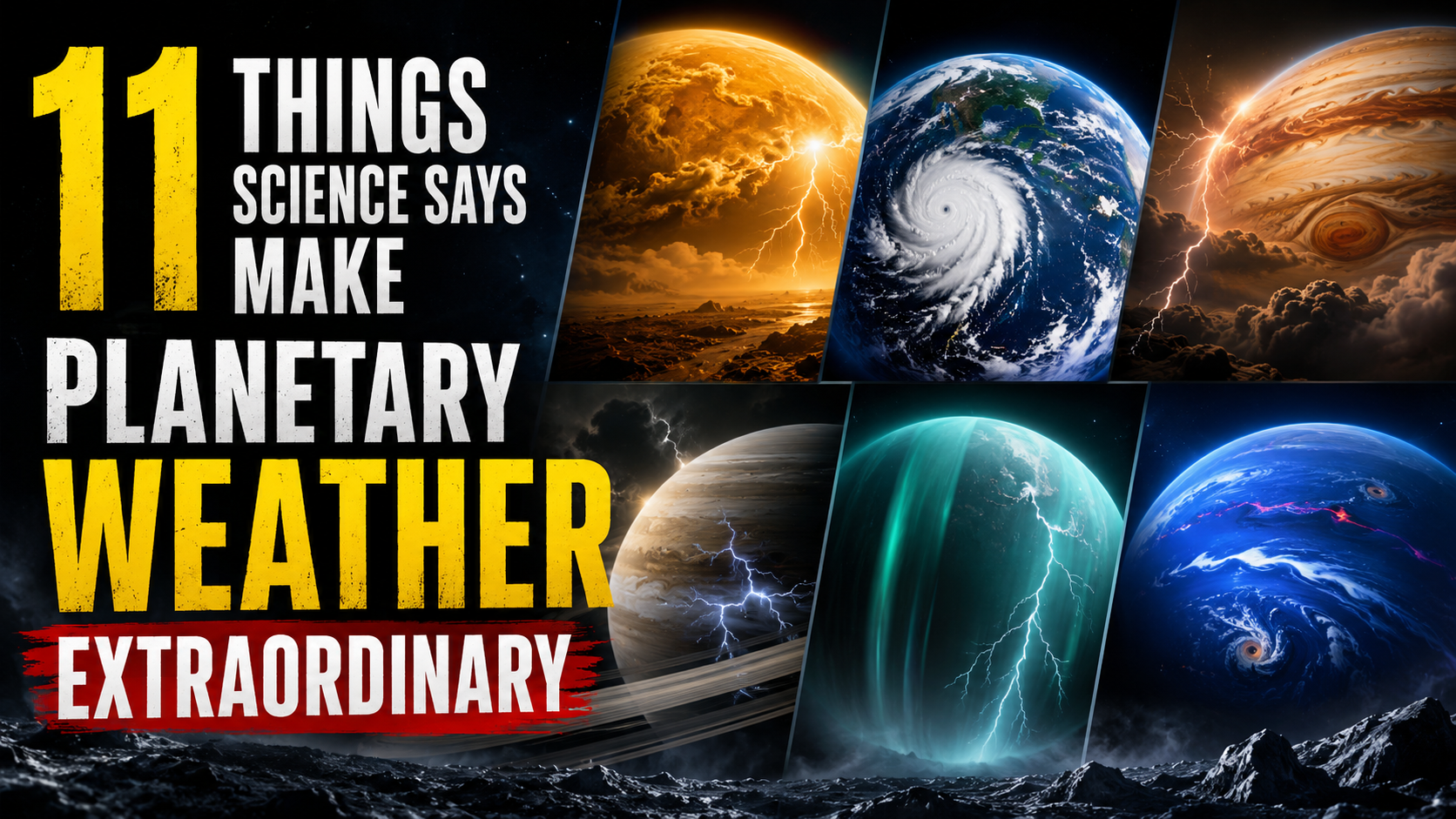
When people think about weather, they usually imagine familiar events such as rain, snow, thunderstorms, or heat waves. On Earth, weather shapes daily life, influences ecosystems, and even affects human history. Yet our planet’s weather is only a tiny example of what nature can create.
Across the solar system, scientists have discovered weather conditions that seem almost impossible. Some planets experience winds faster than the speed of sound. Others have storms larger than Earth itself. There are worlds where temperatures melt metal, clouds contain toxic chemicals, and rain may consist of substances that sound more like science fiction than science.
The more researchers learn about planetary atmospheres, the more they realize that Earth’s weather is relatively mild. Here are 11 fascinating reasons why planetary weather is among the most extraordinary phenomena in the universe.
1. Some Planets Experience Rain That Isn’t Water
On Earth, rain is simple: water evaporates, forms clouds, and falls back to the ground.
Elsewhere in the solar system, things become much stranger.
Venus has clouds made largely of sulfuric acid. Scientists believe droplets of sulfuric acid form high in the atmosphere before evaporating long before reaching the surface because of the planet’s intense heat.
Meanwhile, researchers suspect that deep inside Uranus and Neptune, immense pressure may transform carbon into diamonds that could fall through the atmosphere like glittering rain.
The idea of diamond rain sounds unbelievable, but physics suggests it may be possible under the extreme conditions found inside these giant planets.
2. Winds Can Reach Incredible Speeds
Earth occasionally experiences hurricanes with winds exceeding 150 miles per hour. Those storms are powerful enough to cause widespread destruction.
Neptune makes even the strongest Earth storms look modest.
Scientists have recorded winds exceeding 1,200 miles per hour on Neptune, making them among the fastest observed anywhere in the solar system.
These winds blow despite the planet receiving very little sunlight compared to Earth.
Researchers are still investigating how Neptune generates and maintains such extraordinary atmospheric energy.
3. Some Storms Last for Centuries
Most weather systems on Earth are relatively short-lived.
Thunderstorms may last hours. Hurricanes survive days or weeks.
Jupiter hosts a storm unlike anything seen on Earth.
Known as the Great Red Spot, this gigantic storm has been raging for centuries. It is so large that multiple Earth-sized planets could fit inside it.
Although the storm has gradually changed size over time, it remains one of the most iconic examples of extreme weather in our solar system.
4. Temperatures Vary Beyond Human Imagination
Weather is heavily influenced by temperature.
On Earth, a difference of a few dozen degrees can dramatically alter conditions.
Across the solar system, temperatures reach astonishing extremes.
Venus is hot enough to melt lead, with surface temperatures around 900°F (475°C). Meanwhile, distant planets and moons can plunge hundreds of degrees below zero.
These temperature differences influence atmospheric circulation, cloud formation, and weather patterns in ways that have no direct comparison on Earth.
5. Clouds Come in Unexpected Forms
When most people picture clouds, they imagine water vapor floating in the sky.
Planetary science reveals a much broader range of possibilities.
Clouds on other worlds may contain:
- Sulfuric acid
- Methane
- Ammonia
- Hydrocarbons
- Exotic ice crystals
Each type of cloud forms under specific environmental conditions.
Studying these unusual cloud systems helps scientists understand atmospheric chemistry and the diversity of planetary environments.
6. Planetary Atmospheres Can Be Astonishingly Thick
Earth’s atmosphere is relatively thin compared to some planetary neighbors.
Venus provides an excellent example.
Its atmosphere is roughly 90 times denser than Earth’s. Standing on the surface of Venus would feel somewhat like being deep beneath Earth’s oceans due to the immense pressure.
This dense atmosphere traps heat through a runaway greenhouse effect, creating one of the most hostile climates known in the solar system.
Atmospheric density plays a major role in shaping weather patterns and surface conditions.
7. Seasons Can Last for Decades
Earth experiences four seasons each year because of its tilt and orbital motion.
On planets farther from the Sun, seasons can last much longer.
Uranus takes approximately 84 Earth years to complete one orbit around the Sun.
As a result, each season can persist for more than two decades.
The planet’s unusual tilt causes extreme seasonal changes, with parts of the world experiencing prolonged periods of sunlight or darkness.
These lengthy seasons create atmospheric conditions unlike anything found on Earth.
8. Lightning Exists Beyond Our Planet
Lightning is not unique to Earth.
Scientists have detected evidence of lightning on several planets, including Jupiter and Saturn.
In fact, lightning storms on gas giants may be far more energetic than those on Earth.
These electrical discharges help researchers study atmospheric dynamics and energy transfer within planetary weather systems.
Lightning remains one of the most powerful natural phenomena throughout the solar system.
9. Weather Can Shape Entire Planets
On Earth, weather influences landscapes through erosion, precipitation, and wind.
Other planets experience similar processes, sometimes on a much larger scale.
Wind can sculpt dunes, transport particles, and alter surface features over long periods.
Even worlds with thin atmospheres can experience weather-driven changes.
Understanding these interactions helps scientists reconstruct planetary histories and better understand how different environments evolve.
Weather is not merely a temporary condition—it can be a powerful geological force.
10. Planetary Weather Helps Scientists Search for Habitable Worlds
One reason scientists study planetary weather so closely is its connection to habitability.
Atmospheres regulate temperature, distribute energy, and influence the presence of liquid water.
By understanding weather systems throughout our solar system, researchers improve their ability to evaluate distant exoplanets.
Questions scientists ask include:
- Can liquid water exist there?
- Is the atmosphere stable?
- Are temperatures suitable for life?
- How does weather affect surface conditions?
The search for life beyond Earth depends heavily on understanding planetary climates.
11. Every New Discovery Reveals More Complexity
One of the most remarkable findings in planetary science is that every world appears unique.
Scientists once assumed that weather followed relatively simple rules.
Modern observations reveal astonishing complexity.
Each planet combines different factors:
- Atmospheric composition
- Temperature
- Gravity
- Rotation speed
- Solar energy
- Internal heat
These ingredients produce weather systems unlike any others.
The more we explore, the more diverse and surprising planetary environments become.
Why Planetary Weather Fascinates Scientists
Weather offers clues about how planets function.
Atmospheric behavior reflects deeper processes occurring within a planet’s interior, surface, and surrounding environment.
By studying weather, researchers gain insights into:
- Climate evolution
- Atmospheric chemistry
- Planetary formation
- Potential habitability
- Long-term environmental change
Weather acts as a visible expression of a planet’s underlying characteristics.
In many ways, understanding weather means understanding the planet itself.
Earth’s Weather Is More Special Than We Often Realize
Learning about other planets can increase appreciation for our own.
Earth’s atmosphere provides a delicate balance that supports life.
Temperatures remain within a relatively narrow range. Water cycles continuously between oceans, clouds, and land. Oxygen supports complex organisms, while weather systems distribute heat around the globe.
Compared with sulfuric acid clouds, diamond rain, and centuries-long storms, Earth’s weather appears remarkably friendly.
That balance may be one reason life has flourished here for billions of years.
The Future of Planetary Weather Research
New telescopes and space missions are expanding our knowledge of planetary climates.
Scientists are now studying not only the planets in our solar system but also thousands of worlds orbiting distant stars.
Future discoveries may reveal:
- Exotic cloud systems
- New forms of precipitation
- Unexpected atmospheric chemistry
- Potentially habitable environments
As technology improves, researchers will continue uncovering weather phenomena that challenge our imagination.
The universe likely contains atmospheric conditions far stranger than anything discovered so far.
Final Thoughts
Planetary weather is one of the most fascinating subjects in modern science because it reveals how creative nature can be. From sulfuric acid clouds on Venus to possible diamond rain deep within Neptune and Uranus, the solar system is filled with weather systems that seem almost unbelievable.
These extraordinary conditions remind us that Earth is only one example among countless planetary environments. Every world follows the same fundamental laws of physics, yet each produces dramatically different results. As scientists continue exploring the solar system and beyond, planetary weather will remain a powerful window into understanding how planets form, evolve, and perhaps even support life. The skies above other worlds may be strange, extreme, and sometimes hostile—but they also tell some of the most remarkable stories in the universe







