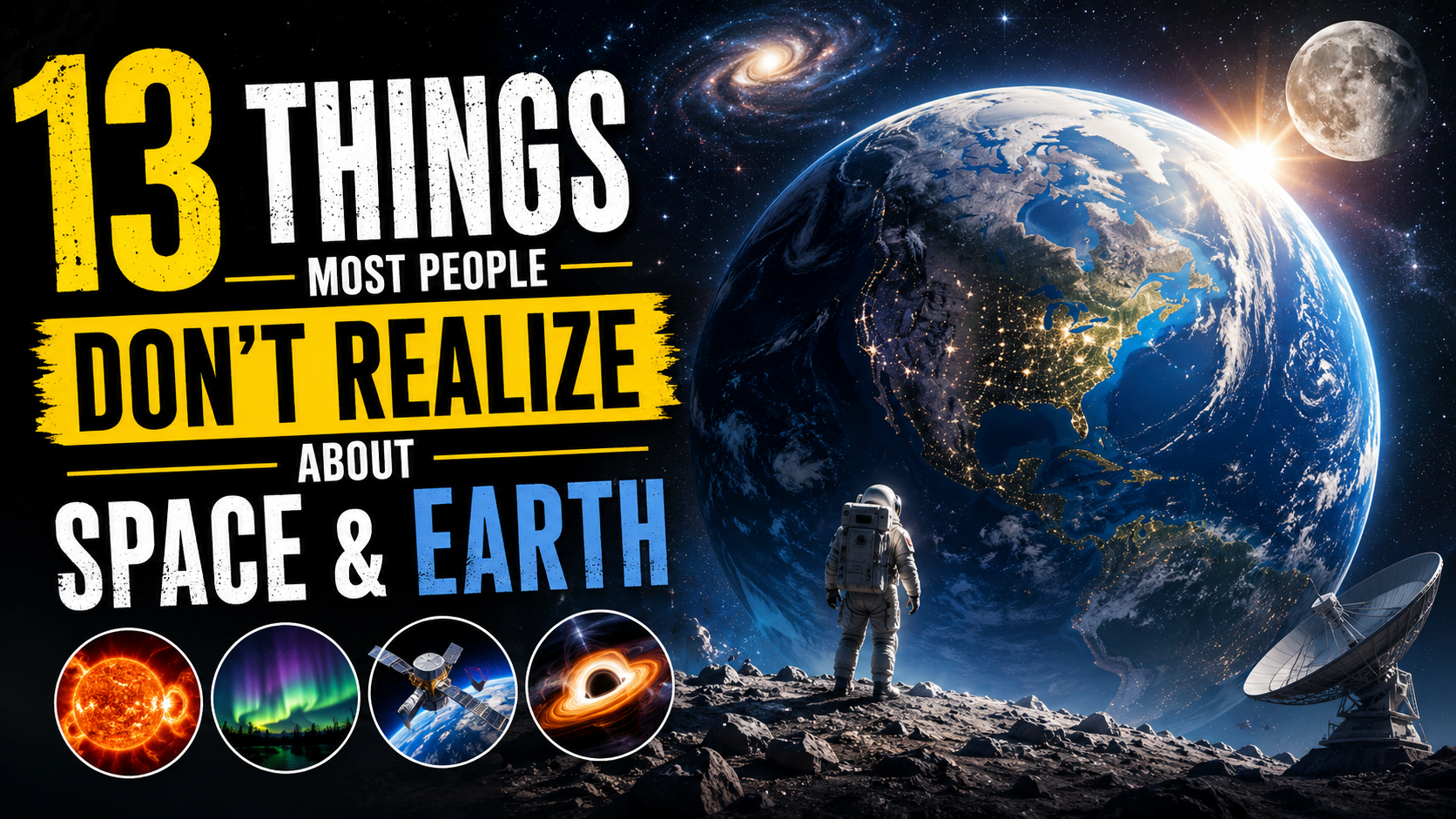
When we look up at the night sky, it’s easy to feel like Earth is the center of everything. After all, it’s the only world we’ve ever known. Yet modern science has revealed a humbling reality: our planet is just one small part of an unimaginably vast and dynamic universe.
What’s even more surprising is that many of the forces shaping our daily lives originate far beyond Earth’s atmosphere. The Sun, the Moon, magnetic fields, cosmic radiation, and distant celestial events all influence the planet in ways most people rarely think about.
At the same time, Earth itself possesses remarkable features that make life possible. From an invisible protective shield surrounding the planet to delicate atmospheric systems that regulate temperature, our world is far more extraordinary than it appears from the ground.
Here are 13 fascinating things most people don’t realize about space and Earth.
1. Earth Travels Through Space at Incredible Speeds
Although it feels like we’re standing still, Earth is constantly moving.
The planet rotates on its axis at roughly 1,000 miles per hour near the equator. At the same time, it orbits the Sun at about 67,000 miles per hour.
But that’s not all.
Our entire solar system is moving through the Milky Way galaxy, and the galaxy itself is traveling through the universe.
In other words, every person on Earth is moving at extraordinary speeds right now without feeling a thing.
This happens because everything around us moves together.
2. Earth’s Magnetic Field Acts Like a Giant Shield
One of the most important reasons life exists on Earth is something we cannot see.
Earth generates a powerful magnetic field that extends far into space. This invisible barrier helps deflect charged particles streaming from the Sun.
Without it, solar radiation could gradually strip away parts of the atmosphere and expose living organisms to far greater levels of harmful radiation.
Scientists often describe the magnetic field as one of the planet’s most important natural defense systems.
It’s quietly protecting life every second of every day.
3. Space Isn’t Completely Empty
Many people imagine space as a perfect vacuum containing absolutely nothing.
While space is extremely empty compared with Earth, it isn’t entirely vacant.
Tiny particles, gas clouds, magnetic fields, radiation, and microscopic dust exist throughout the cosmos.
Massive regions between stars contain enormous clouds of hydrogen and other materials that eventually help form new stars and planets.
The universe may appear empty from a distance, but it is far more active than it seems.
4. The Moon Does More Than Light Up the Night Sky
The Moon influences Earth in ways many people overlook.
Its gravitational pull creates ocean tides and helps stabilize Earth’s axial tilt.
This stability contributes to relatively predictable seasons and long-term climate patterns.
Some scientists believe the Moon played an important role in making Earth a suitable environment for life.
Without our natural satellite, the planet might look very different today.
5. Earth’s Atmosphere Is Surprisingly Thin
When viewed from space, Earth’s atmosphere appears as a delicate blue layer surrounding the planet.
Although it feels vast from the ground, the breathable portion of the atmosphere is surprisingly thin relative to Earth’s size.
This fragile blanket protects life by regulating temperature, blocking harmful radiation, and supporting weather systems.
Without it, Earth would resemble a far more hostile world.
Its thinness serves as a reminder of how precious and vulnerable our environment truly is.
6. The Sun Powers Almost Everything We Do
Nearly all life on Earth depends on solar energy.
Plants convert sunlight into energy through photosynthesis, forming the foundation of most food chains.
Solar energy also drives weather patterns, ocean currents, and climate systems.
Even many fossil fuels originated from ancient organisms that ultimately relied on sunlight.
The Sun’s influence reaches nearly every aspect of life, whether we notice it or not.
7. Earth Is Constantly Bombarded by Space Debris
Every day, thousands of tons of dust and tiny particles enter Earth’s atmosphere from space.
Fortunately, most are extremely small.
As they encounter atmospheric friction, they burn up and create brief streaks of light commonly known as meteors or shooting stars.
Most never reach the surface.
This ongoing process means Earth is continuously interacting with material from space.
8. There Are More Stars Than Most People Can Imagine
The numbers involved in astronomy can be difficult to comprehend.
Our Milky Way galaxy alone contains hundreds of billions of stars.
Beyond that, scientists estimate there are hundreds of billions of galaxies in the observable universe.
The total number of stars likely exceeds the number of grains of sand on all Earth’s beaches combined.
These staggering figures highlight just how enormous the universe truly is.
9. Earth Is Located in a Rare “Habitable Zone”
Scientists often refer to Earth’s location as being within the Sun’s habitable zone.
This means the planet orbits at a distance where temperatures allow liquid water to exist on the surface.
Too close to the Sun and water would evaporate.
Too far away and it would freeze.
While other factors also contribute to habitability, Earth’s position plays a crucial role in supporting life.
It’s one of several fortunate circumstances that make our planet unique.
10. Space Weather Can Affect Daily Life
Weather doesn’t only happen on Earth.
The Sun regularly produces bursts of energy and charged particles known as solar storms.
These events can interact with Earth’s magnetic field and occasionally affect satellites, communication systems, navigation technology, and power grids.
Most people never notice these events, but scientists monitor them closely.
As technology becomes increasingly important, understanding space weather becomes even more essential.
11. Earth Recycles Its Surface
Unlike many worlds in the solar system, Earth has active plate tectonics.
The planet’s outer shell is divided into massive plates that slowly move over time.
These movements create mountains, earthquakes, volcanoes, and ocean trenches.
They also recycle materials between Earth’s surface and interior.
This geological activity helps regulate long-term environmental conditions and contributes to the planet’s continued habitability.
12. We Are Made From Ancient Stardust
One of the most astonishing facts in science is that the elements within our bodies were created long before Earth existed.
Hydrogen originated shortly after the universe formed.
Heavier elements such as carbon, oxygen, calcium, and iron were forged inside stars.
When those stars died, they scattered these materials across space.
Eventually, some of that cosmic material became part of the solar system, Earth, and every living thing.
In a very real sense, humans are connected to the stars.
13. Scientists Still Know Less Than You Might Think
Despite centuries of discovery, many fundamental questions remain unanswered.
Researchers continue investigating mysteries involving dark matter, dark energy, black holes, planetary formation, and the possibility of life elsewhere in the universe.
Even Earth still holds secrets.
Large portions of the deep ocean remain unexplored, and scientists regularly discover new species and geological features.
The more we learn, the more we realize there is still much left to understand.
Why Understanding Space Helps Us Understand Earth
It’s easy to think of astronomy and Earth science as separate fields, but they are deeply connected.
Studying the Sun helps scientists predict solar storms.
Investigating planetary atmospheres improves climate models.
Exploring other worlds provides valuable context for understanding Earth’s history and future.
By looking outward into space, researchers often gain new insights about our own planet.
This connection makes space exploration far more relevant to everyday life than many people realize.
The Importance of Scientific Curiosity
Many of humanity’s greatest discoveries began with simple questions.
Why do planets move?
What causes seasons?
How do stars form?
Could life exist elsewhere?
Curiosity drives scientific progress and helps expand our understanding of the universe.
Every new answer often leads to even more questions, creating a continuous journey of discovery.
That process has transformed our view of both Earth and the cosmos.
A Perspective That Changes Everything
One of the most powerful lessons from space science is perspective.
When astronauts view Earth from orbit, many describe a profound realization.
National borders disappear.
Differences between people seem smaller.
The planet appears as a single interconnected world floating in the darkness of space.
This perspective highlights both the fragility and the rarity of our home.
Earth is not merely where we live—it is currently the only known place in the universe capable of supporting human civilization.
Final Thoughts
Space and Earth are connected in ways that many people rarely consider. From the magnetic field that shields us from solar storms to the stardust that forms our bodies, countless invisible forces shape our existence every day.
The more scientists learn about the universe, the more extraordinary our planet appears. Earth occupies a unique position within a vast cosmic landscape, protected by delicate systems that make life possible.
Perhaps the most surprising realization is that despite centuries of exploration, we are still only beginning to understand our place in the universe. Every discovery reveals new mysteries, reminding us that the story of Earth and space is far from complete.
And that may be the most fascinating fact of all.







