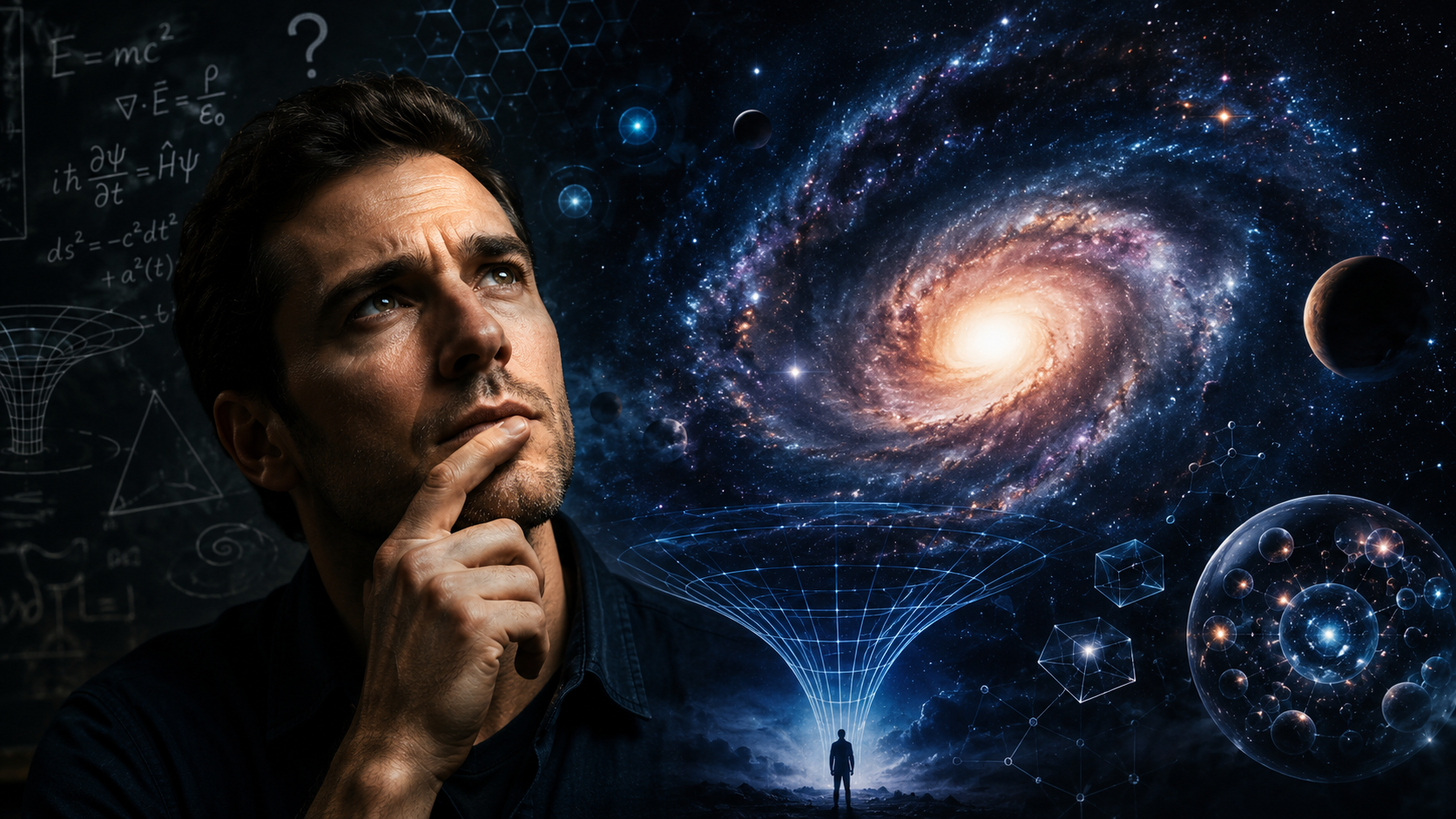
For centuries, humanity has tried to understand the true nature of the universe. From ancient stargazers mapping the night sky to modern physicists studying the smallest subatomic particles, each generation has uncovered new pieces of a puzzle that seems to grow more intricate with every discovery.
Despite tremendous advances in science, some of the biggest questions remain unanswered. What is the universe made of? How did it begin? Are there dimensions beyond those we can perceive? Is reality itself more complicated than it appears?
To explore these mysteries, scientists have developed theories that push the boundaries of our imagination. Some are supported by strong mathematical frameworks, while others remain highly speculative. Together, they reveal a fascinating possibility: the cosmos may be far more complex than our everyday experience suggests.
Here are eight theories that propose the universe is much stranger and more intricate than we currently understand.
1. The Multiverse Theory
One of the most captivating ideas in modern physics is the possibility that our universe is only one of many.
According to various versions of the multiverse theory, countless universes could exist beyond our own, each with different physical laws, constants, or histories. Some may be nearly identical to ours, while others could be radically different.
Certain interpretations of cosmic inflation and quantum mechanics provide theoretical foundations for this concept. Although there is currently no direct evidence proving the existence of other universes, the idea continues to attract serious scientific discussion.
If true, our universe may represent just a tiny fraction of a much larger cosmic reality.
2. String Theory and Extra Dimensions
Most people experience the world in three dimensions of space and one dimension of time. However, string theory suggests reality may contain many more dimensions than we can perceive.
According to this framework, the fundamental building blocks of nature are not point-like particles but tiny vibrating strings. Different vibration patterns produce different particles and forces.
For the mathematics of string theory to work, additional spatial dimensions are often required—sometimes as many as ten or eleven total dimensions.
These extra dimensions could be curled up at scales far too small to detect directly, hidden within the fabric of space itself.
3. Dark Matter
Everything humans can see—stars, planets, galaxies, gas clouds, and people—accounts for only a small fraction of the universe.
Astronomers have discovered that galaxies rotate in ways that cannot be explained by visible matter alone. Something unseen appears to provide additional gravitational influence.
This mysterious substance is called dark matter.
Although scientists have not yet identified exactly what dark matter is, evidence suggests it makes up a significant portion of the universe’s total mass. If confirmed, it means most of the matter in existence remains invisible and largely unknown.
4. Dark Energy
As surprising as dark matter may be, dark energy presents an even greater mystery.
Observations indicate that the expansion of the universe is accelerating rather than slowing down. To explain this phenomenon, scientists propose the existence of dark energy—a mysterious force or property of space itself that drives cosmic expansion.
Dark energy is estimated to make up the majority of the universe’s total energy content.
Despite its apparent importance, researchers still do not fully understand what dark energy is or how it works, making it one of the greatest unsolved problems in science.
5. The Holographic Universe Hypothesis
The holographic principle suggests that the universe may function in a way that challenges our deepest assumptions about reality.
This idea proposes that all the information contained within a three-dimensional region of space could be encoded on a two-dimensional boundary. In essence, our three-dimensional universe might emerge from information stored on a lower-dimensional surface.
The concept originated from studies of black holes and quantum gravity and has become an important area of theoretical research.
If correct, reality may be fundamentally different from how it appears, much like a hologram creates the illusion of depth from a flat surface.
6. Quantum Many-Worlds Interpretation
Quantum mechanics describes particles existing in multiple possible states until measured. One interpretation of this behavior is the Many-Worlds Interpretation.
According to this idea, every possible outcome of a quantum event actually occurs. Instead of one outcome becoming reality, the universe branches into multiple versions, each representing a different possibility.
In this framework, countless parallel realities could coexist simultaneously.
While highly debated and impossible to verify directly at present, the theory offers a fascinating explanation for some of quantum mechanics’ most puzzling features.
7. Simulation Theory
Simulation theory has gained attention both within scientific discussions and popular culture.
The hypothesis suggests that reality as we experience it could be an advanced simulation created by a highly sophisticated civilization. Similar to how humans create virtual worlds using computers, an advanced intelligence might simulate entire universes containing conscious beings.
The idea remains speculative and lacks direct evidence. However, some philosophers and scientists have argued that future technological advancements could make such simulations possible, raising intriguing questions about the nature of existence.
Whether or not the theory is correct, it challenges assumptions about what reality truly means.
8. The Universe as a Quantum Network
Some emerging theories suggest that space, time, and gravity may not be fundamental features of reality.
Instead, they could emerge from deeper quantum relationships connecting information throughout the universe. In these models, reality resembles a vast network of interconnected quantum states rather than a fixed stage on which events occur.
Researchers studying quantum gravity continue exploring whether space-time itself may arise from more fundamental processes.
If these ideas prove correct, our familiar understanding of the universe could be only a surface-level description of a much deeper structure.
Why These Theories Matter
At first glance, some of these concepts may seem abstract or disconnected from everyday life. However, exploring such theories plays a crucial role in scientific progress.
Many of history’s most transformative discoveries began as speculative ideas. Concepts once considered strange—such as black holes, quantum particles, and expanding galaxies—eventually became central pillars of modern science.
Theories that challenge existing assumptions encourage researchers to develop new experiments, refine mathematical models, and search for evidence that advances human understanding.
Even when a theory turns out to be incorrect, investigating it can lead to valuable insights and unexpected breakthroughs.
The Limits of Human Perception
One reason the universe may appear simpler than it truly is is that human senses evolved to navigate everyday environments rather than cosmic extremes.
We cannot naturally see ultraviolet light, perceive quantum particles, or detect gravitational waves. Much of what scientists know about the universe comes from instruments that extend our senses far beyond their natural limits.
As technology improves, humanity continues uncovering phenomena that were once invisible and unimaginable.
This suggests there may still be aspects of reality waiting to be discovered.
What Science Knows—and Doesn’t Know
Modern science has achieved extraordinary success in explaining many aspects of the natural world. Researchers understand the behavior of atoms, the life cycles of stars, the structure of DNA, and countless other phenomena.
Yet significant mysteries remain.
Questions about dark matter, dark energy, quantum gravity, consciousness, and the origins of the universe continue to challenge scientists. These unanswered questions provide fertile ground for new theories and future discoveries.
The existence of such mysteries reminds us that scientific knowledge is always evolving.
The Future of Cosmic Exploration
Upcoming telescopes, particle accelerators, gravitational-wave observatories, and space missions may help test some of these ideas.
Future discoveries could reveal new particles, uncover evidence for extra dimensions, clarify the nature of dark matter, or provide entirely unexpected insights into the structure of reality.
History shows that every time humanity develops a more powerful way to observe the universe, new mysteries emerge alongside new answers.
The next major breakthrough may fundamentally change our understanding of existence once again.
Final Thoughts
The universe already contains enough wonders to inspire awe, from black holes and distant galaxies to quantum particles and cosmic expansion. Yet the theories explored by modern physics suggest reality may be even more complex than it appears.
Whether through hidden dimensions, parallel universes, dark matter, quantum networks, or entirely new forms of physics, researchers continue pushing the boundaries of what we know. While many of these ideas remain unproven, they encourage us to think beyond familiar assumptions and explore possibilities that challenge our understanding of existence.
These eight theories remind us that the universe is not only vast—it may also be far stranger, deeper, and more intricate than we can currently imagine. As science advances, humanity’s view of reality may continue to evolve in ways that are every bit as astonishing as the cosmos itself.







