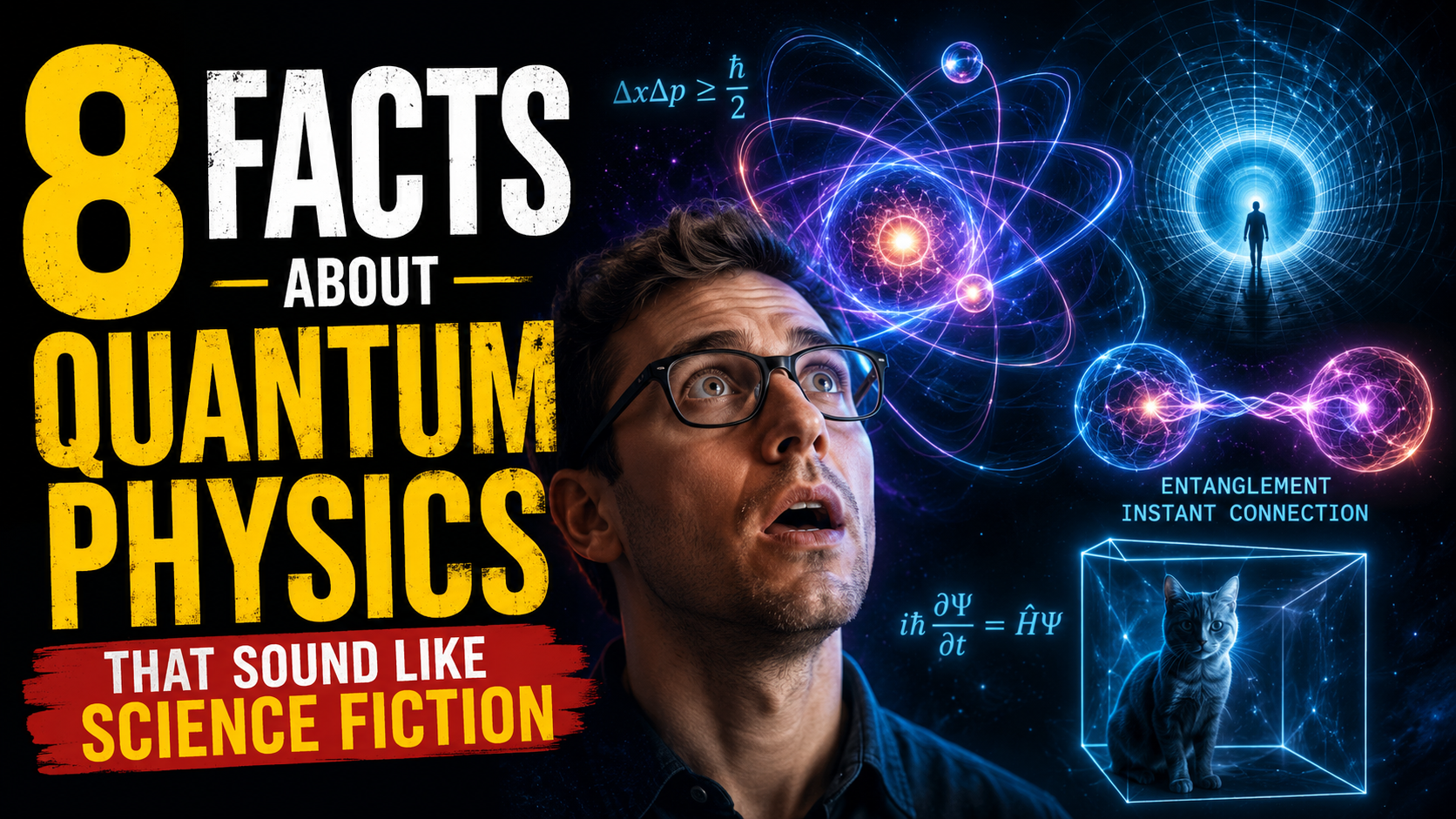
For most people, quantum physics sounds like something pulled straight from a futuristic movie. The subject is filled with strange ideas, mysterious particles, and discoveries that challenge our everyday understanding of reality. Yet quantum physics isn’t science fiction at all. It is one of the most successful scientific theories ever developed and forms the foundation of many technologies we use every day.
From smartphones and lasers to medical imaging and modern computers, quantum mechanics has transformed the world. What makes it so fascinating is that the universe behaves very differently at the smallest scales than it does in our everyday lives.
Scientists studying atoms and subatomic particles have repeatedly encountered phenomena that seem impossible from a common-sense perspective. The deeper researchers look, the stranger reality appears.
Here are eight remarkable facts about quantum physics that sound like they belong in a science fiction novel but are supported by decades of scientific research.
1. Particles Can Exist in Multiple States at Once
Imagine flipping a coin and somehow having it land as both heads and tails at the same time.
While that sounds impossible in everyday life, something similar happens in the quantum world.
One of the central principles of quantum mechanics is known as superposition. Before a quantum particle is measured, it can exist in multiple possible states simultaneously.
An electron, for example, doesn’t necessarily occupy a single defined position. Instead, it can exist in a range of possible locations until an observation is made.
This concept challenges our intuition because we are accustomed to objects having one clear state at any given moment.
Yet countless experiments have confirmed that superposition is a real feature of the quantum world.
2. Two Particles Can Remain Connected Across Vast Distances
Perhaps no quantum phenomenon sounds more unbelievable than entanglement.
When two particles become entangled, their properties become linked in a special way. Even if the particles are separated by enormous distances, measuring one provides information about the other.
This strange connection puzzled scientists for decades.
Even famous physicist Albert Einstein found the idea unsettling and referred to it as “spooky action at a distance.”
Modern experiments have repeatedly demonstrated that quantum entanglement is real.
Today, researchers are exploring ways to use entanglement in secure communication systems and next-generation computing technologies.
3. Empty Space Isn’t Actually Empty
Most people think of empty space as complete nothingness.
Quantum physics tells a different story.
According to modern theory, even the emptiest regions of space contain fluctuating energy fields. Tiny particles can briefly appear and disappear before vanishing again.
These temporary fluctuations occur constantly throughout the universe.
While invisible to human senses, they have measurable effects that scientists have observed in laboratory experiments.
The idea that “nothing” is actually full of activity is one of the most surprising discoveries in modern science.
4. Observation Can Influence Outcomes
One of the most discussed concepts in quantum mechanics is the role of measurement.
In certain experiments, particles behave differently depending on how scientists observe them.
A famous example is the double-slit experiment. When particles pass through two openings without being measured, they display wave-like behavior. When researchers observe which path the particles take, the outcome changes.
This does not mean human thoughts magically alter reality.
Instead, it reveals that the act of measurement plays a fundamental role in determining how quantum systems behave.
The exact interpretation remains an active area of scientific debate.
5. Particles Sometimes Behave Like Waves
In everyday life, objects are either particles or waves.
A baseball is a particle.
Ocean ripples are waves.
Quantum physics reveals that subatomic particles can display characteristics of both.
Electrons, photons, and other particles sometimes behave like tiny objects and sometimes like waves spreading through space.
Scientists refer to this phenomenon as wave-particle duality.
Although it sounds bizarre, countless experiments have confirmed it.
This discovery fundamentally changed how researchers understand matter and energy.
6. Quantum Tunneling Allows Particles to Pass Through Barriers
Imagine throwing a ball at a wall and having it somehow appear on the other side without breaking through.
In the quantum world, something surprisingly similar can happen.
Particles occasionally pass through barriers that classical physics says should stop them.
This phenomenon is called quantum tunneling.
Rather than physically drilling through an obstacle, the particle has a probability of appearing beyond the barrier.
Quantum tunneling plays an important role in many natural and technological processes.
In fact, the Sun’s energy production depends on quantum tunneling occurring inside its core.
Without it, life on Earth might not exist.
7. Quantum Computers Could Solve Certain Problems Much Faster
Traditional computers process information using bits that represent either 0 or 1.
Quantum computers use quantum bits, or qubits.
Because qubits can exist in superposition, they can represent multiple possibilities simultaneously.
This unique capability allows quantum computers to approach certain calculations differently than conventional machines.
Although quantum computing is still developing, researchers believe it could eventually revolutionize fields such as:
- Drug discovery
- Materials science
- Artificial intelligence
- Climate modeling
- Cryptography
While these machines won’t replace traditional computers for every task, they may dramatically accelerate specific types of problem-solving.
8. Scientists Still Don’t Fully Understand Quantum Reality
Perhaps the most astonishing fact about quantum physics is that many of its deepest mysteries remain unresolved.
Quantum mechanics is incredibly successful at predicting experimental outcomes.
Yet scientists continue debating what those predictions actually mean.
Questions remain about:
- The nature of measurement
- The interpretation of probability
- The relationship between quantum mechanics and gravity
- The true structure of reality
Several competing interpretations attempt to explain quantum phenomena, but no single explanation has gained universal acceptance.
The theory works extraordinarily well, but its deeper meaning remains one of science’s greatest puzzles.
Why Quantum Physics Feels So Strange
The reason quantum physics sounds so unusual is that human intuition evolved to navigate the everyday world.
Our brains developed to understand objects such as rocks, trees, animals, and moving objects—not subatomic particles.
The quantum world operates according to rules that differ dramatically from our everyday experiences.
As a result, concepts like superposition and entanglement often feel counterintuitive.
Science repeatedly reminds us that reality does not always conform to human expectations.
Quantum Physics in Everyday Life
Many people assume quantum mechanics exists only in laboratories.
In reality, quantum principles influence technologies used daily.
Examples include:
Smartphones
Modern electronics rely on semiconductor technology that would not exist without quantum physics.
Lasers
Laser systems used in medicine, communications, manufacturing, and entertainment are based on quantum principles.
GPS Systems
Satellite technologies depend on precise physical calculations informed by modern physics.
Medical Imaging
Several advanced diagnostic tools rely on discoveries rooted in quantum research.
Without quantum mechanics, much of modern technology would be impossible.
Common Misconceptions About Quantum Physics
Because quantum mechanics is so complex, misconceptions frequently arise.
One common myth is that quantum physics proves anything is possible.
In reality, quantum systems still follow strict mathematical laws and probabilities.
Another misconception is that consciousness directly controls physical reality.
While observation plays an important role in measurement, scientific evidence does not support many popular claims associated with this idea.
A third misunderstanding is that quantum effects operate the same way in everyday life as they do at atomic scales.
Most quantum behaviors become difficult to observe in large objects because interactions with the environment quickly overwhelm them.
The Future of Quantum Research
Scientists continue making exciting discoveries in quantum science.
Researchers are exploring:
- Quantum communication networks
- Advanced quantum sensors
- Quantum encryption systems
- New computing architectures
- Fundamental questions about reality
These investigations may lead to technologies that seem just as extraordinary to future generations as smartphones would have appeared a century ago.
As our understanding grows, new possibilities continue to emerge.
Why People Are Fascinated by Quantum Physics
Quantum physics captures the imagination because it challenges assumptions about how reality works.
It raises profound questions:
What is matter?
What is information?
How does observation influence physical systems?
What is the true nature of reality?
These questions extend beyond science and touch philosophy, technology, and human curiosity itself.
The field reminds us that the universe is often far stranger and more fascinating than it first appears.
Final Thoughts
Quantum physics has revealed a hidden world where particles exist in multiple states, distant objects remain mysteriously connected, and empty space teems with activity. Many of its discoveries sound like ideas borrowed from science fiction, yet they are supported by some of the most successful experiments ever conducted.
Although researchers have learned an extraordinary amount about the quantum universe, many mysteries remain unsolved. Every new discovery seems to uncover deeper questions about the nature of matter, energy, space, and reality itself.
Perhaps that is what makes quantum physics so captivating. It reminds us that even in an age of advanced technology and scientific achievement, the universe still holds secrets capable of inspiring wonder and challenging everything we think we know.







