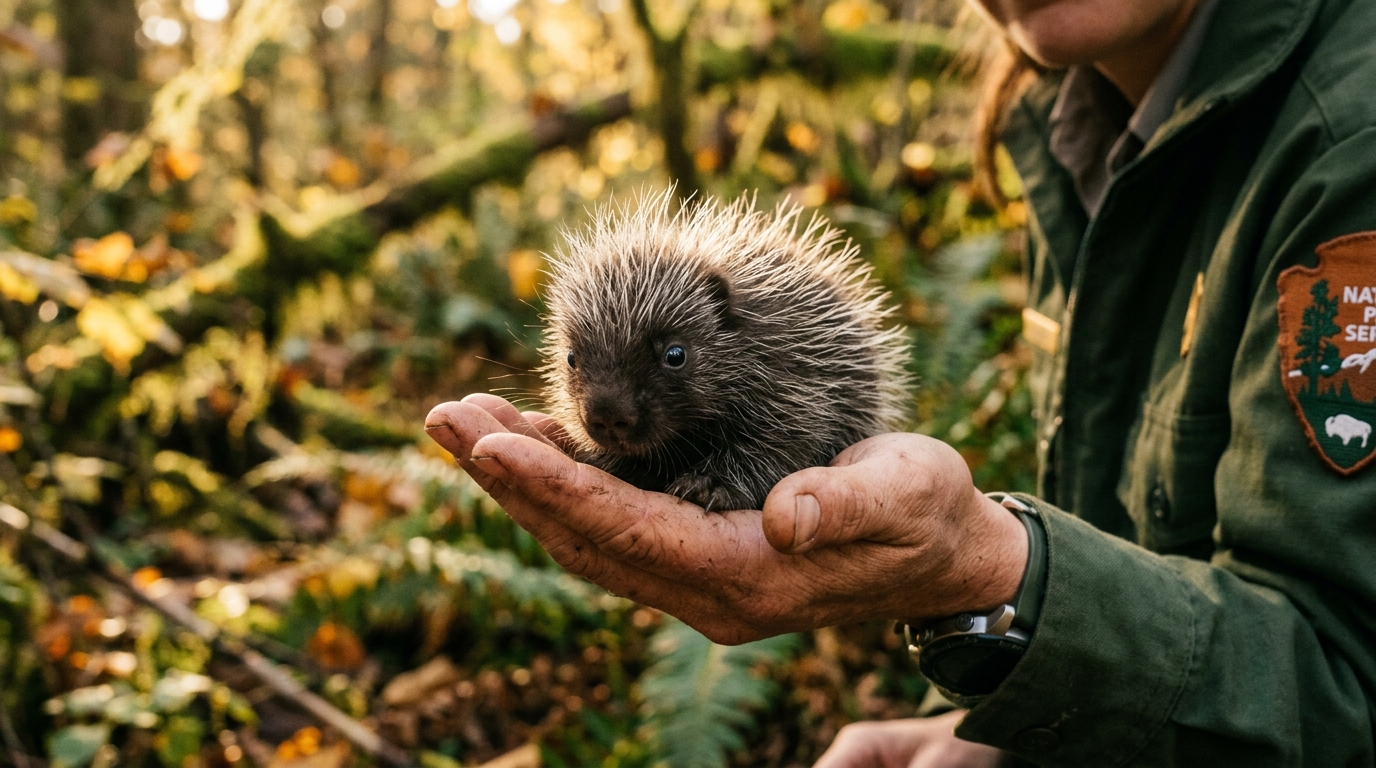
When people think of porcupines, they usually picture an animal covered in sharp quills that serves as one of nature’s most effective defensive specialists. But few realize that baby porcupines—often called porcupettes—are among the most fascinating newborns in the animal kingdom.
From the moment they enter the world, these tiny mammals display extraordinary adaptations that help them survive in environments filled with predators and challenges. While they may look adorable, baby porcupines are equipped with unique biological features that make them stand out from many other young animals.
Scientists continue to study porcupines because of their unusual anatomy, behavior, and developmental processes. The early lives of porcupettes reveal just how inventive nature can be when it comes to survival.
Here are eight reasons baby porcupines are among nature’s most remarkable newborns.
1. They Are Born With Quills—But Not the Way You Might Expect
One of the most surprising facts about baby porcupines is that they are born with quills already covering their bodies.
At first glance, this may sound dangerous for both the newborn and its mother. However, nature has developed an elegant solution. When porcupettes are born, their quills are soft, flexible, and covered with a protective layer that helps prevent injury during birth.
Within a matter of hours, those soft quills begin to dry and harden.
This remarkable adaptation allows newborn porcupines to gain defensive protection quickly while ensuring a safer delivery process.
Few mammals arrive with such a sophisticated built-in defense system.
2. Their Quills Harden Surprisingly Fast
The transformation that occurs after birth is one of the most fascinating aspects of porcupine development.
As the protective coating dries, the quills gradually become firmer and more effective as a defensive tool. This process happens rapidly, giving the young animal an important survival advantage during its earliest days of life.
In the wild, newborn mammals are often vulnerable to predators. The quick hardening of quills provides porcupettes with an extra layer of protection that many species simply do not possess.
The speed of this transformation highlights how finely tuned porcupine evolution has become.
3. Porcupettes Are More Developed Than Many Mammal Newborns
Compared with some other mammals, baby porcupines enter the world surprisingly well developed.
Many species are born blind, helpless, and completely dependent on parental care. Porcupettes, by contrast, often have open eyes shortly after birth and can begin exploring their surroundings relatively quickly.
This advanced level of development helps improve their chances of survival.
Researchers classify such animals as relatively precocial, meaning they are born in a more mature state than many other mammalian newborns.
The ability to become mobile early in life can be a significant advantage.
4. They Learn Survival Skills From Their Mothers
Although porcupettes are born with impressive adaptations, they still rely heavily on maternal care.
Mother porcupines invest significant time and energy into protecting and nurturing their young. During this period, babies learn important behaviors related to feeding, movement, and recognizing potential dangers.
Like many mammals, porcupines benefit from a combination of instinct and learning.
The bond between mother and offspring plays a crucial role in helping young animals develop the skills they need to survive independently.
5. They Are Excellent Climbers at a Young Age
Many porcupine species spend considerable time in trees.
As a result, climbing becomes an essential skill early in life. Young porcupines often begin developing their climbing abilities while still under their mother’s supervision.
Strong claws, sturdy limbs, and natural instincts help them navigate branches and elevated habitats.
For arboreal species, mastering tree-climbing techniques can mean the difference between safety and vulnerability.
Watching a young porcupette carefully explore a tree demonstrates just how quickly these animals learn.
6. Their Defensive Strategy Is Often Misunderstood
One of the biggest misconceptions about porcupines is that they can shoot their quills at predators.
In reality, porcupines cannot launch quills through the air. Instead, the quills detach upon contact when a predator comes too close.
Young porcupines begin learning defensive behaviors early. When threatened, they may raise their quills, turn their backs toward danger, or adopt postures designed to discourage attackers.
These behaviors work alongside their physical defenses to create a highly effective survival strategy.
Even at a young age, porcupettes possess tools that many predators prefer to avoid.
7. They Grow Into Some of Nature’s Best-Protected Mammals
The impressive defenses of adult porcupines begin developing almost immediately after birth.
As porcupettes grow, their quills become stronger and more numerous. Over time, they transform into animals equipped with one of the most successful passive defense systems found in nature.
Unlike predators that rely on speed, strength, or aggression, porcupines survive primarily through deterrence.
Their strategy is simple yet highly effective: make attacking them an unpleasant experience.
This approach has helped porcupines thrive across a variety of habitats for millions of years.
8. They Demonstrate Nature’s Remarkable Ingenuity
Perhaps the most fascinating aspect of baby porcupines is what they reveal about evolution itself.
Every feature—from soft newborn quills to rapid development and early mobility—reflects solutions to specific survival challenges. These adaptations did not appear by accident; they evolved over countless generations as natural selection favored traits that improved survival.
Porcupettes serve as a reminder of the creativity found throughout the natural world.
Their existence showcases how animals can evolve highly specialized traits that perfectly match their environments.
What Makes Porcupines Unique Among Mammals?
Porcupines belong to a select group of animals that rely primarily on physical defenses rather than speed or aggression.
Their quills are modified hairs made of keratin, the same protein found in human hair and fingernails. Depending on the species, a porcupine may carry tens of thousands of quills across its body.
When threatened, these quills provide a highly effective deterrent against predators.
Few mammals possess such a distinctive survival strategy.
The Difference Between Old World and New World Porcupines
Interestingly, not all porcupines are the same.
Scientists divide porcupines into two major groups:
- Old World porcupines, found in parts of Africa, Europe, and Asia.
- New World porcupines, found throughout North and South America.
Although both groups share quills as a defining characteristic, they evolved independently and possess notable differences in behavior, appearance, and habitat preferences.
Many tree-climbing species belong to the New World group.
Understanding these distinctions helps researchers better appreciate porcupine diversity.
Challenges Facing Young Porcupines
Despite their remarkable defenses, baby porcupines still face numerous threats.
Potential challenges include:
- Predation by large carnivores.
- Harsh weather conditions.
- Habitat loss.
- Disease.
- Human-related environmental pressures.
The early months of life can be especially critical.
Strong maternal care and effective defensive adaptations help improve survival odds during this vulnerable period.
Why Scientists Study Porcupines
Researchers are interested in porcupines for several reasons.
Their quills have inspired studies in fields such as:
- Biomimicry
- Medical device design
- Evolutionary biology
- Animal behavior
- Ecology
Scientists have examined how quills penetrate tissue, how they detach, and how their structure could inspire improved medical needles and surgical tools.
This research demonstrates how studying wildlife can sometimes lead to innovations that benefit humans.
What Porcupettes Teach Us About Nature
The story of baby porcupines is ultimately a story about adaptation.
These newborn animals enter the world with a remarkable combination of protective features, developmental advantages, and behavioral instincts. Together, these traits provide a strong foundation for survival in challenging environments.
Their journey from soft-quilled newborns to well-protected adults illustrates the incredible diversity of life on Earth.
Every stage of their development reflects millions of years of evolutionary refinement.
Final Thoughts
Baby porcupines may not receive the same attention as lion cubs, panda babies, or elephant calves, but they are every bit as remarkable. From their soft quills at birth and rapid development to their climbing abilities and sophisticated defenses, porcupettes possess a collection of traits unlike those of almost any other mammal.
The eight reasons explored here reveal why these tiny animals continue to fascinate scientists and wildlife enthusiasts alike. They are living examples of nature’s ingenuity, demonstrating how evolution can produce elegant solutions to complex survival challenges.
The next time you see a porcupine, it is worth remembering that even the smallest porcupette begins life with extraordinary tools. In a world filled with remarkable newborn animals, baby porcupines have certainly earned their place among nature’s most impressive young survivors.







