When most people think about astronomy, they imagine powerful telescopes capturing stunning images of distant galaxies, colorful nebulae, and glittering stars. Yet some of the most important discoveries about the universe have not come from what scientists can see—but from what they can hear.
Of course, space is a vacuum, so sound cannot travel through it in the way it does through air. When astronomers talk about “listening” to the universe, they are referring to radio waves—forms of electromagnetic radiation that travel across enormous distances. Specialized radio telescopes detect these invisible signals and transform them into data that scientists can analyze.
For nearly a century, radio astronomy has revealed a hidden universe that traditional optical telescopes cannot see. From mysterious cosmic explosions to evidence of invisible matter, radio signals have opened a new window into the cosmos.
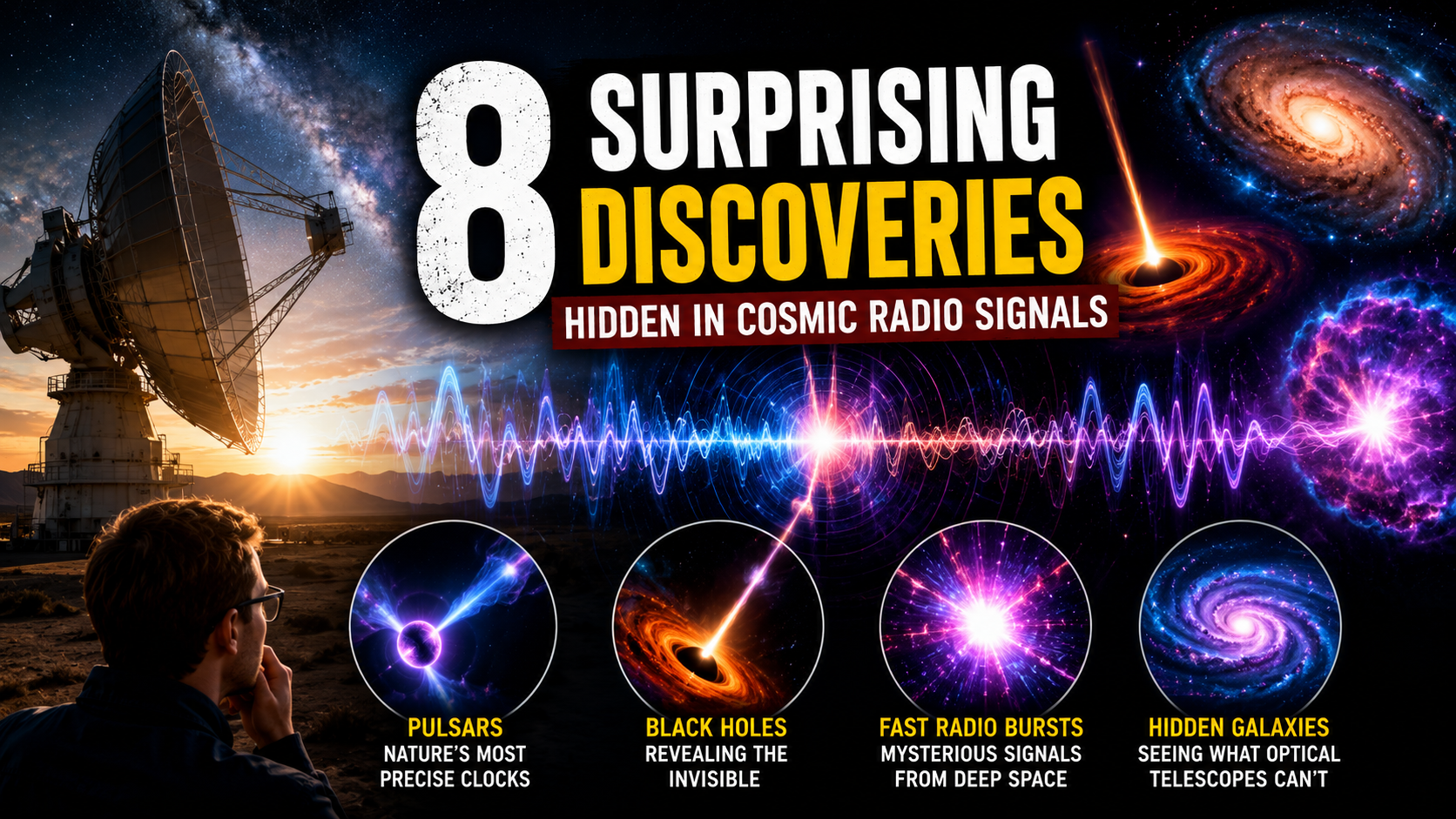
Here are eight surprising discoveries hidden within cosmic radio signals that have transformed our understanding of the universe.
1. The Milky Way Is Far More Active Than It Appears
To the naked eye, the night sky often looks peaceful and still. Stars appear fixed in place, quietly shining against the darkness.
Radio observations tell a completely different story.
When scientists examine our galaxy through radio telescopes, they discover enormous clouds of gas, energetic particles, magnetic fields, and regions of intense activity. Entire star-forming nurseries are hidden behind thick clouds of dust that visible light cannot penetrate.
Radio signals reveal giant structures stretching thousands of light-years across space. They show that the Milky Way is not a quiet collection of stars but a dynamic and constantly evolving system.
Without radio astronomy, much of this activity would remain invisible.
2. Pulsars Became Nature’s Most Precise Cosmic Clocks
One of the most remarkable discoveries in radio astronomy occurred in 1967 when researchers detected a strange repeating signal coming from space.
The pulses were so regular that some jokingly wondered whether they originated from intelligent extraterrestrial life.
The source turned out to be something equally fascinating: pulsars.
Pulsars are rapidly rotating neutron stars—the dense remnants of massive stars that exploded as supernovae. As they spin, they emit beams of radio waves that sweep across space like cosmic lighthouses.
Some pulsars rotate hundreds of times per second while maintaining extraordinary precision.
In fact, certain pulsars rival the accuracy of atomic clocks, making them valuable tools for studying gravity, time, and the structure of the universe.
3. Black Holes Reveal Themselves Through Radio Signals
Black holes are famously difficult to observe because they emit no visible light of their own.
Yet radio telescopes have become powerful tools for detecting them.
When matter falls toward a black hole, enormous amounts of energy can be released. Some black holes launch powerful jets of charged particles that travel at incredible speeds.
These jets generate radio emissions that can be detected from millions or even billions of light-years away.
Radio observations have helped scientists map gigantic black hole structures and better understand how these mysterious objects influence entire galaxies.
What once seemed completely invisible can often be detected through its radio signature.
4. Fast Radio Bursts Remain One of Astronomy’s Greatest Mysteries
In recent years, astronomers have discovered incredibly brief but powerful bursts of radio energy arriving from distant galaxies.
These events, known as Fast Radio Bursts (FRBs), typically last only milliseconds.
Despite their short duration, they can release enormous amounts of energy.
Scientists are still investigating their origins.
Possible explanations include highly magnetized neutron stars, extreme cosmic environments, and other energetic astrophysical events.
Although researchers have made significant progress, many questions remain unanswered.
Every newly detected FRB provides valuable clues about some of the most extreme conditions in the universe.
5. Radio Waves Help Scientists Map Invisible Matter
One of the most surprising lessons from modern astronomy is that much of the universe cannot be seen directly.
Visible matter—including stars, planets, and galaxies—accounts for only a small fraction of the cosmos.
Radio observations help scientists study the distribution of gas, magnetic fields, and other structures that reveal how galaxies evolve.
Combined with other forms of observation, radio astronomy contributes to investigations involving dark matter and large-scale cosmic structures.
While dark matter itself remains invisible, radio data helps researchers understand the environments where its gravitational effects become apparent.
In many ways, radio telescopes help uncover the hidden framework of the universe.
6. Some Cosmic Signals Have Traveled for Billions of Years
Every time a radio telescope receives a signal from a distant galaxy, it is also receiving a message from the past.
Because light and radio waves travel at finite speeds, observing distant objects means looking back in time.
A signal arriving today may have begun its journey billions of years ago.
Some radio emissions detected by astronomers originated before Earth even existed.
This extraordinary fact allows scientists to study earlier stages of cosmic history and observe how galaxies evolved across vast periods of time.
Radio astronomy effectively transforms telescopes into time machines.
7. The Universe Is Filled With Invisible Magnetic Structures
Magnetic fields exist throughout the cosmos, but they are often impossible to see directly.
Radio observations provide a way to map these hidden forces.
By studying how radio waves interact with magnetic environments, researchers can trace enormous magnetic structures spanning entire galaxies.
These fields influence star formation, cosmic particle movement, and the evolution of large-scale structures.
The discovery of widespread magnetic networks has revealed that the universe is interconnected in ways scientists once barely understood.
What appears empty may actually contain invisible forces shaping cosmic events.
8. Radio Signals Continue to Reveal New Cosmic Surprises
One reason radio astronomy remains so exciting is that discoveries continue to emerge.
New observatories equipped with advanced technology are detecting previously unseen phenomena and collecting unprecedented amounts of data.
Scientists are now studying:
- Mysterious transient radio sources
- Signals from distant galaxies
- Cosmic magnetic fields
- Black hole activity
- Early stages of galaxy formation
- Unusual energetic events
Each improvement in radio telescope sensitivity expands humanity’s view of the universe.
The hidden cosmos keeps revealing new surprises.
Why Radio Astronomy Matters
Many people assume astronomy is mainly about taking pictures of stars and planets.
In reality, modern astronomy relies on multiple methods of observation.
Visible light represents only a tiny portion of the electromagnetic spectrum.
Radio waves provide information that optical telescopes cannot access.
Without radio astronomy, scientists would know far less about:
- Pulsars
- Black holes
- Star formation
- Galactic structure
- Cosmic magnetic fields
- Deep-space phenomena
Radio telescopes allow researchers to explore regions of space that would otherwise remain hidden.
How Radio Telescopes Work
Unlike traditional telescopes that collect visible light, radio telescopes detect radio-frequency signals arriving from space.
Large dish-shaped antennas gather these weak signals and direct them toward highly sensitive receivers.
Computers then process the data, converting raw radio measurements into maps, images, and scientific information.
Many modern observatories combine data from multiple antennas spread across vast distances.
This technique allows scientists to achieve remarkable levels of detail.
Some radio telescope networks operate across entire continents.
Listening to the Universe
The phrase “listening to the universe” captures the imagination because it suggests a deeper connection with the cosmos.
Although radio waves are not sound in the traditional sense, scientists often convert radio data into audio representations that help identify patterns.
These converted signals can reveal repeating pulses, bursts, and other unique characteristics.
The process highlights just how active the universe truly is.
Far from being silent, the cosmos constantly generates streams of information traveling across space.
What the Future Holds
The future of radio astronomy looks incredibly promising.
New observatories are expected to answer some of the biggest questions in science:
- How did the first galaxies form?
- What causes Fast Radio Bursts?
- How do black holes evolve?
- What role do magnetic fields play in cosmic evolution?
- Can we detect previously unknown cosmic phenomena?
Projects under development will generate enormous amounts of data and allow researchers to study the universe with unprecedented precision.
Many scientists believe some of the most important discoveries are still ahead.
Final Thoughts
Radio astronomy has transformed humanity’s understanding of the universe by revealing phenomena invisible to ordinary telescopes. Through faint radio signals traveling across unimaginable distances, scientists have discovered pulsars, mapped magnetic fields, investigated black holes, and uncovered clues about the universe’s distant past.
Perhaps the most remarkable lesson is that the cosmos contains far more than meets the eye. Every radio signal arriving on Earth carries information about events occurring across space and time, offering glimpses into regions of the universe that would otherwise remain hidden.
As technology advances and new observatories come online, radio astronomy will continue uncovering secrets buried within the cosmic whispers that have been traveling through space for billions of years.







