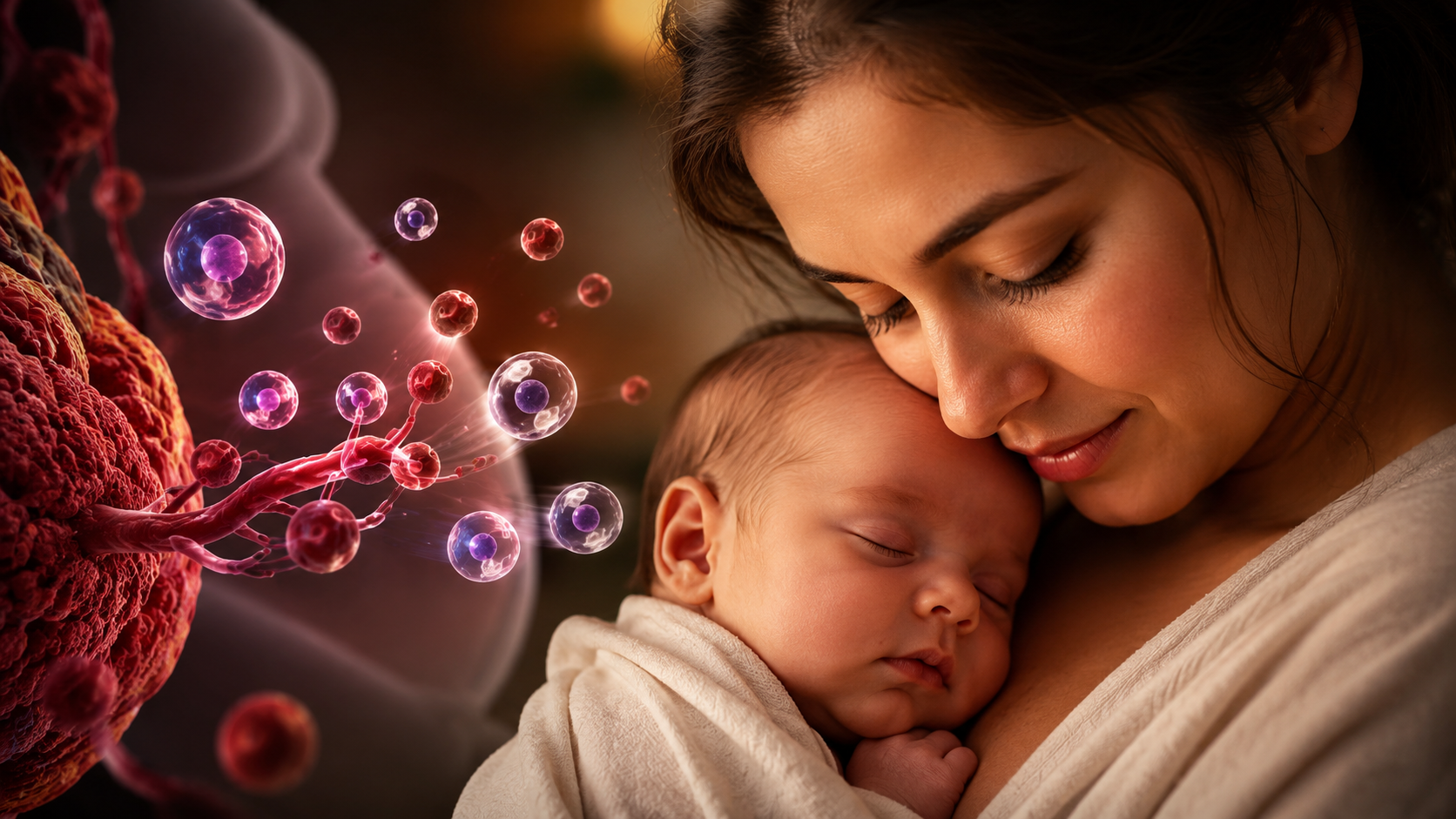
Pregnancy is often described as a remarkable bond between mother and child, but modern science suggests that connection may be even deeper than previously imagined. For decades, researchers believed the relationship between a developing baby and its mother was largely limited to the exchange of nutrients, oxygen, and waste products through the placenta. However, groundbreaking studies have revealed something far more fascinating.
During pregnancy, cells from a developing baby can cross the placenta and enter the mother’s body. Even more surprising, some of these cells may remain there for years—or even decades—after childbirth. This phenomenon, known as fetal microchimerism, has become one of the most intriguing areas of medical research.
Scientists are still uncovering exactly how these cells behave and what effects they may have on a mother’s health. While many questions remain unanswered, the discoveries made so far are reshaping our understanding of pregnancy and the long-term biological connection between mothers and their children.
Here are eight remarkable scientific discoveries about babies sending cells to their mothers.
1. Baby Cells Can Cross the Placenta During Pregnancy
One of the most significant discoveries is that fetal cells can move from the baby into the mother’s bloodstream while pregnancy is still ongoing.
For many years, the placenta was thought to act as an almost complete barrier between mother and child. Researchers now know that certain fetal cells are capable of crossing this boundary and entering maternal circulation.
This transfer can begin relatively early in pregnancy and continues throughout gestation. Scientists have detected fetal cells in maternal blood samples, providing clear evidence that a biological exchange occurs between the two bodies.
The finding challenged long-held assumptions and opened the door to an entirely new field of research.
2. Some Baby Cells May Remain for Decades
Perhaps the most astonishing discovery is how long fetal cells can survive.
Researchers have identified cells originating from children in mothers decades after pregnancy. In some cases, fetal cells have been detected more than 20 years after childbirth.
These lingering cells become part of a phenomenon called microchimerism, where a person carries a small number of genetically distinct cells from another individual.
The fact that cells from a child can remain in a mother’s body for such an extended period has transformed scientific thinking about the long-term effects of pregnancy.
3. Baby Cells Have Been Found in Multiple Organs
Scientists initially expected fetal cells to remain primarily in the bloodstream. Instead, research has revealed that they can travel throughout the body.
Studies have detected fetal cells in organs and tissues including the lungs, liver, kidneys, thyroid, skin, and even the brain.
This widespread distribution suggests that fetal cells may actively migrate to different locations rather than simply circulating passively in the blood.
Their presence in diverse tissues continues to raise important questions about their purpose and potential influence on maternal health.
4. Some Fetal Cells Behave Like Stem Cells
Another remarkable discovery is that certain fetal cells appear to possess stem-cell-like properties.
Stem cells are unique because they can develop into different types of specialized cells. Researchers have observed fetal cells that seem capable of adapting to various tissues within the mother’s body.
This flexibility has led scientists to investigate whether fetal cells might contribute to tissue repair or regeneration in certain circumstances.
Although the exact mechanisms remain under study, the possibility that baby-derived cells could participate in healing processes has generated significant scientific interest.
5. Researchers Are Investigating Their Role in Tissue Repair
One of the most exciting areas of research involves the potential healing abilities of fetal cells.
Scientists have found evidence suggesting that fetal cells may migrate to sites of injury within a mother’s body. In some studies, these cells appeared concentrated near damaged tissues, leading researchers to explore whether they play a role in repair processes.
For example, fetal cells have been identified in areas affected by injury, inflammation, and surgical scars.
While it remains unclear exactly how much these cells contribute to healing, their presence at damaged sites suggests they may serve functions beyond simply existing in maternal tissues.
Further research is needed to determine the extent of their regenerative potential.
6. Fetal Cells Have Been Detected in the Brain
One of the most surprising discoveries involves the human brain.
Researchers examining brain tissue have identified fetal cells in mothers years after pregnancy. The idea that cells from a child can cross into the brain and persist long-term was once considered unlikely.
The finding has sparked numerous scientific questions about how these cells interact with the nervous system and whether they influence neurological processes.
Although researchers are still investigating the implications, the discovery highlights how deeply fetal cells can integrate into maternal biology.
It also reinforces the idea that pregnancy creates lasting biological connections that extend far beyond childbirth.
7. Scientists Are Exploring Links to Immune Function
The immune system plays a central role in pregnancy, as the mother’s body must adapt to the presence of a genetically distinct developing baby.
Researchers believe fetal cells may interact with maternal immune responses in complex ways. Some studies suggest these cells could influence immune regulation, while others are examining possible connections to autoimmune conditions.
The relationship appears highly complex and may vary from one individual to another.
Understanding how fetal cells interact with the immune system could eventually provide new insights into both pregnancy biology and immune-related diseases.
8. The Discovery Is Changing How We Understand Motherhood
Perhaps the most profound discovery is what fetal microchimerism reveals about the biological relationship between mother and child.
For centuries, motherhood has been understood through emotional, social, and psychological perspectives. Modern science now adds a remarkable biological dimension to that understanding.
The idea that a mother’s body may continue carrying cells from her children years after pregnancy suggests that the physical connection between mother and child may be far more enduring than previously recognized.
This realization has inspired scientists, healthcare professionals, and families alike to view pregnancy through a new lens—one that highlights the extraordinary complexity of human development and maternal biology.
What Scientists Still Don’t Know
Despite the excitement surrounding fetal microchimerism, many questions remain unanswered.
Researchers continue to investigate:
- Why some fetal cells persist for decades while others disappear.
- Whether these cells consistently provide benefits, risks, or both.
- How they influence different organs and tissues.
- Their exact role in healing and regeneration.
- Their relationship to immune system function and disease.
Because fetal microchimerism is a relatively young field of study, many discoveries are likely still ahead.
As technology advances, scientists are gaining better tools to track and analyze these rare cells, which may lead to a deeper understanding of their behavior and significance.
Why This Research Matters
The study of fetal cells in maternal tissues goes far beyond satisfying scientific curiosity.
Understanding how these cells function could potentially contribute to advances in regenerative medicine, immune system research, pregnancy care, and disease prevention.
If researchers learn how fetal cells participate in tissue repair, for example, that knowledge could inspire new therapeutic approaches for injuries and chronic illnesses.
Likewise, understanding how these cells interact with the immune system may provide valuable insights into autoimmune disorders and other health conditions.
The implications extend well beyond pregnancy itself.
The Future of Fetal Microchimerism Research
Interest in fetal microchimerism continues to grow around the world.
Scientists are now using advanced genetic techniques and imaging technologies to better understand where fetal cells travel, how they survive, and what functions they perform.
Future studies may reveal whether these cells actively contribute to maternal health, simply coexist within tissues, or perform roles that have yet to be discovered.
What is already clear is that the relationship between mother and child is biologically more complex than researchers once imagined.
Final Thoughts
The discovery that babies can send cells into their mothers’ bodies has transformed scientific understanding of pregnancy. Through a process known as fetal microchimerism, fetal cells cross the placenta, travel throughout the body, and in some cases remain for decades after childbirth.
Researchers have found these cells in multiple organs, observed stem-cell-like behavior, and begun investigating their potential roles in tissue repair and immune function. While many questions remain unanswered, these findings reveal an extraordinary biological connection that extends long beyond pregnancy.
As scientists continue exploring this fascinating field, one thing is becoming increasingly clear: the bond between mother and child is not only emotional and psychological—it may also be written into the very cells of the body itself.







