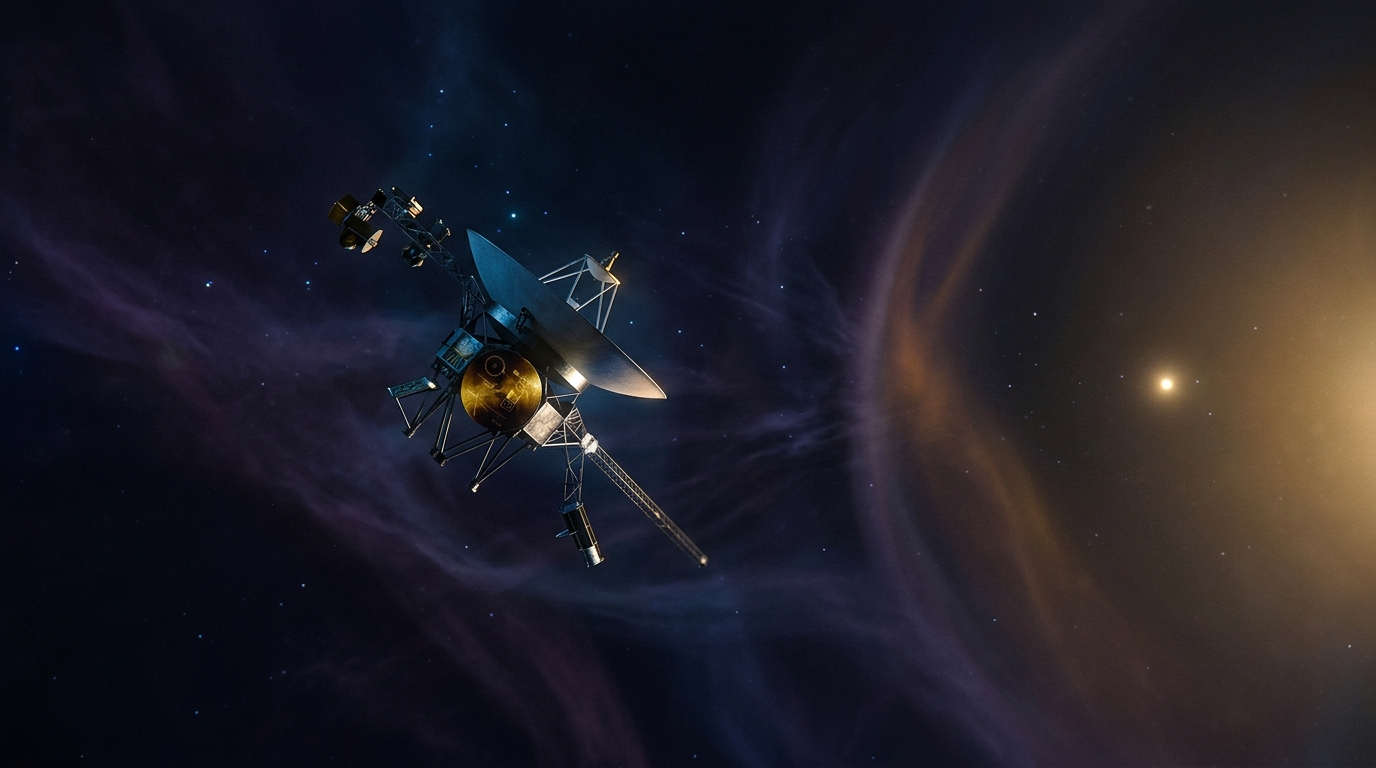
Few achievements in human history capture the imagination quite like the Voyager missions. Launched in 1977, the twin spacecraft Voyager 1 and Voyager 2 were designed for what was originally a relatively modest goal: to study the outer planets of our solar system. But over time, their mission evolved into something far more extraordinary.
Today, the Voyager probes have traveled farther than any human-made objects ever created. They are now exploring interstellar space—the vast region beyond the influence of the Sun’s immediate environment.
What makes this even more remarkable is that both spacecraft are still sending data back to Earth, even after nearly five decades in space.
Here are 10 mind-blowing facts about the Voyager missions that highlight just how extraordinary their journey has been.
1. The Voyagers Were Never Originally Designed to Leave the Solar System
When engineers at NASA designed the Voyager spacecraft, they were focused on a planetary tour of Jupiter and Saturn.
The idea of sending them beyond the solar system was not part of the original plan.
However, due to their successful flybys and gravitational assists, the spacecraft gained enough velocity to continue outward indefinitely.
What started as a planetary mission became humanity’s first journey into interstellar space.
2. Voyager 1 Is the Farthest Human-Made Object From Earth
Among all human creations, Voyager 1 holds the record for distance traveled.
It is currently more than 15 billion miles (over 24 billion kilometers) away from Earth and still moving outward.
At this distance, even light takes over 20 hours to reach the spacecraft.
Despite this enormous gap, Voyager 1 continues to communicate with Earth using the Deep Space Network.
3. Voyager 2 Is the Only Spacecraft to Visit All Four Outer Planets
Voyager 2 achieved a unique milestone in space exploration history.
It is the only spacecraft to have performed close flybys of Jupiter, Saturn, Uranus, and Neptune.
Each encounter provided unprecedented images and scientific data about these distant worlds.
Its journey revealed details about planetary atmospheres, moons, and ring systems that were previously unknown.
4. The Golden Record Carries a Message to Potential Extraterrestrial Life
Both Voyager spacecraft carry a special artifact known as the Golden Record.
This is a gold-plated phonograph record containing sounds and images representing life on Earth.
It includes:
- Music from different cultures
- Greetings in multiple languages
- Natural sounds like wind and thunder
- Images of Earth and human life
The Golden Record was designed as a time capsule, intended for any intelligent life that might encounter the spacecraft in the distant future.
It represents one of humanity’s most symbolic attempts at cosmic communication.
5. Voyager 1 Entered Interstellar Space in 2012
In 2012, Voyager 1 officially crossed into interstellar space.
This boundary is known as the heliopause—the region where the Sun’s solar wind is no longer strong enough to push against interstellar material.
This made Voyager 1 the first human-made object to leave the heliosphere.
The transition was confirmed through changes in particle measurements and magnetic field data.
It marked a historic moment in space exploration.
6. Voyager 2 Followed Into Interstellar Space in 2018
Voyager 2 entered interstellar space six years after Voyager 1, in 2018.
Although it followed a different trajectory, it provided valuable complementary data about the structure of the heliosphere.
Having two spacecraft in different regions allowed scientists to compare conditions in multiple directions beyond the solar system.
This dual perspective has significantly improved our understanding of interstellar space.
7. The Spacecraft Still Communicate Using Weak but Precise Signals
Despite their extreme distance, both Voyager spacecraft still send signals back to Earth.
However, these signals are incredibly faint—comparable to a refrigerator light bulb’s power output.
NASA uses the Deep Space Network, a system of giant radio antennas on Earth, to detect and decode these signals.
Because of the distance, communication delays are enormous, and data transmission is extremely slow.
Even so, every bit of information returned is scientifically valuable.
8. Their Power Sources Are Gradually Declining but Carefully Managed
The Voyager spacecraft are powered by radioisotope thermoelectric generators (RTGs), which convert heat from decaying plutonium into electricity.
Over time, this power source naturally weakens.
To extend mission life, NASA engineers have gradually shut down non-essential instruments.
This careful power management ensures that critical systems continue operating as long as possible.
Despite diminishing energy, the spacecraft remain functional decades beyond their expected lifespan.
9. The Voyagers Are Traveling in Completely Empty Space
One of the most fascinating aspects of the Voyager missions is the environment they are now in.
Interstellar space is not completely empty, but it is extremely sparse, containing very few particles per cubic meter.
This means the spacecraft are essentially traveling through a near-vacuum environment with minimal resistance.
There are no planets, no asteroids, and no nearby stars in their immediate path.
They are, quite literally, drifting through the quiet emptiness between stars.
10. The Voyagers Will Outlive Earth-Based Civilization
Perhaps the most astonishing fact about the Voyager missions is their longevity.
Even after Earth-based systems no longer function, the spacecraft will continue traveling through space for millions of years.
They are expected to pass near other star systems in tens of thousands of years, although the probability of interception is extremely low.
Still, the Golden Record ensures that if they are ever found, they will carry a message from humanity across time and space.
In a sense, the Voyagers are eternal ambassadors of Earth.
Why the Voyager Missions Matter
The Voyager missions are more than just engineering achievements—they represent a turning point in human exploration.
They transformed our understanding of the solar system and opened the door to interstellar science.
Some of their most important contributions include:
- First close-up images of outer planets
- Discovery of volcanic activity on moons
- Confirmation of planetary magnetic fields
- First measurements of interstellar space
These discoveries reshaped planetary science and continue to influence research today.
The Human Story Behind the Voyagers
Behind the spacecraft is a story of human curiosity, ambition, and collaboration.
Thousands of engineers, scientists, and technicians contributed to their design, launch, and ongoing operation.
What makes the Voyager missions especially powerful is their simplicity of purpose: to explore the unknown and extend human understanding beyond our immediate reach.
They are reminders of what humanity can achieve when driven by curiosity and persistence.
Final Thoughts
The Voyager missions remain one of the most extraordinary achievements in space exploration history.
From their unexpected journey beyond the solar system to their continued operation nearly 50 years later, they have surpassed every expectation.
The 10 key facts highlight their significance:
- Originally designed for planetary exploration
- Farthest human-made objects in space
- Only spacecraft to visit all outer planets (Voyager 2)
- Carry the Golden Record message from Earth
- First to enter interstellar space (Voyager 1)
- Followed by Voyager 2 into interstellar space
- Still transmitting data across billions of miles
- Powered by slowly declining RTGs
- Traveling through near-empty interstellar space
- Will outlast human civilization
Together, they represent not just scientific progress but also a message of human curiosity sent into the cosmos.
Even as their signals grow weaker over time, their legacy continues to expand.
The Voyagers are no longer just spacecraft—they are humanity’s enduring footprint in the universe.