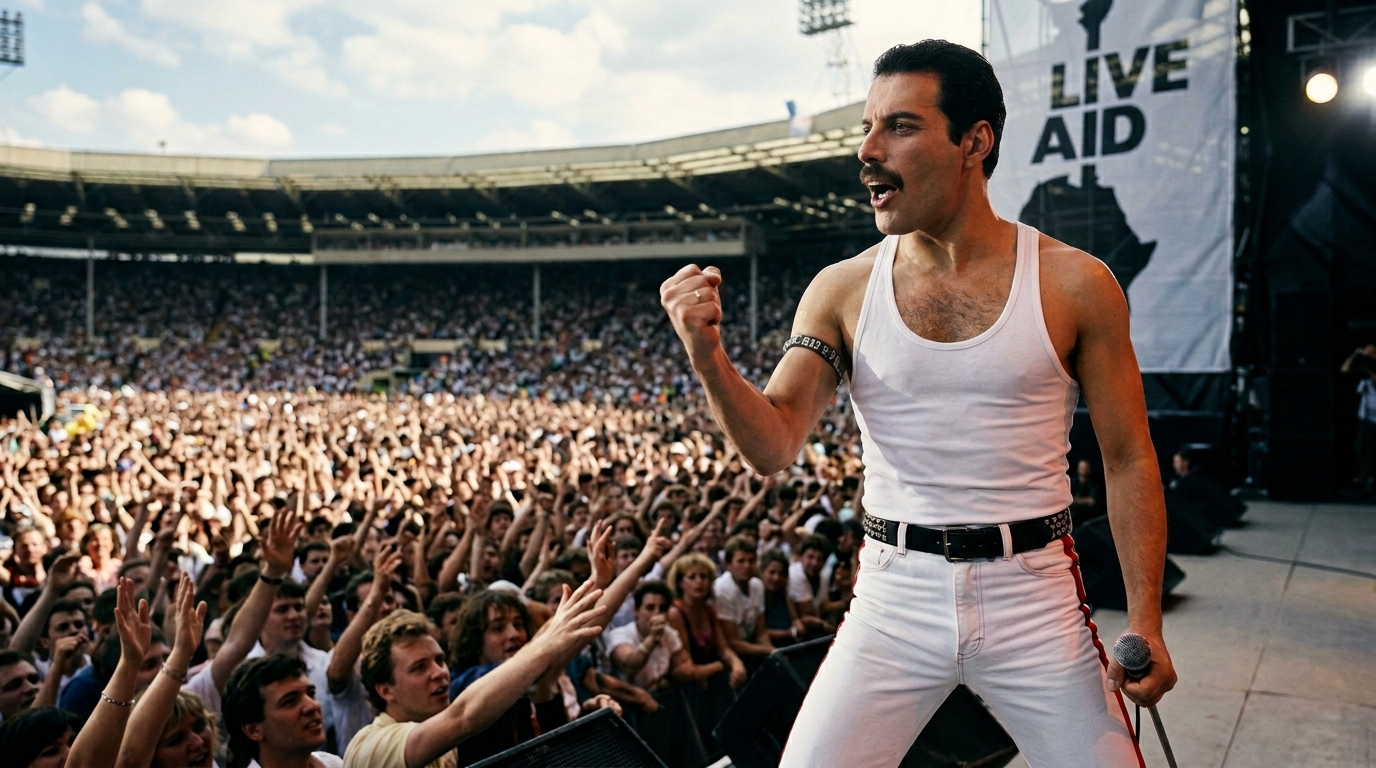
On July 13, 1985, music history changed in real time. On that day, at Wembley Stadium in London, the world witnessed one of the most powerful live performances ever recorded: the set by Freddie Mercury with Queen during the global charity event known as Live Aid.
Organized by Bob Geldof and Midge Ure, Live Aid was a dual-venue concert held in London and Philadelphia to raise funds for famine relief in Ethiopia. While many legendary artists performed that day, Queen’s 20-minute set has come to be widely regarded as the greatest live rock performance in history.
What makes this moment so extraordinary is not just the music itself, but the precision, energy, and emotional control Mercury displayed in front of an audience of over 70,000 people at Wembley—and an estimated 1.9 billion viewers worldwide.
Even decades later, musicians, vocal coaches, and performance experts continue to analyze what happened on that stage. Here are 15 facts about Freddie Mercury’s Live Aid performance that still amaze experts today.
1. The Setlist Was Designed for Maximum Impact
Queen carefully structured their six-song set to maintain constant momentum.
They opened with “Bohemian Rhapsody” (partial intro), followed by “Radio Ga Ga,” “Hammer to Fall,” “Crazy Little Thing Called Love,” “We Will Rock You,” and “We Are the Champions.”
Each song was chosen for instant recognition and audience participation, ensuring maximum engagement from the very first note.
2. Freddie Mercury Took Full Control of the Crowd Within Seconds
One of the most studied aspects of the performance is how quickly Mercury connected with the audience.
Within moments of stepping on stage, he clapped, gestured, and directed the crowd with precision.
Experts often point out that it took less than a minute for Wembley Stadium to become fully synchronized with him.
3. The “Ay-O” Vocal Pattern Became an Improvised Masterstroke
During “Radio Ga Ga,” Mercury led the audience in the now-famous “Ay-O” call-and-response section.
Although simple, this moment became one of the most iconic audience participation sequences in rock history.
It transformed 70,000 spectators into part of the performance itself.
4. Mercury Was Not Originally Comfortable With Live Aid
Behind the scenes, Mercury and Queen were initially unsure about performing at Live Aid.
The band had not toured extensively in the period leading up to the event, and there were concerns about whether they could match the scale of the occasion.
Their eventual decision to perform proved historic.
5. The Performance Required Extremely Precise Timing
With only a 20-minute slot, Queen had to execute their set with near-perfect timing.
There was no room for extended improvisation or technical delays.
Every transition between songs was carefully rehearsed to maintain flow and energy.
6. Freddie’s Vocal Control Was Remarkably Consistent
Despite the physical intensity of the performance, Mercury’s vocal delivery remained controlled and powerful throughout.
Voice experts have analyzed recordings and noted his ability to shift seamlessly between chest voice, head voice, and falsetto without strain.
This level of control under pressure is considered exceptional even by professional standards.
7. The Stage Movement Was Choreographed but Felt Spontaneous
Mercury’s movements across the stage appeared completely natural, but much of it was carefully structured.
He used spatial awareness to ensure every section of the stadium felt included.
His positioning was strategic, allowing him to engage different audience zones at different moments.
8. Brian May’s Guitar Tone Was Carefully Balanced for Broadcast
Brian May achieved a guitar sound that translated exceptionally well for live television and stadium acoustics.
The tone was bright, clear, and powerful without overwhelming the vocals.
Sound engineers have praised the mix as one of the best live broadcast balances of its era.
9. The Performance Was Captured With Cutting-Edge (for 1985) Technology
Live Aid used a multi-camera broadcast system that was advanced for its time.
This allowed Queen’s performance to be shown from multiple angles, enhancing the emotional impact for viewers worldwide.
The editing helped amplify Mercury’s connection with the crowd.
10. The Audience Reaction Became Part of the Performance
Unlike many concerts where the audience is passive, Live Aid turned the crowd into an active participant.
The synchronized clapping, singing, and movement became a core element of Queen’s set.
Mercury essentially conducted the audience like an orchestra.
11. “Hammer to Fall” Showcased Raw Rock Energy
The performance of “Hammer to Fall” stood out for its intensity.
It provided a contrast to the more theatrical moments in the set and highlighted Queen’s rock credentials.
Mercury’s vocal aggression during this song is frequently cited by critics as peak performance energy.
12. Mercury Used Minimal Props to Maximize Focus
There were no elaborate stage props or visual distractions.
This simplicity ensured that attention remained entirely on the band and audience interaction.
Experts often point out that this restraint was key to the performance’s timelessness.
13. The Lighting Design Enhanced Emotional Flow
The lighting at Wembley was carefully adjusted to shift with the mood of each song.
Bright, expansive lighting was used for crowd anthems, while tighter beams focused attention during vocal moments.
This subtle design helped guide emotional pacing throughout the set.
14. The Performance Is Still Used in Music Education Today
Music schools and performance coaches frequently analyze Queen’s Live Aid set as a case study in live stagecraft.
It is used to teach crowd engagement, vocal endurance, and stage presence.
Few live performances are studied with such consistency decades later.
15. It Is Widely Considered the Greatest Live Performance of All Time
Many music critics, historians, and performers rank Queen’s Live Aid set as the greatest live rock performance ever recorded.
This assessment is based not only on musical quality but on emotional impact, audience interaction, and historical significance.
The performance has been referenced in documentaries, films, and academic studies on live entertainment.
Why the Performance Still Resonates Today
The lasting power of Queen’s Live Aid performance lies in its simplicity and emotional clarity.
There were no special effects, no elaborate staging, and no technological enhancements beyond the broadcast setup.
Instead, the performance relied entirely on human connection—between artist and audience, and between music and emotion.
Freddie Mercury’s ability to unify tens of thousands of people in a single moment remains unmatched in modern performance history.
Final Thoughts
The Live Aid performance by Queen was more than a concert set—it was a cultural turning point.
The 15 facts outlined above highlight why experts continue to study it:
- Perfectly structured setlist
- Instant crowd control
- Innovative audience participation
- Vocal mastery under pressure
- Strategic stage movement
- Technical excellence in sound and broadcast
Together, these elements created a moment that transcended music.
Even decades later, Freddie Mercury’s performance remains a benchmark for what live artistry can achieve when preparation, talent, and connection align perfectly.
It is not just remembered—it is still felt.







