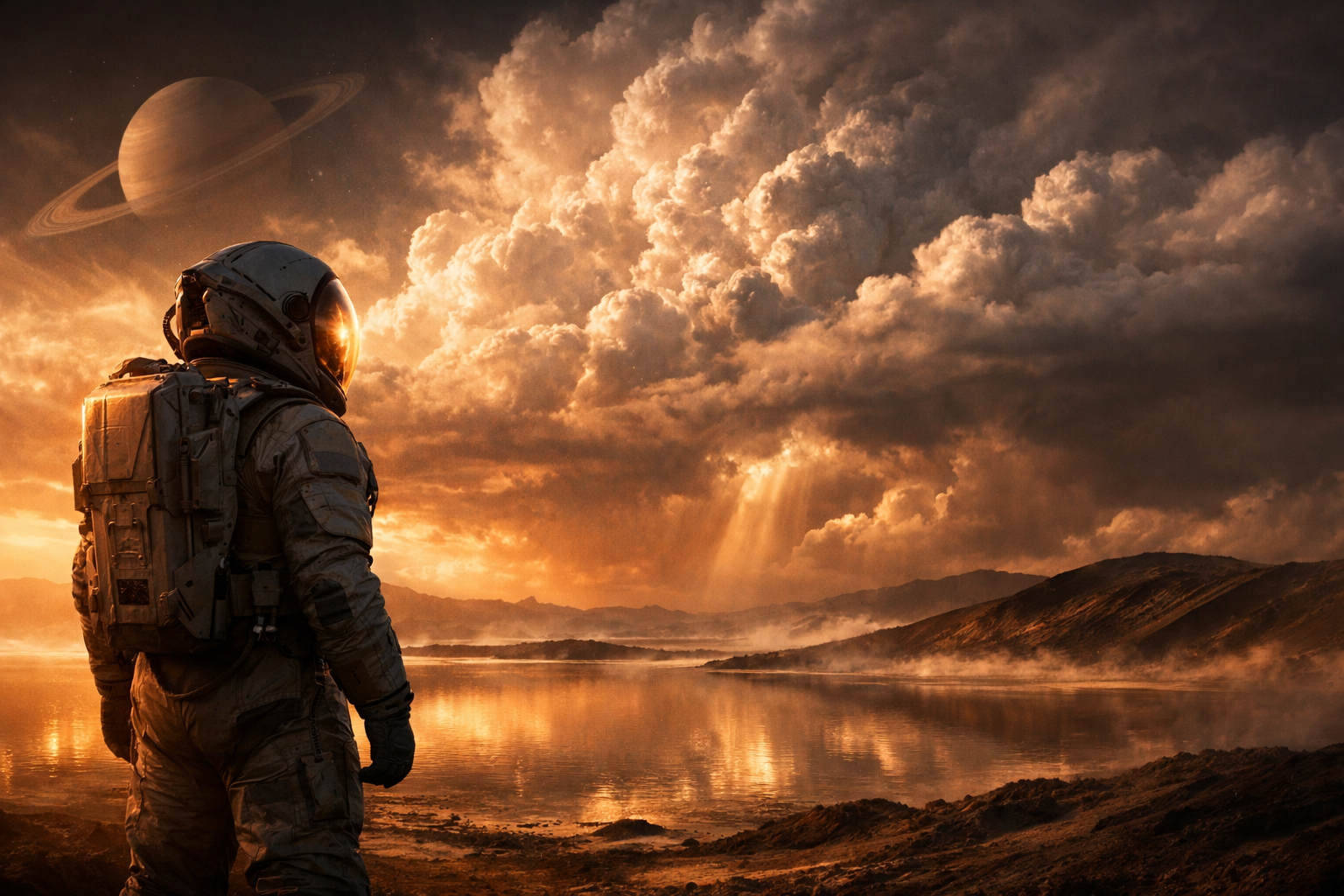
When people think of places in the solar system that resemble Earth, Saturn’s moon Titan is rarely the first to come to mind. With its freezing temperatures, thick orange haze, and methane-rich atmosphere, Titan initially seems like a world completely alien to our own.
Yet, beneath its strange chemistry lies something surprisingly familiar. Titan is the only other place in the solar system known to have stable liquids flowing on its surface, along with a weather system that, in some ways, mirrors Earth’s hydrological cycle.
That unusual combination makes Titan one of the most scientifically fascinating worlds we know. As scientists continue to study data from missions like Cassini–Huygens mission, they are discovering that Titan’s weather patterns share more similarities with Earth than anyone originally expected.
Here are seven ways Titan’s weather resembles Earth’s in surprising detail.
1. Titan Has a Complete “Liquid Cycle” Like Earth’s Water Cycle
One of the most remarkable similarities between Earth and Titan is the existence of a full liquid cycle.
On Earth, water evaporates, forms clouds, and falls back as rain. On Titan, this cycle happens with methane and ethane instead of water.
Methane evaporates from lakes and seas, rises into the atmosphere, forms clouds, and eventually falls back as methane rain.
This creates a closed loop system that is strikingly similar to Earth’s hydrological cycle, even though the chemistry is completely different.
It is one of the strongest reasons scientists consider Titan an “Earth-like” world in terms of atmospheric dynamics.
2. Titan Has Rainfall That Shapes Its Surface
Just like Earth, Titan experiences rainfall that actively shapes its landscape.
However, instead of water, the rain consists of liquid methane, which can fall in slow, steady showers or intense storms.
This rainfall carves channels, valleys, and drainage networks across Titan’s surface.
Images from the Huygens probe revealed dry riverbeds and erosion patterns that strongly resemble river systems on Earth.
This shows that similar physical processes can create similar landforms, even with completely different materials.
3. Titan Has Lakes, Rivers, and Seas
One of Titan’s most Earth-like features is its stable bodies of liquid on the surface.
These lakes and seas are primarily composed of methane and ethane, and they are concentrated near the moon’s polar regions.
Some of these liquid bodies are large enough to be considered seas, making Titan the only other world in the solar system with confirmed stable surface liquids.
These features behave in ways similar to Earth’s lakes and oceans, including evaporation, precipitation, and seasonal changes.
This makes Titan one of the closest analogs to Earth’s surface hydrology anywhere in the solar system.
4. Titan Experiences Seasonal Weather Changes
Just like Earth, Titan has seasons caused by its axial tilt and orbit around Saturn.
These seasonal cycles influence atmospheric circulation, cloud formation, and rainfall patterns.
During certain seasons, methane clouds become more active, leading to increased precipitation and storm activity.
Other times, the atmosphere becomes more stable and less dynamic.
This seasonal variability shows that Titan is not a static world—it is an active, evolving environment influenced by orbital mechanics.
5. Titan Has Winds That Shape Its Surface
Titan’s thick atmosphere allows for strong wind systems that influence surface features over time.
Although the winds are generally gentle compared to Earth’s storms, they are capable of moving organic particles and shaping dunes across the landscape.
These dunes, made of hydrocarbon particles, stretch across vast regions of Titan and resemble desert dunes on Earth.
The presence of wind-driven surface features reinforces the idea that similar atmospheric processes can produce similar geological structures.
6. Titan’s Atmosphere Creates Weather Systems and Clouds
Titan has a dense atmosphere composed mostly of nitrogen, with a significant amount of methane and organic compounds.
This thick atmosphere allows for cloud formation, weather systems, and atmospheric circulation patterns.
Methane clouds form in the upper atmosphere and can lead to precipitation events similar to thunderstorms on Earth.
Although Titan’s storms are composed of different materials, the structural behavior of cloud formation is remarkably similar.
This makes Titan one of the few places in the solar system where full weather systems exist.
7. Titan’s Surface Erosion Mimics Earth-Like Geological Processes
One of the most surprising discoveries about Titan is that its surface shows clear signs of erosion.
Flowing liquid methane, rainfall, and wind all contribute to shaping the landscape over time.
Valleys, channels, and shorelines on Titan closely resemble those formed by water erosion on Earth.
This suggests that the same physical laws governing fluid movement and erosion apply even in drastically different environments.
The result is a landscape that feels strangely familiar despite its alien composition.
Why Titan Feels Earth-Like Despite Its Differences
At first glance, Titan seems nothing like Earth. It is extremely cold, with surface temperatures around -180°C, and its chemistry is entirely different from our planet’s.
However, when scientists study its atmospheric and surface processes, they find striking parallels.
The key similarity is not the materials themselves, but the processes that shape them.
Both Earth and Titan have:
- A liquid cycle
- Weather systems
- Surface liquids
- Atmospheric circulation
- Erosion-driven landscapes
These shared processes make Titan one of the most Earth-like environments in the outer solar system.
The Role of the Cassini–Huygens Mission
Much of what we know about Titan comes from the groundbreaking Cassini–Huygens mission mission.
The Cassini spacecraft orbited Saturn for over a decade, while the Huygens probe descended through Titan’s atmosphere and landed on its surface in 2005.
These missions provided the first direct images and data of Titan’s surface and weather systems.
Without this mission, many of Titan’s Earth-like features would still be unknown.
Could Titan Support Life?
Titan’s similarities to Earth’s weather systems have led scientists to consider its potential for exotic forms of life.
While the surface is too cold for liquid water, the presence of liquid methane and organic molecules raises interesting questions about alternative biochemistry.
Some researchers speculate that life, if it exists on Titan, would be fundamentally different from Earth-based life.
This makes Titan a key target for future exploration missions.
Why Titan Matters in Planetary Science
Titan is more than just an interesting moon—it is a natural laboratory for understanding planetary processes.
By comparing Titan’s methane cycle to Earth’s water cycle, scientists can better understand how weather systems develop in different environments.
This also helps improve models of climate dynamics, both on Earth and beyond.
Titan demonstrates that similar physical principles can operate under vastly different conditions.
Final Thoughts
Titan stands out as one of the most intriguing worlds in the solar system because of its unexpected similarities to Earth.
The seven key parallels include:
- A full liquid cycle using methane
- Rainfall that shapes the surface
- Stable lakes and seas
- Seasonal weather changes
- Wind-driven landscapes
- Cloud and storm systems
- Earth-like erosion processes
Together, these features reveal a world that, while alien in composition, is familiar in behavior.
Titan reminds us that Earth-like processes are not unique to Earth itself.
They may be a common feature of planetary systems throughout the universe.
And as exploration continues, Titan remains one of the most promising places to deepen our understanding of how worlds—both familiar and strange—are shaped by the forces of nature.







