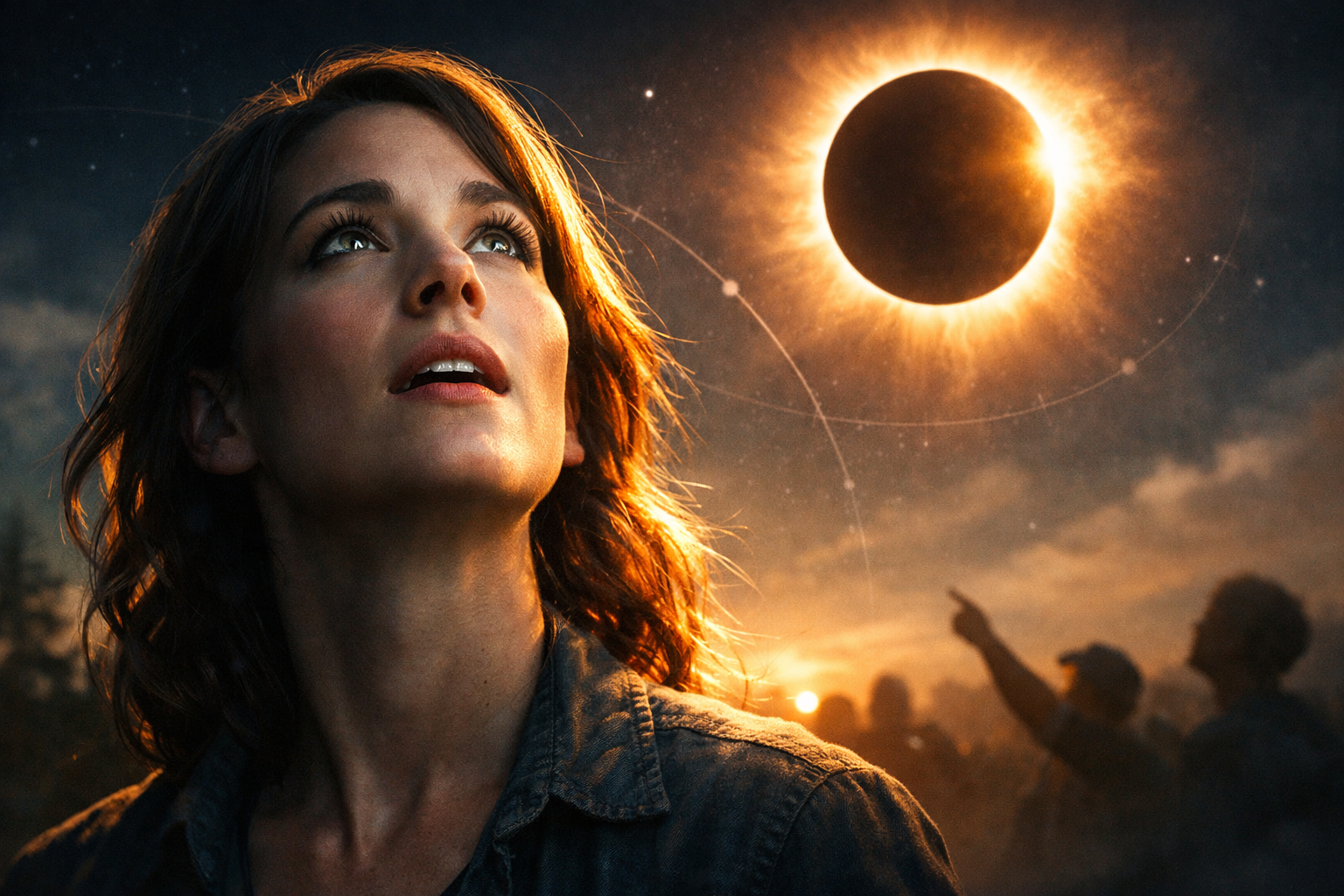
A solar eclipse is one of the most breathtaking natural events visible from Earth. For a few brief moments, the Moon passes between Earth and the Sun, partially or completely blocking sunlight and transforming daytime into an eerie twilight.
Most people remember the main event—the darkening sky, the disappearing Sun, and the collective excitement of observers looking upward. But what many don’t realize is that a solar eclipse is far more complex than it appears at first glance.
Beyond the dramatic visual spectacle, there are subtle environmental, atmospheric, and behavioral changes that often go unnoticed. These hidden details are just as fascinating as the eclipse itself.
Here are 11 things most people miss during a solar eclipse.
1. The Temperature Drops Noticeably but Gradually
One of the most overlooked effects of a solar eclipse is the drop in temperature.
As sunlight is blocked, the ground stops receiving direct solar energy, causing air temperatures to decrease.
This cooling is usually gradual but can be clearly felt during longer totality phases.
People often notice a sudden chill without realizing it is directly connected to the Moon’s shadow moving across the Earth.
2. Animal Behavior Changes in Unexpected Ways
Animals are highly sensitive to changes in light, and they often respond quickly during an eclipse.
Birds may stop singing or return to their nests, mistaking the darkness for nighttime. Insects such as crickets may become more active, while nocturnal animals may briefly emerge.
These behavioral shifts can create a strange mix of daytime and nighttime activity occurring simultaneously.
Many observers are so focused on the sky that they miss these subtle changes happening around them.
3. Shadows Become Sharper and Strangely Defined
As the Sun is partially obscured, shadows on the ground change dramatically.
During the peak phases of an eclipse, shadows can become unusually sharp and well-defined due to the reduced intensity of scattered sunlight.
In some cases, multiple overlapping shadows appear because of the Sun’s crescent shape.
These unusual lighting effects often go unnoticed because people are focused upward rather than downward.
4. The Sky Turns an Unnatural Shade of Twilight Blue
During a total or near-total eclipse, the sky does not simply become dark—it changes color in a very specific way.
Instead of turning black like night, the sky often takes on a deep, twilight-like blue or grayish tone.
This happens because sunlight is still scattering through the upper atmosphere, even when direct sunlight is blocked.
The result is a surreal lighting environment that feels neither day nor night.
5. The Sun’s Corona Becomes Visible
One of the most spectacular features of a total solar eclipse is the appearance of the Sun’s outer atmosphere, known as the corona.
Normally invisible due to the Sun’s brightness, the corona appears as a glowing halo surrounding the dark silhouette of the Moon.
It has a wispy, dynamic structure that changes shape over time.
Many casual observers miss fine details of the corona because the event is so brief and visually overwhelming.
6. Street and Artificial Lights Begin to Activate
As daylight fades unexpectedly during an eclipse, artificial lighting systems may begin to turn on.
Streetlights, building lights, and vehicle headlights can activate automatically depending on ambient light levels.
This creates a strange visual mix of artificial illumination and natural twilight conditions.
Many people are so focused on the sky that they fail to notice this gradual shift in the ground-level environment.
7. The Horizon Glows Like a 360-Degree Sunset
During totality, the horizon often appears as if all directions are experiencing sunset at once.
This occurs because sunlight is still reaching the edges of the Earth’s atmosphere, even though the observer is in the Moon’s shadow.
The result is a glowing ring of warm colors—orange, pink, and gold—surrounding the entire horizon.
This phenomenon is one of the most beautiful but frequently overlooked aspects of a solar eclipse.
8. Human Crowds React in Waves of Silence and Excitement
While the eclipse itself is a visual event, the human reaction is equally interesting.
Crowds often fall into sudden silence as totality approaches, followed by bursts of excitement and awe.
These emotional shifts happen collectively, almost like synchronized behavior.
However, many individuals are so focused on photographing the event that they miss the emotional atmosphere around them.
9. Shadows of Leaves Create Crescent Patterns
A lesser-known optical effect occurs when sunlight passes through small gaps, such as leaves on trees.
During an eclipse, these gaps act as natural pinhole cameras, projecting crescent-shaped shadows onto the ground.
Instead of circular light spots, observers may see hundreds of tiny crescent suns scattered across surfaces.
This phenomenon is subtle but visually striking for those who notice it.
10. Wind Patterns Can Temporarily Change
Some eclipses, especially longer ones, can slightly affect local wind behavior.
As the ground cools rapidly, air movement may shift due to temperature differences between shaded and unshaded areas.
This can create brief, unusual wind patterns that feel different from normal daytime conditions.
Because these changes are subtle, many people do not associate them with the eclipse itself.
11. The Psychological Sense of Time Feels Distorted
One of the most fascinating effects of a solar eclipse is psychological rather than physical.
Many observers report that time feels distorted during the event.
The sudden shift from daylight to twilight, combined with the rarity of the experience, can make minutes feel stretched or compressed.
This altered perception is influenced by emotional intensity, anticipation, and sensory overload.
As a result, people often underestimate or overestimate how long totality actually lasts.
Why Solar Eclipses Feel So Powerful
Solar eclipses are not just astronomical events—they are full sensory experiences involving light, temperature, sound, and human emotion.
The combination of predictable celestial mechanics and unpredictable environmental responses creates a powerful sense of awe.
Unlike many natural phenomena, eclipses are both scientifically precise and emotionally overwhelming at the same time.
This dual nature is what makes them so memorable.
How to Experience an Eclipse More Fully
To truly appreciate a solar eclipse, observers can take a few simple steps:
- Look away from the Sun periodically to observe surroundings
- Pay attention to temperature and wind changes
- Watch animal behavior closely
- Observe shadows on the ground
- Take breaks from cameras to experience the moment directly
By engaging all senses, the eclipse becomes more than a visual event—it becomes a full environmental experience.
Final Thoughts
A solar eclipse is far more than just the moment the Sun disappears behind the Moon.
It is a complex interaction of light, atmosphere, wildlife, and human perception.
The 11 overlooked aspects include:
- Temperature drops
- Animal behavior shifts
- Sharpened shadows
- Twilight sky colors
- Visible solar corona
- Artificial light activation
- 360-degree sunset glow
- Crowd emotional reactions
- Crescent leaf shadows
- Wind pattern changes
- Time perception distortion
Together, these effects show that a solar eclipse transforms not just the sky, but the entire environment.
For those who take the time to notice, the experience becomes far richer than the brief moment of totality.
It becomes a reminder of how interconnected Earth is with the cosmic rhythms above it—and how much there is to observe when we slow down and truly look.







