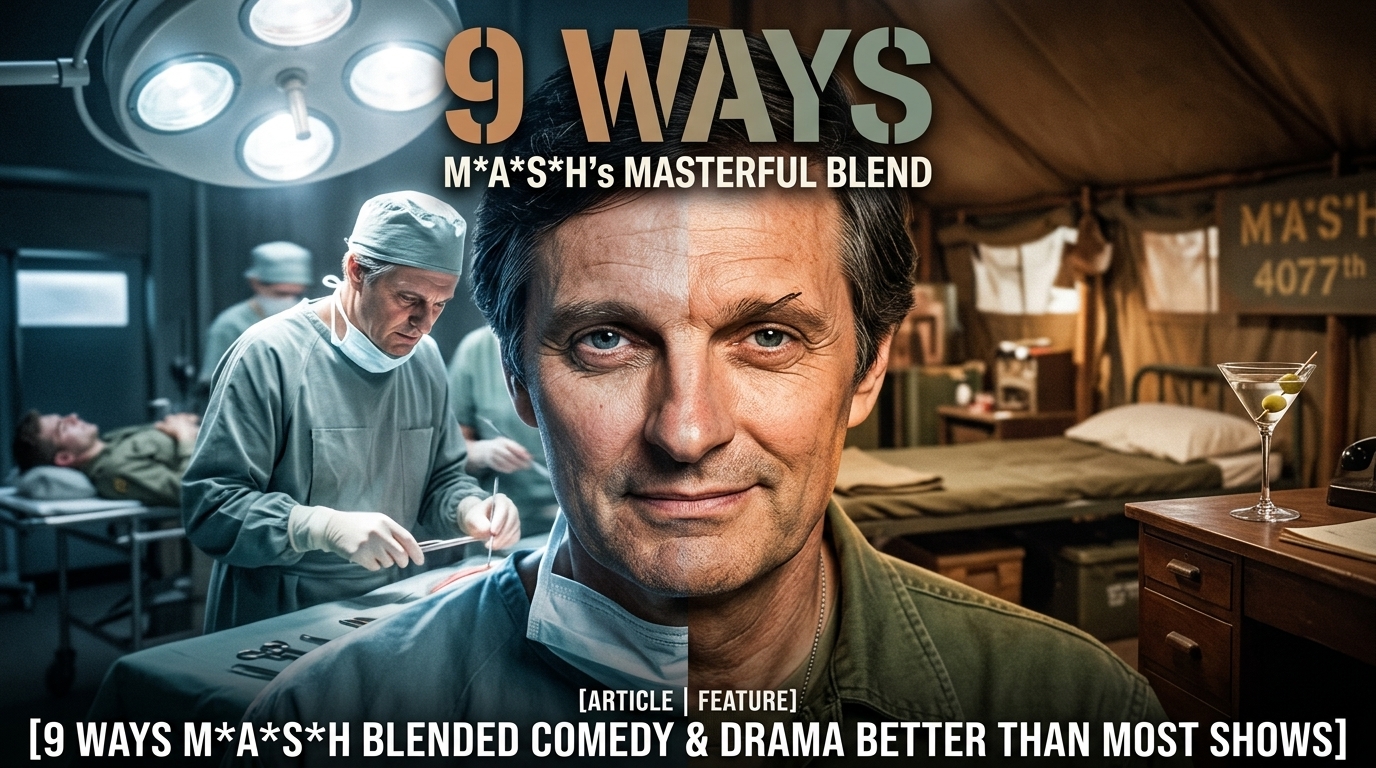
Few television series have managed to balance humor and emotional depth as effectively as MAS*H. Set during the Korean War but produced in the context of the Vietnam War era, the show became a groundbreaking example of how comedy and tragedy can coexist within a single narrative.
At first glance, MAS*H appears to be a lighthearted sitcom about military doctors stationed at a Mobile Army Surgical Hospital. But beneath the jokes, practical humor, and quirky characters lies a deeply human story about survival, morality, and the emotional cost of war.
What makes the series especially remarkable is how it consistently shifts between laughter and seriousness without losing its tone or authenticity. Many shows attempt this balance, but few achieve it with the same level of precision and emotional impact.
Here are nine ways MAS*H blended comedy and drama better than most television shows ever have.
1. Humor Was Used as a Coping Mechanism, Not a Distraction
One of the defining strengths of MAS*H is that its humor is never meaningless.
The characters use comedy as a way to survive the psychological stress of war. Instead of ignoring the seriousness of their environment, the humor emerges directly from it.
This makes the comedy feel natural and grounded.
The jokes are not there to avoid reality—they are there because reality is overwhelming.
This approach gives the humor emotional depth and makes the dramatic moments even more impactful.
2. Characters Were Written With Emotional Complexity
Unlike many sitcoms of its era, MAS*H did not rely on one-dimensional characters.
Each major character had both comedic traits and serious emotional layers.
For example:
- Hawkeye Pierce combines sarcasm with deep empathy
- Trapper John balances humor with moral awareness
- Margaret Houlihan evolves from rigid authority to emotional vulnerability
This complexity allowed the show to shift tones without breaking character consistency.
Because viewers understood the emotional depth of each character, the transition between comedy and drama felt seamless.
3. Episodes Often Ended on Emotional Gut Punches
Many episodes of MAS*H begin with humor and end with emotional weight.
This structure became one of the show’s signature storytelling techniques.
A lighthearted situation in the operating room or camp often transitions into a serious reflection on loss, trauma, or the consequences of war.
This contrast enhances emotional impact.
The final moments of many episodes leave viewers reflecting long after the laughter has faded.
4. War Was Never Treated as Background Noise
Unlike traditional sitcom settings, MAS*H placed war at the center of its narrative.
The conflict was not a distant backdrop—it was a constant presence influencing every decision and interaction.
This meant that even comedic scenes carried underlying tension.
Sirens, wounded soldiers, and emergency surgeries frequently interrupted daily life in the camp.
This blending of tones created a unique environment where humor and tragedy coexisted naturally.
5. Dialogue Shifted Fluidly Between Humor and Seriousness
One of the show’s most impressive technical achievements is its dialogue writing.
Characters often move between witty banter and serious conversation within the same scene.
A humorous exchange might suddenly shift into a discussion about life, death, or ethical dilemmas in wartime medicine.
This fluidity reflects real human communication more accurately than rigidly structured dialogue.
People in high-stress environments often use humor to deflect, cope, or process emotion, and MAS*H captured this behavior authentically.
6. Emotional Episodes Were Treated With Respectful Silence
When the show chose to focus fully on drama, it did so without unnecessary comedic relief.
Certain episodes step away from humor almost entirely, allowing emotional moments to breathe.
This restraint made those episodes especially powerful.
By removing comedy temporarily, the show emphasized the seriousness of its themes.
This balance ensured that neither tone undermined the other.
It also demonstrated confidence in the audience’s ability to engage with emotional storytelling.
7. Medical Storylines Grounded the Show in Reality
The surgical setting of MAS*H played a critical role in its tone balance.
The medical procedures provided constant reminders of life-and-death stakes.
Operating room scenes often contrasted sharply with the humor of camp life.
This contrast made both elements more meaningful.
Comedy felt like relief, while drama felt earned and realistic.
The medical environment anchored the show’s emotional range in a believable context.
8. Music and Sound Design Enhanced Emotional Transitions
The show’s use of music played a subtle but important role in blending comedy and drama.
Lighthearted scenes often featured upbeat or playful tones, while emotional moments were supported by quieter, more reflective music choices.
These audio cues helped guide viewers through tonal shifts without feeling abrupt.
Silence was also used effectively, especially in dramatic scenes where dialogue was minimal.
The sound design reinforced emotional pacing and supported the storytelling structure.
9. The Show Respected Both Humor and Tragedy Equally
Perhaps the most important reason MAS*H succeeded in blending genres is that it never treated comedy as less important than drama—or vice versa.
Both elements were given equal narrative respect.
Humor was not used to diminish tragedy, and tragedy was not used to override humor.
Instead, both were seen as essential parts of the human experience.
This philosophy allowed the show to explore war in a way that felt honest, layered, and emotionally complete.
Why MAS*H Still Feels Relevant Today
Even decades after its original run, MAS*H continues to resonate with audiences because its emotional balance remains timeless.
Modern viewers still connect with its portrayal of stress, friendship, moral conflict, and resilience.
The show’s ability to blend laughter and sadness mirrors real life more closely than many contemporary productions.
Life rarely fits into a single emotional category, and MAS*H understood that better than most television series.
The Legacy of Genre-Blending Television
MAS*H helped redefine what television storytelling could be.
It demonstrated that comedy and drama are not opposing forces but complementary tools.
This influence can be seen in many later shows that mix emotional tones, from workplace comedies with dramatic arcs to serialized dramas with moments of humor.
The series paved the way for more nuanced storytelling in modern television.
Final Thoughts
The success of MAS*H lies in its ability to reflect the complexity of human experience.
The nine key ways it blended comedy and drama include:
- Humor as coping mechanism
- Emotionally layered characters
- Episodes ending with emotional impact
- War as an active presence
- Fluid dialogue between tones
- Respectful dramatic silence
- Grounded medical realism
- Supportive music and sound design
- Equal respect for humor and tragedy
Together, these elements created a television experience that feels both entertaining and deeply human.
MAS*H remains a powerful reminder that laughter and sorrow often exist side by side—and that storytelling is at its best when it embraces both.







