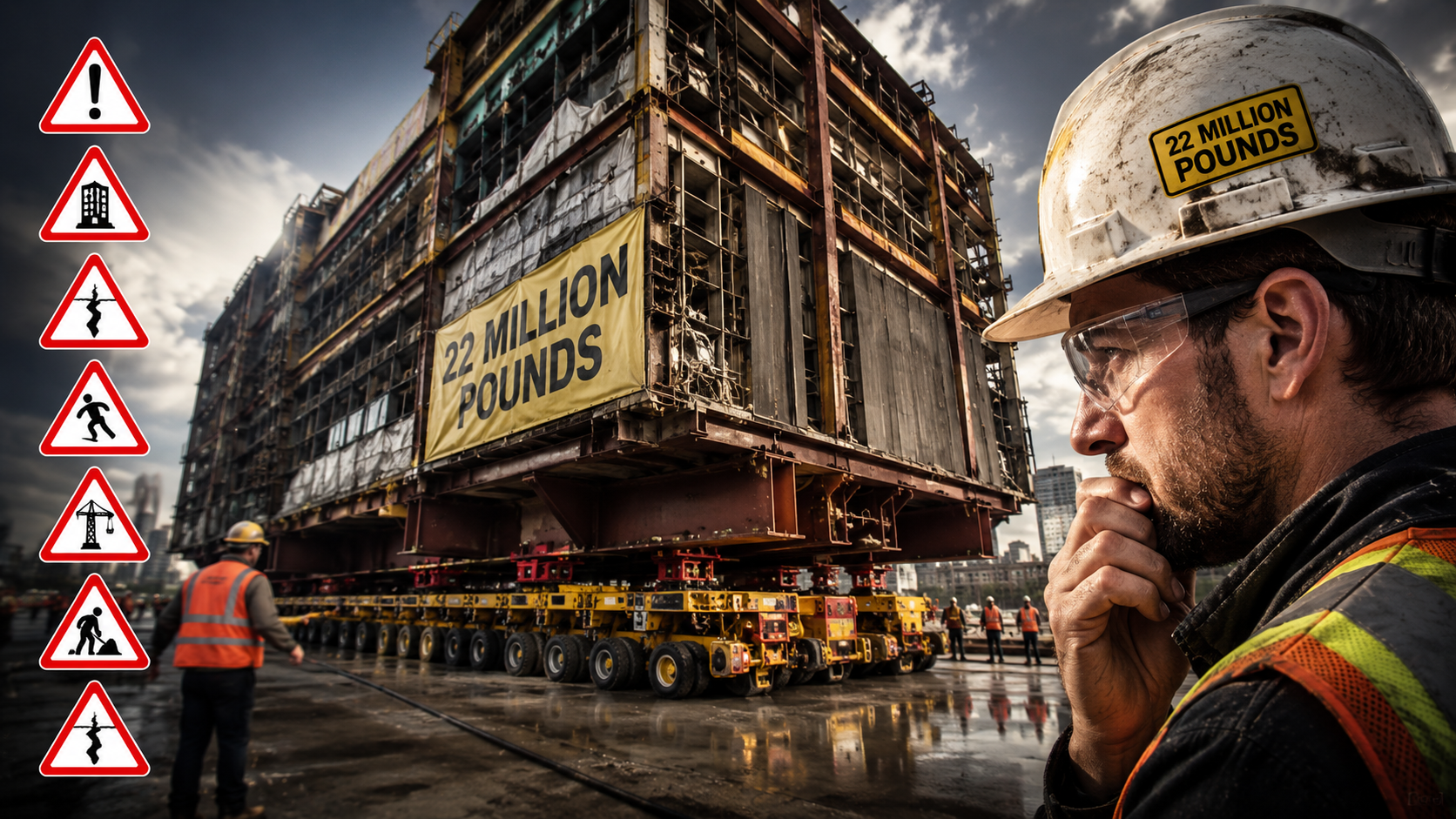
Moving a massive structure weighing tens of millions of pounds is one of the most complex operations in modern engineering. Whether it involves relocating a historic building, repositioning industrial infrastructure, or transporting a large prefabricated facility, the risks are significant and require precise planning, coordination, and execution.
A 22-million-pound structure move is not just a logistical challenge—it is a carefully orchestrated engineering operation where even minor miscalculations can lead to serious consequences.
Engineers, project managers, and safety teams rely on detailed monitoring systems to detect early warning signs of structural stress, mechanical failure, or environmental instability. These indicators help prevent catastrophic outcomes and ensure the structure remains stable throughout the entire process.
Understanding these warning signs is essential for anyone involved in heavy civil engineering, construction logistics, or infrastructure relocation.
Here are seven key warning signs of engineering risks that professionals monitor during a large-scale 22-million-pound structure move.
1. Uneven Load Distribution Across Support Systems
One of the earliest and most critical warning signs is uneven load distribution.
During a structure move, weight must be carefully balanced across hydraulic jacks, beams, rollers, or transport platforms. If one section carries more load than another, the structure can begin to shift unpredictably.
This imbalance can lead to:
- Structural deformation
- Stress concentration in specific areas
- Increased risk of cracking or failure
Engineers use real-time load sensors to ensure weight is evenly distributed. Even slight deviations can signal potential instability.
Maintaining balance is essential because large structures have limited flexibility. Once stress builds unevenly, it can escalate quickly.
2. Unexpected Shifts in Structural Alignment
Alignment is critical during any large-scale move.
If a structure begins to tilt, rotate, or shift even slightly out of its intended path, it may indicate a serious underlying problem.
These shifts can be caused by:
- Ground instability
- Hydraulic system inconsistency
- Mechanical slippage
- Uneven terrain conditions
Modern engineering teams rely on laser-guided monitoring systems and GPS alignment tools to track movement with extreme precision.
Even millimeter-level deviations can trigger immediate corrective action.
Ignoring alignment issues can lead to long-term structural damage or catastrophic failure during transport.
3. Excessive Vibration or Oscillation
Vibration is a natural part of moving large structures, but excessive or irregular oscillation is a major red flag.
When a structure begins to vibrate beyond expected levels, it may indicate:
- Weak connection points
- Instability in support systems
- Resonance effects from movement equipment
- Ground reaction inconsistencies
If not controlled, vibration can weaken joints, loosen temporary supports, and create cumulative stress throughout the structure.
Engineers monitor vibration frequency and amplitude continuously using specialized sensors.
The goal is to ensure that movement remains smooth, controlled, and within safe structural limits.
4. Hydraulic Pressure Irregularities
Hydraulic systems are often used to lift and transport extremely heavy structures.
These systems must operate with precise pressure balance. Any fluctuation in hydraulic pressure can signal mechanical strain or system failure.
Warning signs include:
- Sudden pressure drops
- Uneven cylinder extension
- Delayed response in lifting systems
- Overcompensation in certain support points
Hydraulic irregularities are especially dangerous because they directly affect load-bearing stability.
If one jack fails or lags behind others, the entire structure can shift unexpectedly.
Continuous monitoring and redundancy systems are essential to maintain control.
5. Ground Instability or Soil Movement
The foundation beneath a moving structure plays a critical role in safety.
Even if the structure itself is stable, unstable ground conditions can create serious risks.
Signs of ground instability include:
- Soil compression under heavy load
- Uneven settlement
- Cracking or shifting in temporary roadways
- Moisture-related weakening of support areas
Geotechnical engineers assess soil conditions before and during the move using sensors and survey equipment.
If ground instability is detected, operations may need to pause or adjust support configurations.
A stable foundation is just as important as the structure itself.
6. Unexpected Stress Readings in Structural Components
Modern engineering relies heavily on stress monitoring systems embedded throughout the structure.
These sensors measure tension, compression, and strain at key points.
Warning signs include:
- Rising stress in load-bearing beams
- Sudden spikes in localized pressure
- Uneven stress distribution across structural sections
These readings help engineers understand how the structure is reacting in real time.
If stress exceeds safe thresholds, it may indicate that the structure is not responding evenly to movement forces.
Ignoring these signals can result in cracking, bending, or long-term structural damage.
Real-time data allows engineers to make immediate adjustments before problems escalate.
7. Environmental Conditions Affecting Stability
External environmental factors can significantly influence the safety of a large structure move.
Weather and environmental conditions may introduce unexpected risks, including:
- High winds causing lateral movement
- Rain weakening soil stability
- Temperature changes affecting material expansion
- Poor visibility impacting precision control
Wind is especially dangerous for tall or exposed structures, as it can introduce unpredictable lateral forces.
Rain can saturate soil, reducing its load-bearing capacity.
Temperature fluctuations may cause expansion or contraction in metal components, altering stress distribution.
Engineering teams closely monitor weather forecasts and real-time environmental data to ensure safe operating conditions.
The Complexity Behind Large-Scale Structure Moves
Relocating a 22-million-pound structure is not a single action—it is a multi-phase engineering process involving planning, simulation, execution, and monitoring.
Each stage requires collaboration between:
- Structural engineers
- Geotechnical specialists
- Hydraulic system technicians
- Surveying teams
- Safety coordinators
Advanced computer modeling is often used to simulate the move before it begins. These simulations help identify potential risks and optimize movement strategies.
Despite all planning, real-time monitoring remains essential because no simulation can perfectly replicate real-world conditions.
Why Early Detection of Risks Matters
In heavy engineering, early warning signs are crucial.
Small issues can escalate quickly when dealing with millions of pounds of structural weight.
Early detection allows teams to:
- Adjust load distribution
- Recalibrate hydraulic systems
- Reinforce support points
- Pause operations if necessary
Preventing failure is always more effective than responding to it after the fact.
Safety is not just a priority—it is the foundation of the entire operation.
The Role of Technology in Modern Engineering Moves
Advancements in engineering technology have significantly improved the safety of large structure relocations.
Modern systems now include:
- Real-time load monitoring sensors
- Laser alignment tracking
- Automated hydraulic controls
- AI-assisted predictive modeling
- High-resolution environmental monitoring systems
These technologies allow engineers to detect risks earlier and respond more accurately than ever before.
However, human oversight remains essential.
Technology supports decision-making, but experienced engineers interpret the data and determine the safest course of action.
Final Thoughts
Moving a 22-million-pound structure is one of the most demanding tasks in civil engineering. It requires precision, coordination, and constant awareness of potential risks.
The seven key warning signs include:
- Uneven load distribution
- Alignment shifts
- Excessive vibration
- Hydraulic pressure irregularities
- Ground instability
- Structural stress spikes
- Environmental challenges
Together, these indicators form a critical safety framework that engineers rely on to ensure successful outcomes.
In the world of heavy infrastructure, success depends not only on strength but also on awareness. The ability to detect small warning signs early is what prevents major failures and ensures that even the largest structures can be moved safely and effectively.
At its core, this kind of engineering work is a reminder that precision and vigilance are just as important as power and scale.







