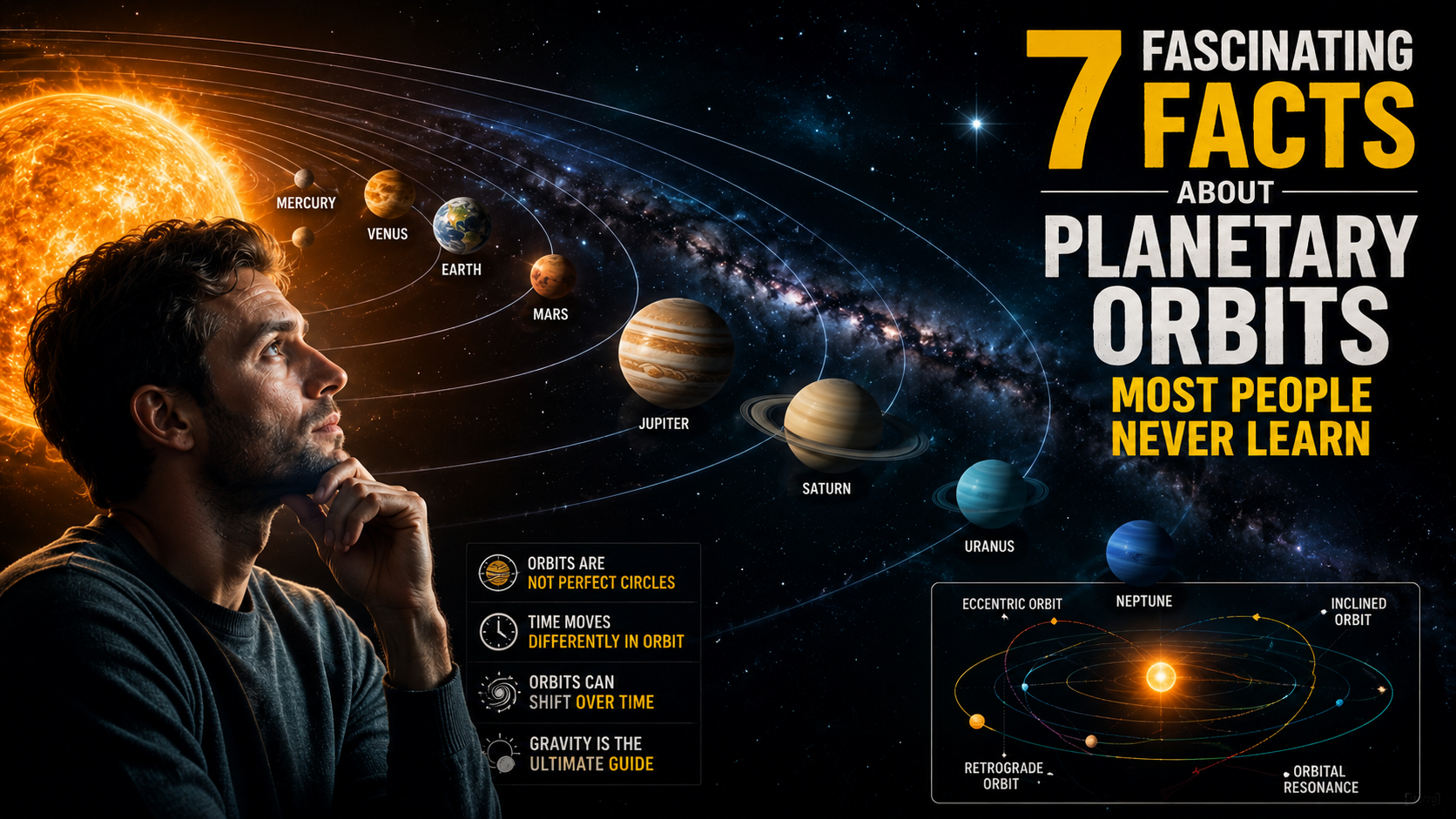
When people imagine space, they often picture planets moving in neat, perfect circles around the Sun. It is a simple and elegant image—but also one that is not entirely accurate. The reality of planetary motion is far more complex, dynamic, and fascinating than most textbooks suggest.
In fact, the way planets move through space is shaped by gravity, speed, distance, and even subtle interactions between multiple celestial bodies. These forces create patterns that are both predictable and surprisingly intricate.
Understanding planetary orbits is not just about astronomy. It is about understanding how our entire solar system maintains balance over billions of years.
Here are seven fascinating facts about planetary orbits that most people never learn in school.
1. Planetary Orbits Are Not Perfect Circles
One of the most common misconceptions about space is that planets travel around the Sun in perfect circular paths.
In reality, planetary orbits are elliptical—meaning they are slightly stretched out ovals.
This shape was first mathematically described by astronomer Johannes Kepler, who showed that planets follow elliptical paths with the Sun located at one focus of the ellipse.
This means that at certain points in their orbit, planets are closer to the Sun, while at other points they are farther away.
These positions are known as:
- Perihelion (closest point to the Sun)
- Aphelion (farthest point from the Sun)
This variation affects orbital speed, seasonal intensity, and energy received from the Sun.
2. Planets Speed Up and Slow Down as They Orbit
Planetary motion is not uniform.
Planets do not travel at a constant speed throughout their orbit. Instead, they move faster when they are closer to the Sun and slower when they are farther away.
This behavior is explained by Kepler’s Second Law of Planetary Motion, which states that a line connecting a planet to the Sun sweeps out equal areas in equal time intervals.
In simple terms, gravity pulls stronger when a planet is closer, increasing its speed. When the planet moves farther away, the gravitational pull weakens slightly, causing it to slow down.
This constant change in speed is one of the key reasons orbital mechanics are so dynamic and precise.
Even small changes in distance can have noticeable effects on velocity over time.
3. Gravity Is a Constant Tug-of-War, Not a Fixed Force
Many people think of gravity as a simple pulling force between two objects. While that is partly true, planetary orbits show that gravity is more complex than a one-directional pull.
In a solar system, every object exerts gravitational force on every other object. This creates a constant gravitational balancing act.
The Sun is the dominant gravitational force, but planets also influence each other slightly.
These interactions can cause:
- Small shifts in orbital paths
- Long-term changes in orbit shape
- Subtle variations in planetary positions
This means that planetary orbits are not fixed or isolated—they are part of a constantly interacting system.
Over long periods of time, these small gravitational influences can accumulate and produce noticeable changes in orbital behavior.
4. Orbits Are Extremely Stable—but Not Perfectly Permanent
One of the most fascinating aspects of planetary motion is its stability.
Despite constant gravitational interactions, planetary orbits remain remarkably stable over millions or even billions of years.
This stability is the result of a delicate balance between forward motion (inertia) and gravitational pull.
A planet is essentially always falling toward the Sun—but moving forward fast enough that it continuously “misses” it, creating an orbit.
However, this stability is not absolute.
Over extremely long timescales, orbits can slowly shift due to gravitational perturbations, asteroid interactions, or changes in mass distribution within the solar system.
While these changes are extremely slow, they remind us that even cosmic systems evolve over time.
5. Some Orbits Are Tilted in Three-Dimensional Space
Another overlooked fact is that planetary orbits are not all aligned on the same flat plane.
While most planets orbit roughly along a shared plane called the ecliptic, each orbit is slightly tilted at a different angle.
These tilts are known as orbital inclinations.
For example:
- Mercury has a more noticeable tilt compared to Earth
- Pluto (a dwarf planet) has a highly inclined and eccentric orbit
This three-dimensional structure adds complexity to the solar system’s overall movement.
Rather than functioning like a flat disk, the solar system resembles a layered, dynamic structure where each planet follows its own unique path through space.
6. Orbital Resonance Can Lock Planets Into Patterns
One of the most intriguing phenomena in orbital mechanics is something called orbital resonance.
This occurs when two or more orbiting bodies exert regular, periodic gravitational influence on each other due to matching orbital periods.
For example, some moons and planets complete orbits in ratios such as 2:1 or 3:2, meaning one body completes two orbits while another completes one.
This synchronization can stabilize or destabilize orbits depending on the system.
In some cases, orbital resonance helps maintain stability. In others, it can create gravitational tension that alters orbital paths over time.
This hidden structure of timing and rhythm adds a musical-like quality to the motion of celestial bodies.
7. The Solar System Is in Constant Motion Through the Galaxy
Planetary orbits are often described as if they exist in a static environment. In reality, the entire solar system is moving through space.
While planets orbit the Sun, the Sun itself is orbiting the center of the Milky Way galaxy at an enormous speed.
This means that planetary orbits are not simple closed loops in space—they are spiraling paths moving through a much larger galactic system.
As a result, every orbit is part of a larger cosmic journey.
This layered motion includes:
- Planetary orbits around the Sun
- The Sun’s orbit around the galaxy
- The galaxy’s motion through the universe
This creates a complex, multi-level system of movement that is constantly in motion.
Why Planetary Orbits Matter Beyond Astronomy
Understanding planetary orbits is not just a scientific curiosity. It has practical applications that affect life on Earth.
Orbital mechanics are essential for:
- Satellite placement and communication systems
- GPS navigation accuracy
- Space missions and interplanetary travel
- Climate modeling and seasonal prediction
Without precise knowledge of orbital behavior, modern technology would not function as reliably as it does.
Space agencies rely on these principles daily to guide spacecraft across vast distances with extreme precision.
The Mathematics Behind Orbital Motion
At the heart of orbital mechanics is mathematics.
Equations developed by Kepler, Newton, and later Einstein describe how gravity and motion interact on cosmic scales.
Newton’s Law of Universal Gravitation explains how objects attract each other based on mass and distance.
Einstein’s General Relativity adds another layer, showing that gravity is also a curvature of spacetime.
Together, these principles help scientists predict planetary motion with extraordinary accuracy.
Even slight deviations in orbit can be measured and modeled using advanced computational systems.
The Beauty of Cosmic Order and Complexity
What makes planetary orbits truly fascinating is the balance between simplicity and complexity.
On one hand, the basic principles are elegant and predictable. On the other hand, the interactions between multiple bodies create layers of subtle variation.
This combination results in a solar system that is both stable and dynamic.
It is orderly enough to be understood—but complex enough to remain endlessly interesting.
Final Thoughts
Planetary orbits are far more intricate than they appear at first glance.
The seven key facts reveal a system shaped by:
- Elliptical paths rather than perfect circles
- Variable speeds governed by gravity
- Continuous gravitational interactions
- Long-term orbital stability with slow evolution
- Three-dimensional orbital tilts
- Resonant orbital patterns
- The solar system’s motion through the galaxy
Together, these insights show that our solar system is not static—it is a constantly moving, interconnected system of forces and motion.
Every planet is part of a vast cosmic dance that has continued for billions of years and will continue long into the future.
And the more we learn about these orbits, the more we understand our place within the universe itself.







